
eloomi Pricing in 2026: Plans, Real Costs, and AI Features

By Sofia KondratSofia KondratCorporate Training Expert & Content EditorHey there! I’m Sofi Kondrat, your go-to corporate training advisor here at EducateMe. I’ve been navigating the highs…Read more
Corporate Training Expert & Content Editor
8 min read
Here's the first thing to know about eloomi pricing: there's no number to look up. eloomi doesn't publish a price list, so every cost you'll see quoted online is a third-party estimate, and those estimates don't agree with each other. This guide breaks down how eloomi actually charges, what its three plans include, the AI features you're paying for, and the setup costs nobody advertises.
I checked eloomi's own pages and the review sites in August 2026, so the figures below reflect where things stand now, including the part where eloomi became a Dayforce product.
eloomi doesn't publish prices — cost is quote-based across three tiers (Play, Plus, eloomi ONE), now sold under Dayforce. Third-party estimates run ~$2.50–$20/user/mo plus $1,000–$20,000 implementation. Its eloomi AI adds course building, quizzes, translation, and skills recommendations, though inclusion isn't disclosed.
How eloomi Pricing Actually Works
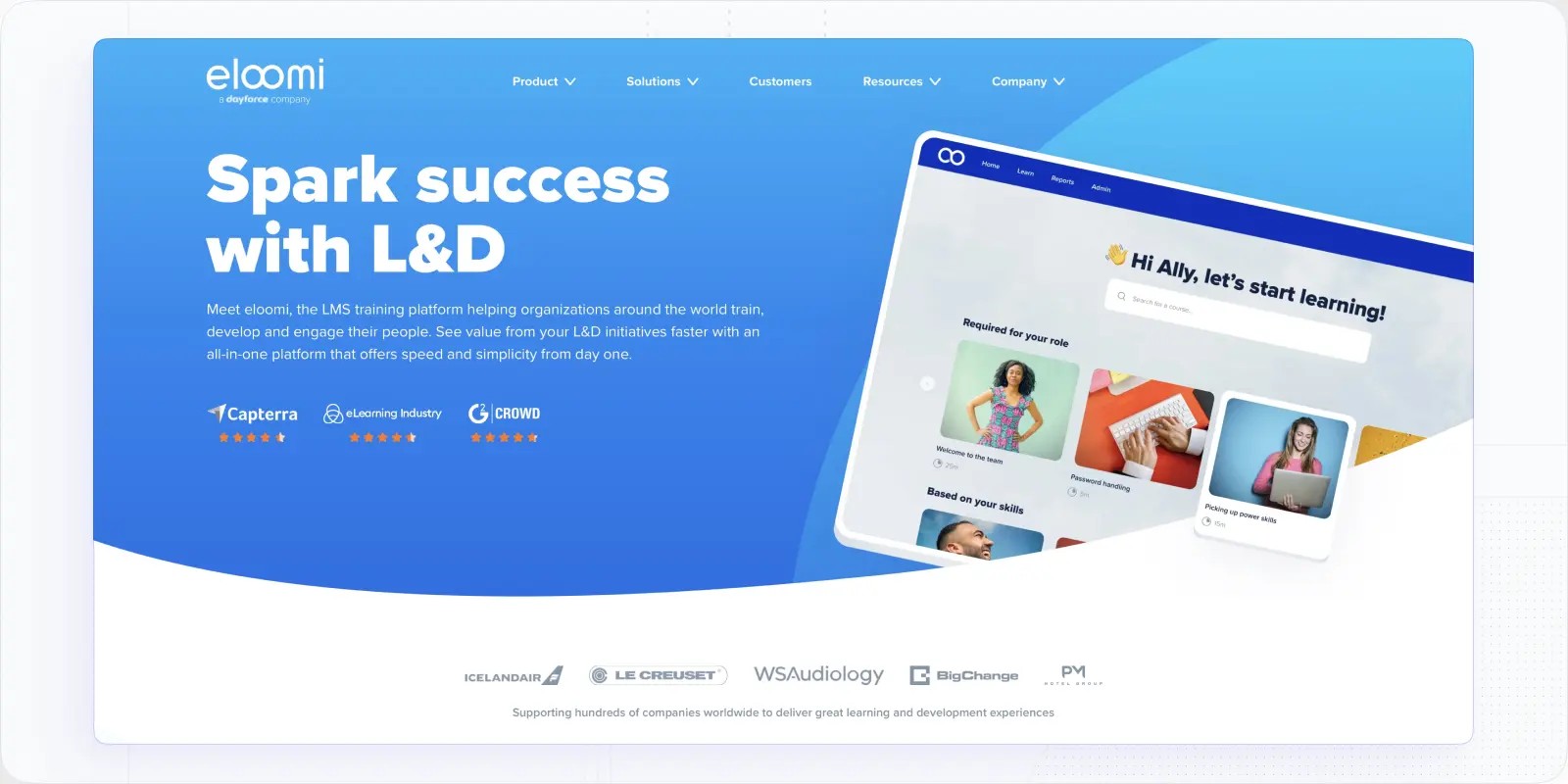
eloomi pricing is quote-based and module-tiered. There's no self-serve checkout and no published rate card — you request a demo, describe your headcount and which modules you want, and sales returns a custom number. When I opened eloomi's pricing page, it routed straight to a “Contact us” form with no dollar figures at all.
Two things drive the quote: how many users you have, and which of the three tiers you land on. Learning-only buyers pay less than teams adding performance management and skills tools on top.
One structural change matters in 2026. eloomi is now part of Dayforce (formerly Ceridian), which acquired it in February 2024. You can still buy eloomi standalone, but it's also sold as the learning layer inside the wider Dayforce HCM suite, and that bundling shapes how larger deals get priced.
Quote-only pricing isn't unusual for people-development software, and it has a logic: eloomi can tailor a number to your exact modules and volume. The trade-off falls on you. You can't compare eloomi pricing against rivals on a spreadsheet, you can't self-serve a small deployment, and you won't know if your quote is competitive without gathering others. For a fast, low-headcount rollout, that friction alone pushes some teams toward vendors who post their rates.
What You Get: eloomi's Three Plans
eloomi splits its product into three tiers, each adding a layer on top of the last. This is where eloomi LMS pricing separates from the broader people-development pricing — the cheapest tier is learning only, and performance management sits behind the top one.
- Play — LMS basics. Course and learning-plan creation, reporting dashboards, certification management, and access to a content marketplace. This is the entry tier for teams that just need to deliver and track training.
- Plus — LXP advanced. Everything in Play, plus social learning, polls, surveys and feedback, onboarding checklists, and skills-gap insight. Aimed at teams that want engagement and development, not just completion tracking.
- eloomi ONE — learning + skills + people development. Everything above, plus performance management: goals and OKRs, 1-on-1 scheduling, and 360 feedback. This is the full people-development platform, and the one that lands eloomi in HCM-suite territory.
So yes, eloomi is an LMS — but the pitch is really an LMS-plus-LXP that grows into performance management. I'd only pay for eloomi ONE if you genuinely intend to run reviews and goals inside the same tool; otherwise you're buying modules you won't switch on.
eloomi AI Features Overview
eloomi markets its AI capabilities under the eloomi AI umbrella, and for a pricing decision the AI is a real part of what you're evaluating. Here's what eloomi describes on its AI page as of August 2026:
- AI Course Builder — generates a full course from a prompt, so a first draft appears in minutes instead of days.
- Auto-generated quizzes — the AI writes quiz questions directly from your course content, cutting the manual assessment-building step.
- Automatic translation — courses translate into multiple languages on demand, useful for distributed or multi-region teams.
- Learning and skills recommendations — AI suggests next courses and flags skill gaps per employee, tied into eloomi's Skills Intelligence module.
Two caveats belong in any honest read of eloomi's AI. First, at least part of the AI page carried a “coming soon” label when I checked, so confirm which features are live before you sign — don't buy on a roadmap. Second, eloomi doesn't state whether eloomi AI is bundled into every plan or sold as an add-on. For a quote-based vendor, that's a question to pin down in writing, because “AI included” and “AI extra” can be a meaningful swing on the invoice.
If you're weighing eloomi mainly for its AI, it's worth seeing how it stacks up against the best AI LMS platforms overall.
The Hidden Costs: Minimums, Setup, and Add-Ons
The subscription is only part of eloomi's total cost, and it's the part most eloomi pricing write-ups stop at. Because pricing is negotiated, the extras are where budgets drift, and none of them show up on a comparison-site chart.
Implementation is a separate line item. Third-party estimates put basic SMB onboarding around $1,000, rising to somewhere between $5,000 and $20,000 for mid-sized and larger rollouts, with go-live commonly reported at four to six weeks. There's a free trial but no free plan, so once the trial ends you're on a paid annual quote.
I'd also plan for the seat-count effect: eloomi scales cost by users, and once you're past roughly a thousand people, sources describe pricing as fully custom. When you gather quotes, ask specifically about implementation, minimum seats, contract length, and whether AI and Skills Intelligence carry their own fees. Those four questions surface most of the “hidden” spend.
What eloomi Might Cost You: A Worked Estimate
Because eloomi hides its rate card, the most useful thing I can give you is a modeled estimate — clearly labeled as an estimate, because it's built from third-party figures, not eloomi's own numbers.
Take the most commonly cited per-user figures: a learning-only Play tier around $2.50 per user per month, and the Plus and eloomi ONE tiers around $9 per user per month. Run those against real team sizes and you get a rough shape:
- A 50-person team on Play lands near $125/month, or about $1,500/year — before implementation.
- A 100-person team on Plus or eloomi ONE lands near $900/month, or roughly $11,000/year — again, before setup.
- A 100-person rollout modeled by one comparison site runs anywhere from $1,500 to $4,000/month once services and modules stack up.
Now add implementation (that $1,000-to-$20,000 range depending on size), and the picture sharpens. A small team is looking at a few thousand dollars in year one; a mid-market rollout with performance management can clear $20,000–$30,000 all-in. Treat these as directional, and for how those totals stack up against the wider market, see our rundown of LMS pricing in 2026. To get eloomi's real numbers you'll need to request a quote — then read it against these ranges so you know whether you're being quoted high.
Is eloomi Worth the Price, and Who It's For
For the right team, eloomi earns its quote — I just wouldn't call it a universal fit, and the eloomi pricing you're offered should be weighed against how many of its modules you'll actually use. Reviewers rate it 4.4 out of 5 on Capterra across 95 reviews (checked August 2026), and its recurring praise is consistent: responsive support, a clean and easy interface, fast setup, and the convenience of learning plus performance management in one place. You can also see reviews on G2 for a second read.
The criticisms are just as consistent. Users report occasional glitches when building custom content, some navigation and customization limits, and integration friction with outside course providers. And the one that matters most for this article — smaller organizations often find the price high for what they use.
eloomi fits best when performance management and learning genuinely belong in the same tool, especially if you already run Dayforce for HR. It's a weaker value if you only need to build and deliver training, because you're paying into a people-development platform to get an LMS.
eloomi Pricing vs a Transparently-Priced Alternative
If the opaque quote is the sticking point, the honest fix is a platform that publishes its numbers. EducateMe is an AI-native LMS for modern corporate training programs, and unlike eloomi, you can read its pricing without a sales call.
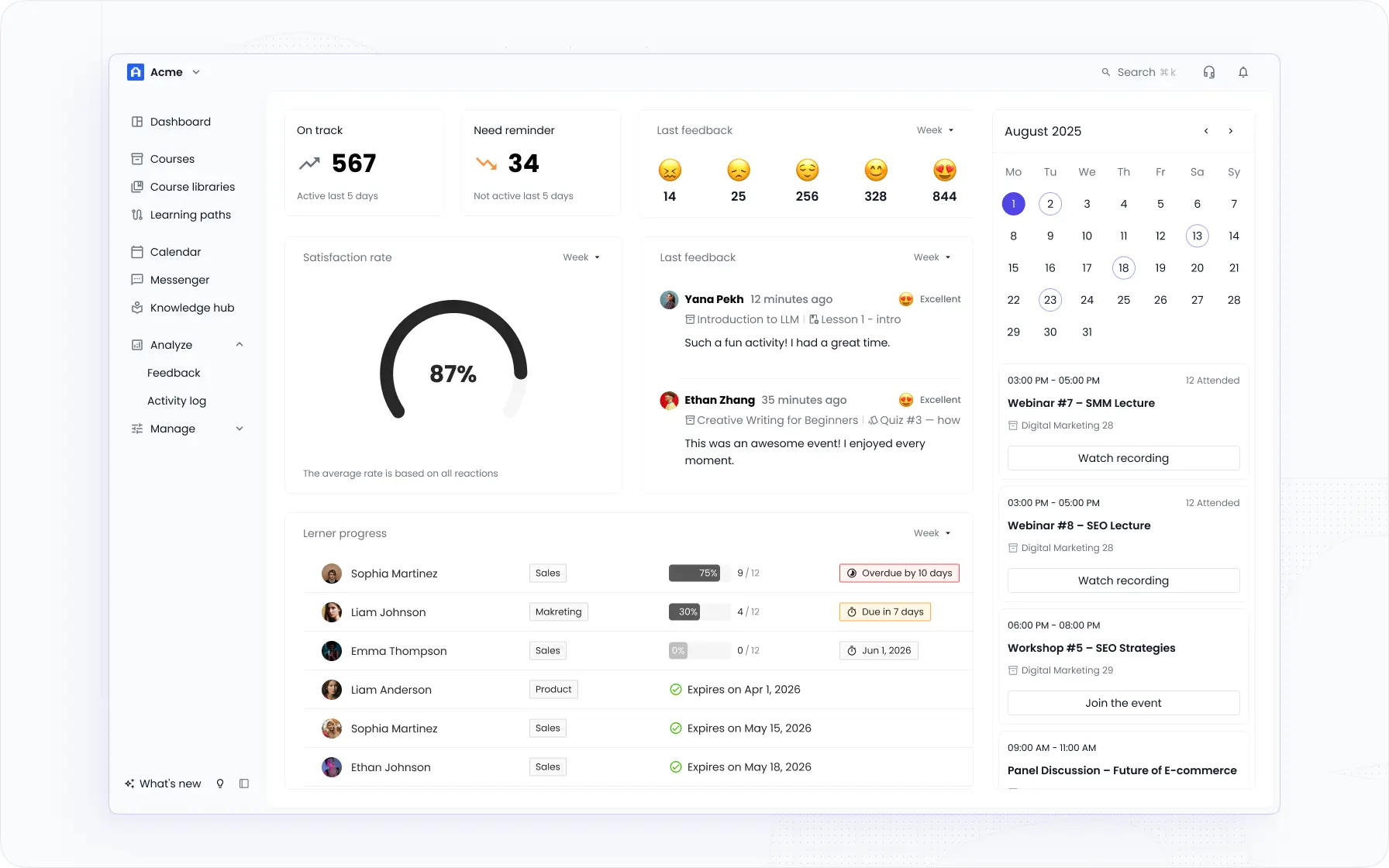
EducateMe publishes three plans: Pro at $239/month (80 users), Premium at $399/month (100 users), and Scale at $999/month (200 users), with a 14-day free trial. That works out to roughly $3–$5 per user — a figure you can plan a budget against, versus eloomi's estimates that scatter anywhere from about $2.50 to $20 per user depending on which source you read.
The AI story is comparable in ambition. EducateMe's AI Assistant builds courses from a prompt, file, URL, or video, and its AI Roleplay Coach lets reps and staff practice real conversations with scored, rubric-based feedback — with customers reporting 3x faster course creation. Where eloomi keeps its AI cost undisclosed, EducateMe states plainly that AI Roleplay sessions are metered per plan (10, 40, or 200 per month).
| Factor | eloomi | EducateMe |
|---|---|---|
| Pricing model | Quote-only, module-tiered | Published plans |
| Starting price | Not published (est. ~$2.50–$20/user/mo) | $239/mo (Pro, 80 users) |
| Free trial | Yes; no free plan | 14-day trial; no free plan |
| AI | eloomi AI (cost undisclosed) | AI Assistant + AI Roleplay (metered per plan) |
| Mobile app | Native iOS & Android apps | Mobile-responsive web only |
I'll be fair to eloomi here: it wins on one line in the table above. eloomi ships native iOS and Android apps, while EducateMe is mobile-responsive web only — a real gap if you train a deskless or offline workforce. EducateMe also leans build-first, with no pre-built course library out of the box. It's the stronger pick for corporate training teams that want AI-native creation and transparent, per-user pricing — not for teams whose priority is an offline mobile app.
Frequently asked questions
eloomi doesn't publish prices, so its cost is quote-only and set by your user count and chosen module tier (Play, Plus, or eloomi ONE). Third-party estimates range from roughly $2.50 to $20 per user per month, plus implementation fees commonly cited between $1,000 and $20,000. Always request a written quote to confirm your actual eloomi pricing.
eloomi offers a free trial but no permanent free plan, so after the trial you move to a paid annual quote. If you want to test a full platform without a sales call first, EducateMe runs a 14-day free trial and publishes its plans openly, starting at $239/month for up to 80 users.
Yes. Dayforce, formerly Ceridian, completed its acquisition of eloomi in February 2024. You can still buy eloomi as a standalone learning platform, but it's also sold as the learning layer inside Dayforce's wider HCM suite, which can influence how larger deals are priced and bundled.
EducateMe is an AI-native LMS that publishes its pricing up front: Pro at $239/month, Premium at $399/month, and Scale at $999/month, roughly $3–$5 per user. It offers AI course creation and an AI Roleplay Coach, though it's web-only with no native mobile app — unlike eloomi, which ships iOS and Android apps.