
10 Best Retail LMS Platforms for Store Teams in 2026

By Sofia KondratSofia KondratCorporate Training Expert & Content EditorHey there! I’m Sofi Kondrat, your go-to corporate training advisor here at EducateMe. I’ve been navigating the highs…Read more
Corporate Training Expert & Content Editor
12 min read
Retail training has three problems most software ignores: staff turn over fast, almost no one works at a desk, and what you teach has to land the same way in every store. A retail LMS earns its keep by solving those three — getting new hires onto the floor in days, running on the phones your associates already carry, and pushing consistent training across every location. Below are the 10 best retail LMS platforms for 2026, judged on exactly that.
Research supports this trend: Devlin Peck found that companies with comprehensive employee training programs see a 218% higher income per employee than those without formalized training. Additionally, LinkedIn research shows that 76% of Generation Z students believe that training is essential for a successful career.
So, how do you create an engaging and highly effective online learning experience? While having captivating content for your online courses is crucial, choosing the right online learning tool is just as important.
We ranked each platform against those three retail realities — turnover onboarding, deskless and mobile access, and multi-store rollout — and added an AI-features read for every option. If you're weighing narrower tools too, see our guides to retail employee training software and frontline training platforms for deskless teams.
The best LMS for retail training supports mobile access, fast onboarding, and compliance across distributed store teams. SC Training leads for mobile-first microlearning. EducateMe offers AI-powered course creation with automated enrollment by role and location - ideal for retail chains scaling onboarding across multiple stores. TalentLMS provides the simplest setup for smaller operations.
What Makes a Great Retail LMS: 7 Criteria That Matter
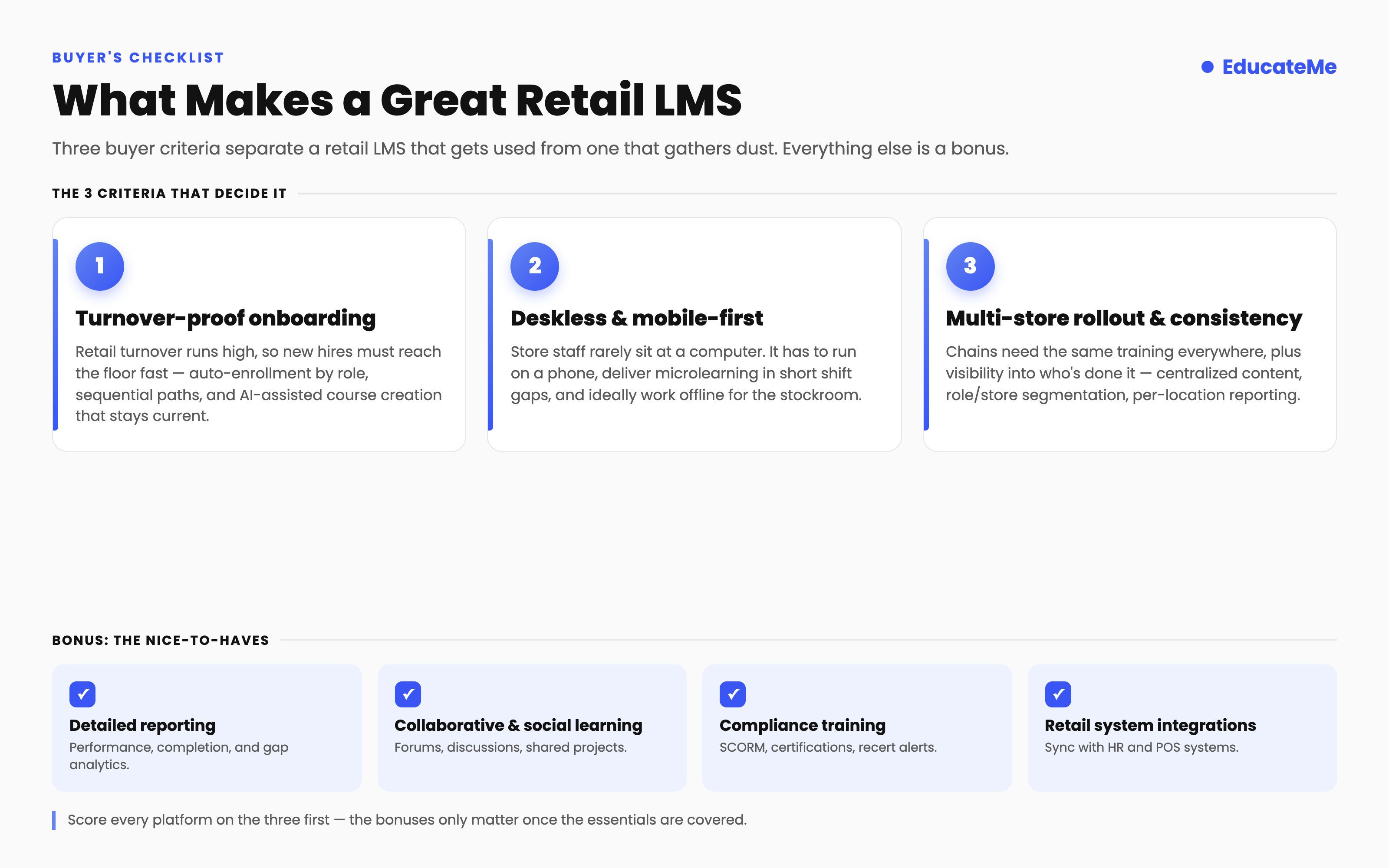
Before the list, here's the lens. In retail, three buyer criteria separate an LMS that gets used from one that gathers dust — everything else is a bonus.
- Turnover-proof onboarding. Retail turnover runs high, so new hires have to reach the floor fast. Look for auto-enrollment by role, sequential learning paths, and AI-assisted course creation that keeps onboarding current without manual rework.
- Deskless and mobile-first. Store staff rarely sit at a computer. The LMS has to run on a phone, deliver microlearning in short shift gaps, and — for stockrooms with patchy Wi-Fi — ideally work offline.
- Multi-store rollout and consistency. Chains need the same training in every location and clear visibility into who has finished it. Look for centralized content, role- and store-level segmentation, and per-location completion reporting.
- Detailed Reporting. Analytics are critical for measuring the effectiveness of training programs. A good LMS should provide comprehensive reports on employee performance, training completion, and areas for improvement. It enables managers to make informed decisions and continuously refine their training strategies.
- Collaborative and Social Learning. An LMS should foster a sense of community and encourage knowledge sharing through features like forums, discussion boards, and collaborative projects. This not only builds team cohesion but also enhances the overall learning experience.
- Compliance Training. Compliance is key in retail, where adhering to industry standards and regulations is non-negotiable. Choose an LMS that supports SCORM and offers robust tools for creating, delivering, and monitoring compliance training. It should also manage certifications and send alerts for recertification to ensure ongoing compliance.
- Integration with Retail Systems. For a seamless training experience, your LMS should integrate with existing retail technologies such as HR and POS systems. This integration ensures that employee data is synchronized and that the LMS aligns with your organization’s broader objectives.
It’s time to discover our top 10 solutions for retail employee training.
EducateMe – Best Retail LMS Software for Corporate Training
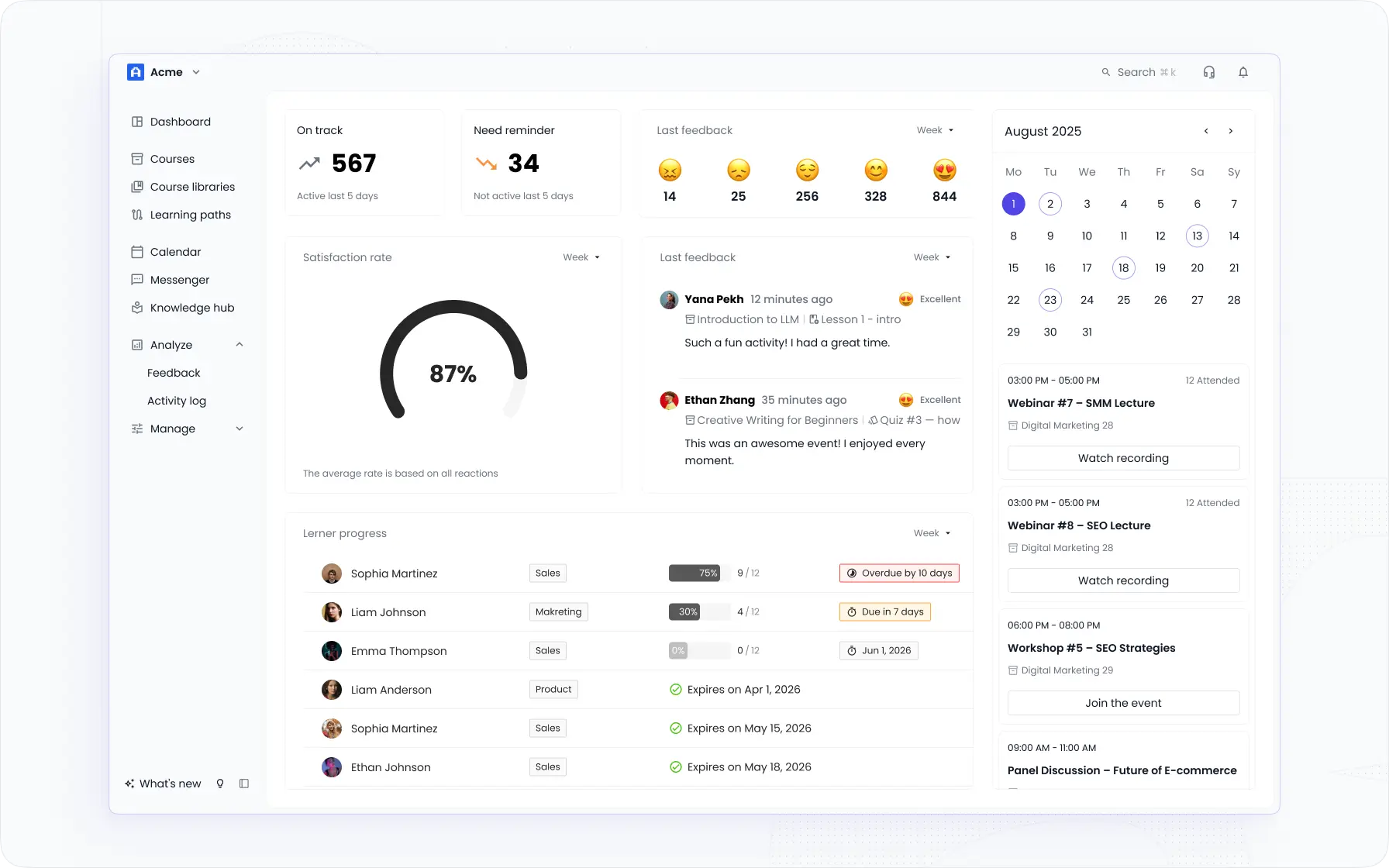
EducateMe is the most innovative and user-friendly AI LMS for retail available today. It stands out for its intuitive design, advanced white-labeling options, and exceptional customer support, the team responds to feedback and feature requests impressively fast (and many users highlight this too).
With EducateMe, you can easily run diverse training programs, from employee onboarding and upskilling to partner and customer education. Thanks to its extended API and Zapier integrations, you can set up and launch fully branded courses in just a few hours.
This LMS combines powerful automation, data-driven analytics, live sessions, video conferencing, and social learning features - everything your organization needs to deliver engaging, results-oriented training in one platform.
What features make it a perfect choice for the retail industry?
Key Features
- White-Labeling: Ensure brand consistency with customizable colors, fonts, logos, and domains to match your company's branding.
- Engagement-Driven Learning: Use a mix of cohort-based and self-paced learning with bite-sized modules, quizzes, webinars, and interactive content to keep your team engaged.
- Kanban Assignment Management: Manage tasks efficiently with a Kanban-style dashboard, complete with deadline management and group assignments to foster teamwork.
- Certificates as Achievements: Recognize and reward your team's accomplishments with certificates to celebrate key milestones.
- Progression-Based Learning: Enhance the learning experience by unlocking new modules only after completing previous sections, keeping learners motivated and on track.
- Seamless Integration: Easily connect EducateMe with your existing sales tools and CRMs, thanks to API and Zapier integrations.
AI features: EducateMe is AI-native. Its AI Assistant builds retail courses from a prompt, PDF, or video; the AI Roleplay Coach lets associates rehearse customer and upsell conversations with scored feedback; and AI assessment surfaces skill gaps — with AI on every plan, not gated to a top tier.
Academy Ocean – Best LMS for Adaptive Learning
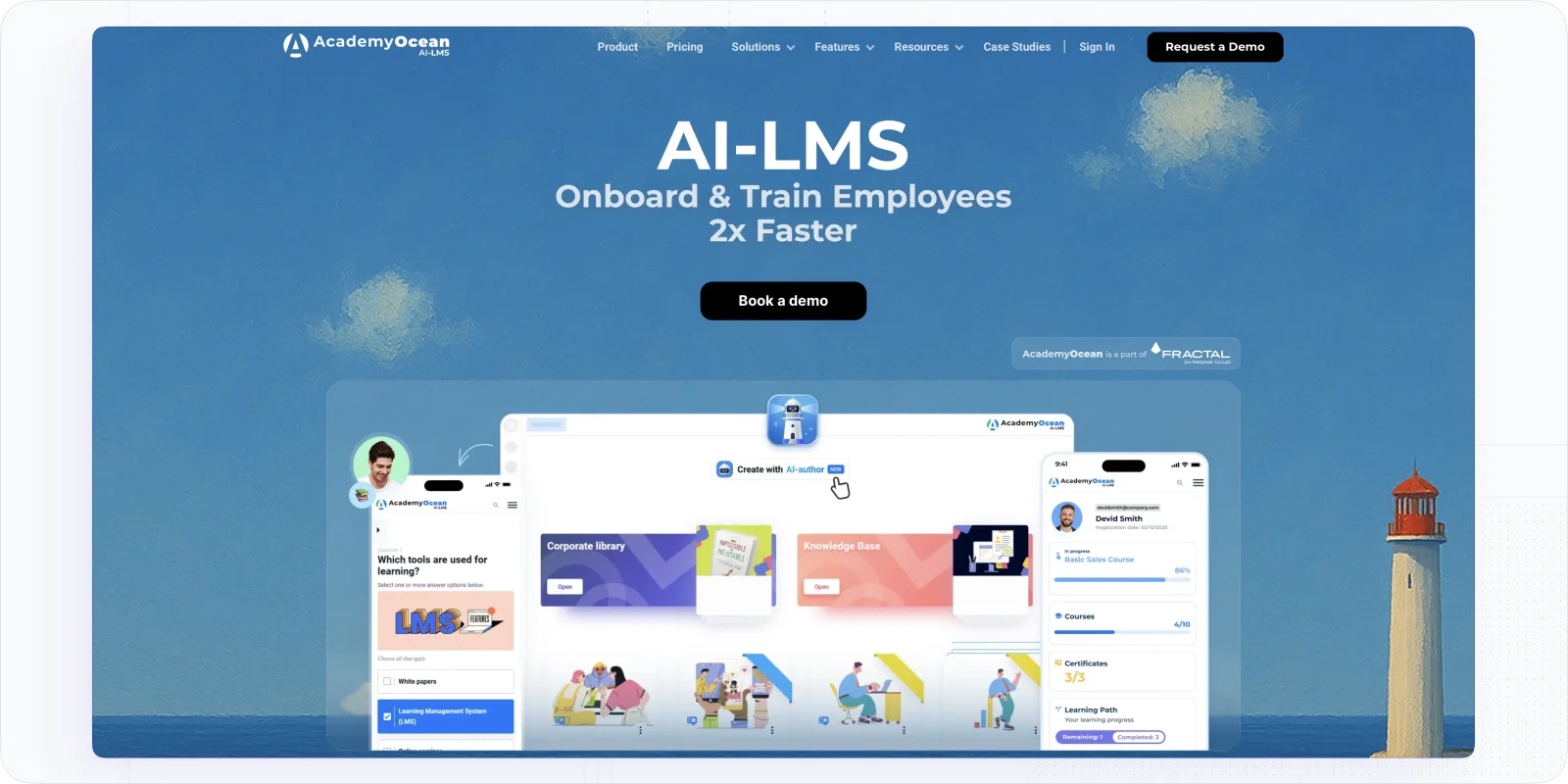
AcademyOcean is an advanced learning management systems LMS for retail sector, providing a powerful platform for employee training and development. Perfect for retail businesses looking to enhance their training programs, they offer a range of tools that make onboarding, continuous learning, and compliance training efficient and engaging.
Pricing: Starts at $300/month (includes 5 admin users and up to 1,000 learners)
Key Features
- Centralized Training Portals: Create a consistent training experience across all your retail locations with centralized portals.
- Adaptive Learning Paths: Whether your employees are new hires or seasoned staff, adaptive learning paths provide relevant, role-specific training that improves performance and retention.
- Automated Onboarding: New employees can start learning immediately, reducing turnover and helping them become productive faster.
- Engaging Content Creation: Create multimedia content, quizzes, and simulations that capture your retail staff's attention and enhance their learning experience.
- In-Depth Analytics and Reporting: Identify knowledge gaps and areas for improvement to ensure that your training programs are as effective as possible.
- Customizable Templates: Use convenient templates to quickly set up training courses that align with your brand and business needs.
AI features: A deep, branded toolset — an AI Course Creator and AI Quiz Creator with AI answer grading, an AI onboarding-guide generator, and Wave, an AI copilot that answers staff questions from your own materials. The onboarding generators fit retail's high-turnover reality well.
Docebo – Best LMS for AI-Based Learning
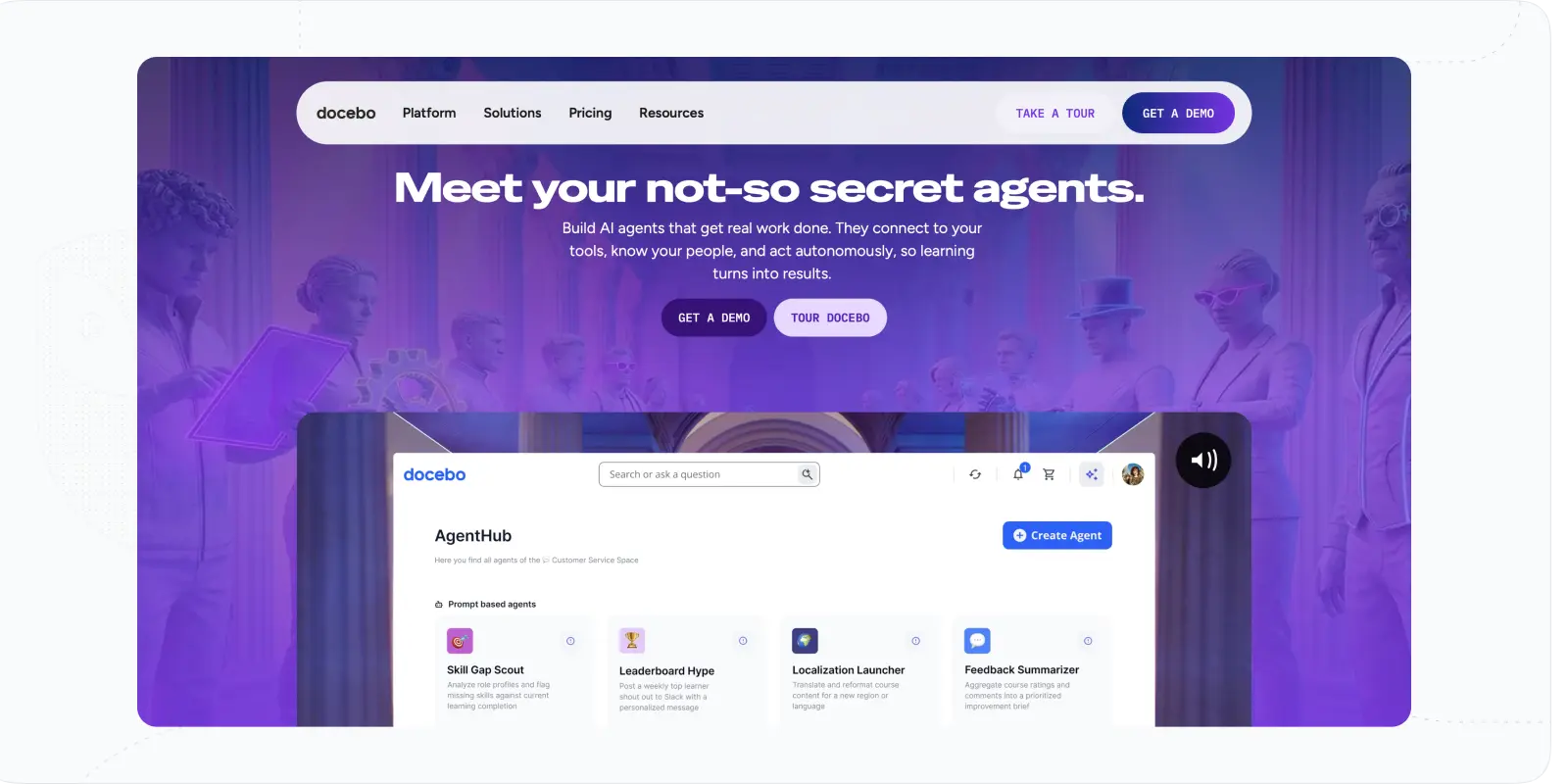
Docebo is another LMS retail example, that provides a comprehensive solution for businesses seeking to enhance their training programs, streamline onboarding, upskill employees, and foster a culture of continuous learning. With advanced AI-driven features, seamless integrations, and robust reporting tools, Docebo is designed to empower retail organizations to build a skilled, productive, and engaged workforce.
Pricing: Docebo offers custom pricing based on the number of users and features required. Contact sales for a quote.
Key Features
- AI-Powered Personalization: AI-driven content recommendations and adaptive learning paths ensure that each retail employee receives training that is most relevant to their role and skill level.
- Seamless Integration: The platform integrates easily with existing tech stacks, including CRM, HRIS, and other business systems.
- Content Marketplace and Creation Tools: Docebo offers a rich content marketplace with a variety of courses and multimedia resources. Additionally, it provides powerful tools for creating custom training materials.
- Gamification and Social Learning: The platform includes gamification features to enhance learner engagement and motivation. Social learning tools enable employees to share knowledge, collaborate, and learn from each other, fostering a culture of continuous improvement.
- Advanced Reporting and Analytics: Docebo provides robust analytics and reporting features.
AI features: Docebo AI handles content recommendations, auto-tagging, and skills mapping, and its Shape tool turns existing documents into structured courses — handy for standing up a retail catalog fast. Some higher-end AI sits in paid add-ons.
Axonify – Best LMS for Continuous Learning
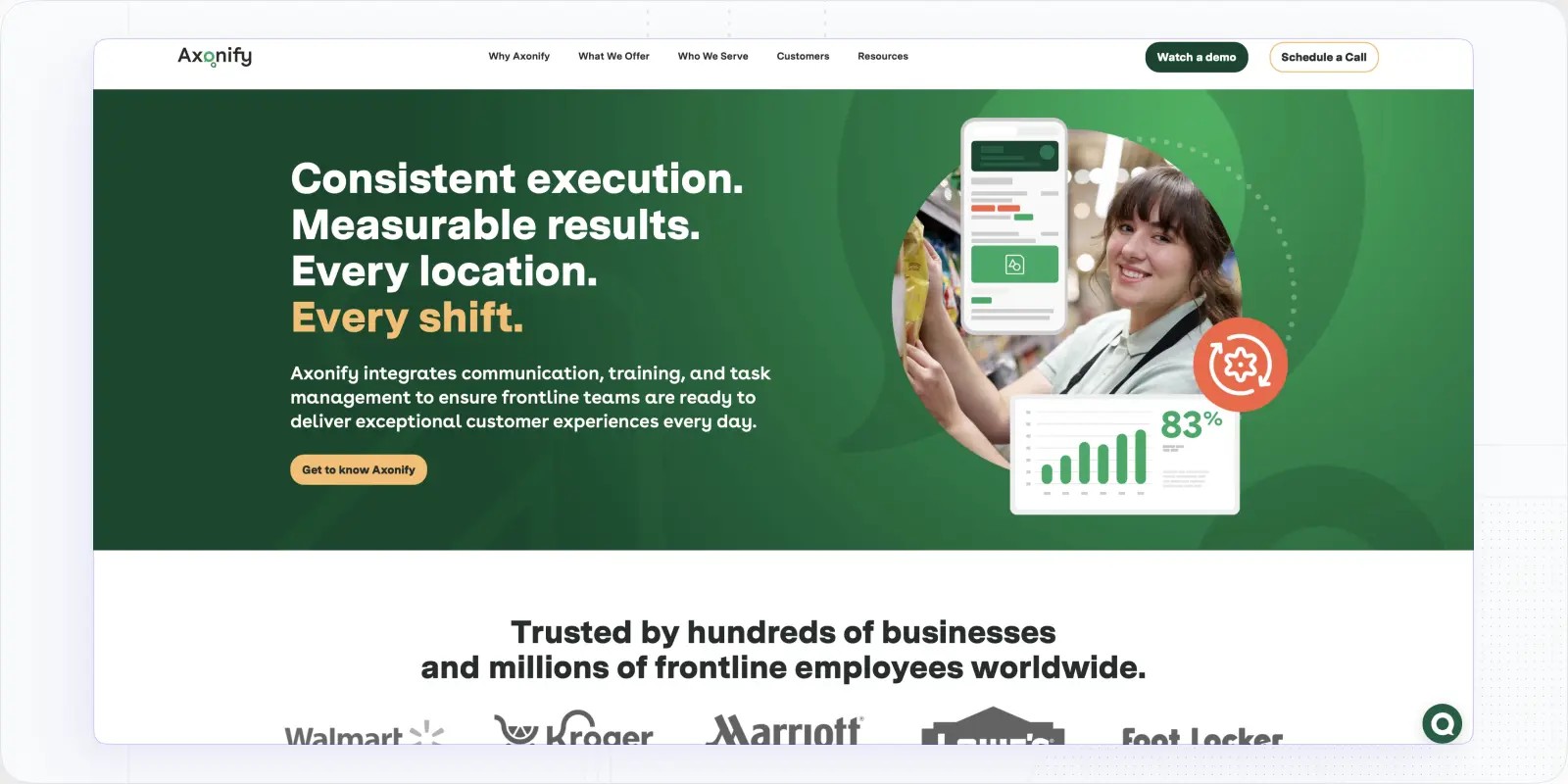
Axonify is an LMS for retail training+ specifically designed to empower frontline workers. By focusing on practical, in-the-moment learning, Axonify ensures that retail businesses associates are equipped with the knowledge and skills they need to deliver memorable customer experiences, drive sales, and maintain operational efficiency. Their science-backed approach to training integrates seamlessly into the daily routines of retail employees.
Pricing: Contact sales for a quote.
Key Features
- AI-Driven Learning and Reinforcement: Axonify uses advanced AI to deliver personalized microlearning and intelligent reinforcement, ensuring that employees retain critical knowledge over time.
- Seamless Onboarding: New hires can onboard quickly by integrating learning directly into their routine.
- Real-Time Communication and Feedback: The platform offers embedded communication tools that keep retail staff connected across all locations, in over 60 languages.
- Task Management and Operational Guidance: This feature ensures that employees know exactly how to apply their training in everyday scenarios, enhancing productivity and driving better business results.
- Data-Driven Insights: This solution provides robust analytics that delivers insights into employee performance, skills, and tasks.
AI features: Now positioned as an AI-powered frontline platform, Axonify uses AI to build content, quizzes, and personalized paths, adds an in-workflow AI assistant, and drives confidence-score-based coaching. It's the most deskless-retail-focused AI story on this list.
360 Learning – Best LMS for Interactive Learning
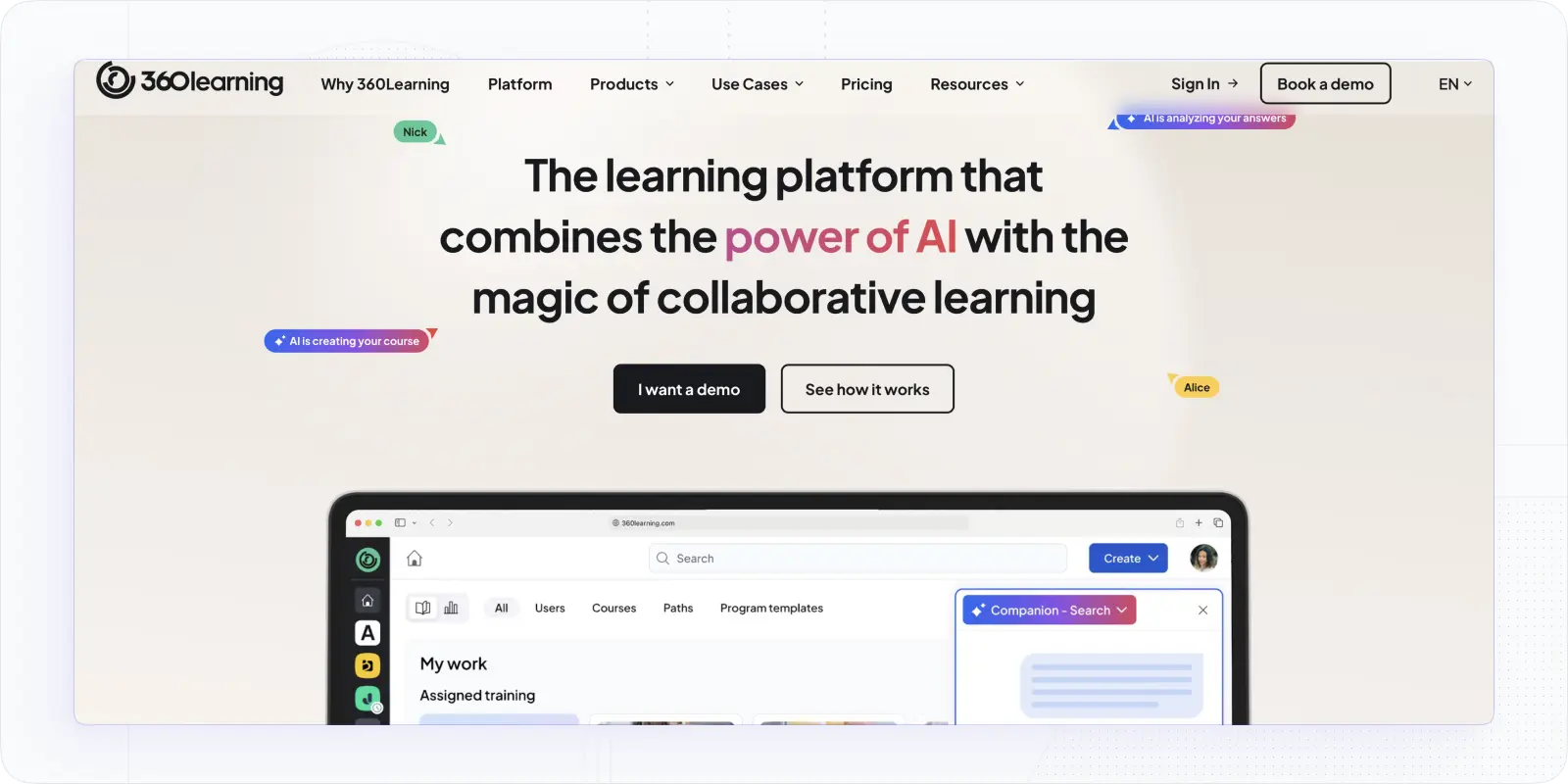
360Learning is another designed to foster collaboration, engagement, and knowledge sharing within teams. With a focus on interactive training and a mobile-first learning approach, 360Learning empowers retail employee training by creating a seamless and engaging learning experience, both online and offline. This LMS integrates advanced tools such as customizable course templates, AI-powered quiz suggestions, and interactive forums, offering retail staff engaging and dynamic training experiences.
Pricing: 30-day free trial; Team Plan — $8/registered user per month (up to 100 users/month); Business Plan — custom price.
Key Features
- Collaborative Learning Environment: With features like comment threads, forums, and virtual classrooms, retail industry employees can learn from each other, share insights, and build a community of practice.
- User-Friendly Course Creation and Management: This feature is particularly useful for creating retail-specific training programs that can be quickly updated to reflect new products, policies, or sales strategies.
- Gamification and Engagement Tools: To enhance engagement, 360Learning incorporates gamification elements such as badges, leaderboards, achievements, and social features like upvotes and sharing options.
- Integrated Content Creation and Customization: The platform allows for easy content creation with customizable course templates, integrated video recordings, and AI-powered quiz suggestions. Retail trainers can embed web-based files and create surveys to gather feedback, making the training experience more interactive and personalized.
- Synchronous and Asynchronous Learning: 360Learning supports both synchronous (real-time) and asynchronous (self-paced) learning environments, offering flexibility in how training is delivered.
AI features: 360Learning's AI drafts courses and quizzes from documents and prompts and suggests skills, with no separate AI surcharge — a fit for chains that want store managers and SMEs co-authoring training.
💡Further Reading: 10 Best 360Learning Alternatives For 2026
Tovuti – Best LMS for Blended Learning
Tovuti is one of the best LMS retail solutions, designed to meet the unique needs of businesses, especially when it comes to blended learning. It enables businesses to create, manage, and deliver high-quality blended learning programs that combine both online and in-person training. This LMS for retail and distribution also excels with its diverse content options, gamification features, and collaborative tools.
Pricing: Starts at $11.160/year; Tovuti Lite starts at $199/mo (up to 50 users, unlimited courses)
Key Features
- User Management: Streamline the management of users, groups, and roles with comprehensive administrative tools.
- Engagement Tools: Enhance learner engagement through gamification features such as badges, leaderboards, and interactive elements.
- Reporting and Analytics: Track key metrics to ensure training goals are being met and identify areas for improvement.
- Blended Learning Support: Leverage the platform’s capabilities to deliver both virtual and face-to-face training sessions, ensuring a holistic learning approach.
- Content Management: Maintain an organized content repository where learners can access training materials, including PowerPoints, PDFs, podcasts, and webinars, at their convenience.
- Custom Branding: Customize the LMS to reflect your brand’s identity with white-label branding options.
- Integration Capabilities: Connect with over 2,000 platforms through API integrations.
AI features: Native AI course authoring turns a topic, outline, or uploaded document into a full course — lessons, quizzes, flashcards, narration, AI images, and SCORM-ready output — all editable before you publish.
💡Further Reading: 10 Best Blended Learning LMS [2026]
SAP Litmos – Best LMS for Gamified Learning
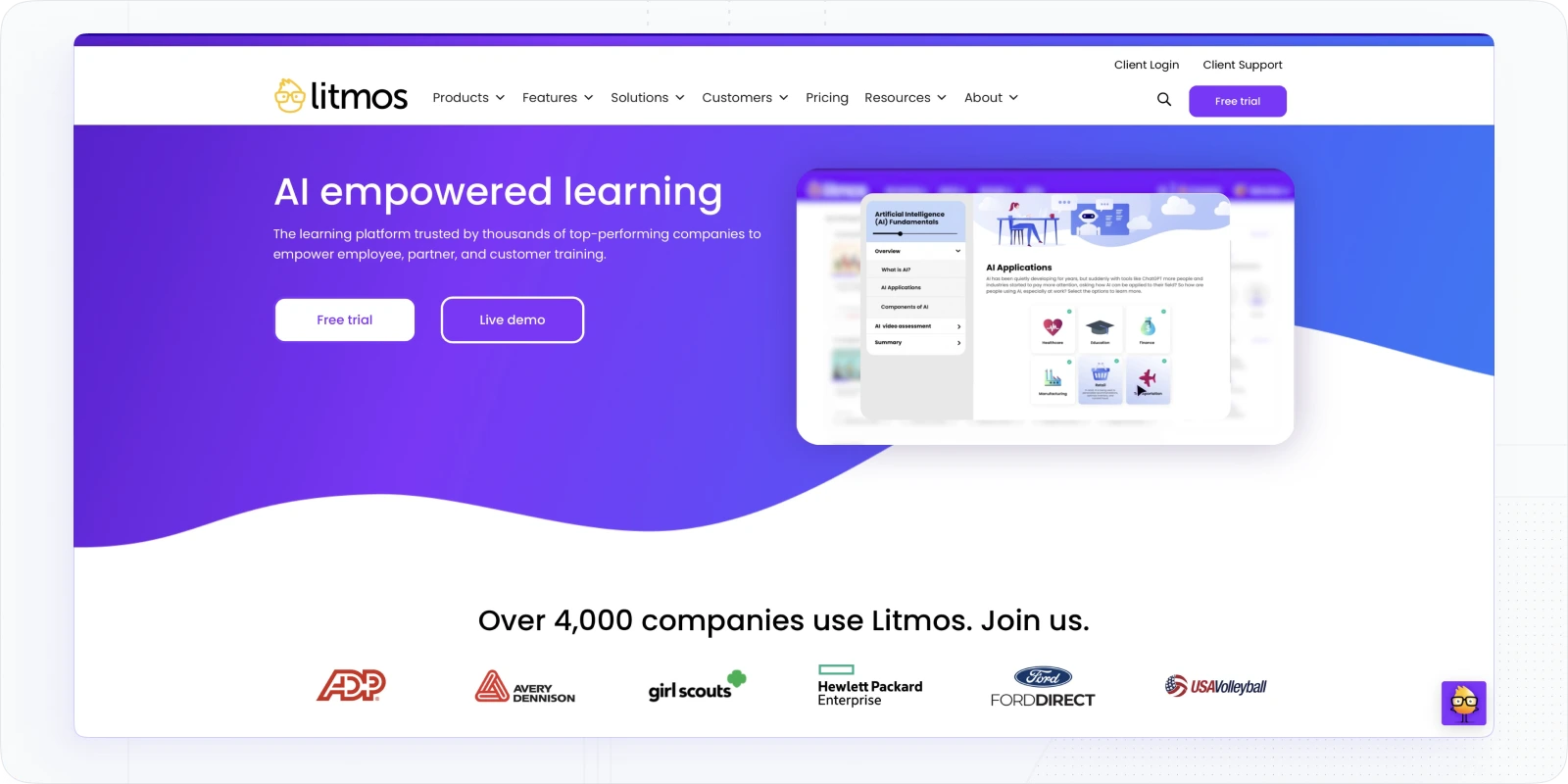
Litmos is an enterprise LMS for retail training and e-learning designed to boost engagement and motivation through gamified learning. Ideal for the retail sector, it provides a platform that combines gamification with robust enterprise administration, pre-built content, and a flexible content management system. This approach not only makes training more enjoyable but also helps improve learning outcomes and employee performance.
Pricing: To get prices for Litmos LMS you need to contact their sales department.
Key Features
- Gamification Tools: Foster a sense of friendly competition among learners with leaderboards, point systems, badges & rewards.
- Flexible Content Options: Use Litmos’ authoring tool to develop SCORM-compliant courses, or utilize existing off-the-shelf courses covering compliance, soft skills, leadership, and more.
- AI Assistant and Video Assessments: Enhance the learning experience with AI Assistant and video assessments. These tools provide interactive feedback and personalized learning paths based on individual performance.
- Rapid Implementation and Integration: Litmos integrates seamlessly with CRM, ERP, and HRIS systems, ensuring smooth deployment and operation.
- Comprehensive Reporting and Tracking: Gain valuable insights into course completions, quiz results, and content popularity to optimize your training strategy.
AI features: Litmos AI is a defined suite — course outlining, first-draft content writing, and quiz generation from your own library, plus an assistant that recommends courses and answers learner questions. Solid, if fairly standard authoring help rather than frontline-specialized.
💡Further Reading: LMS Gamification: Top 6 Examples
Safety Culture – Best LMS for Social Learning
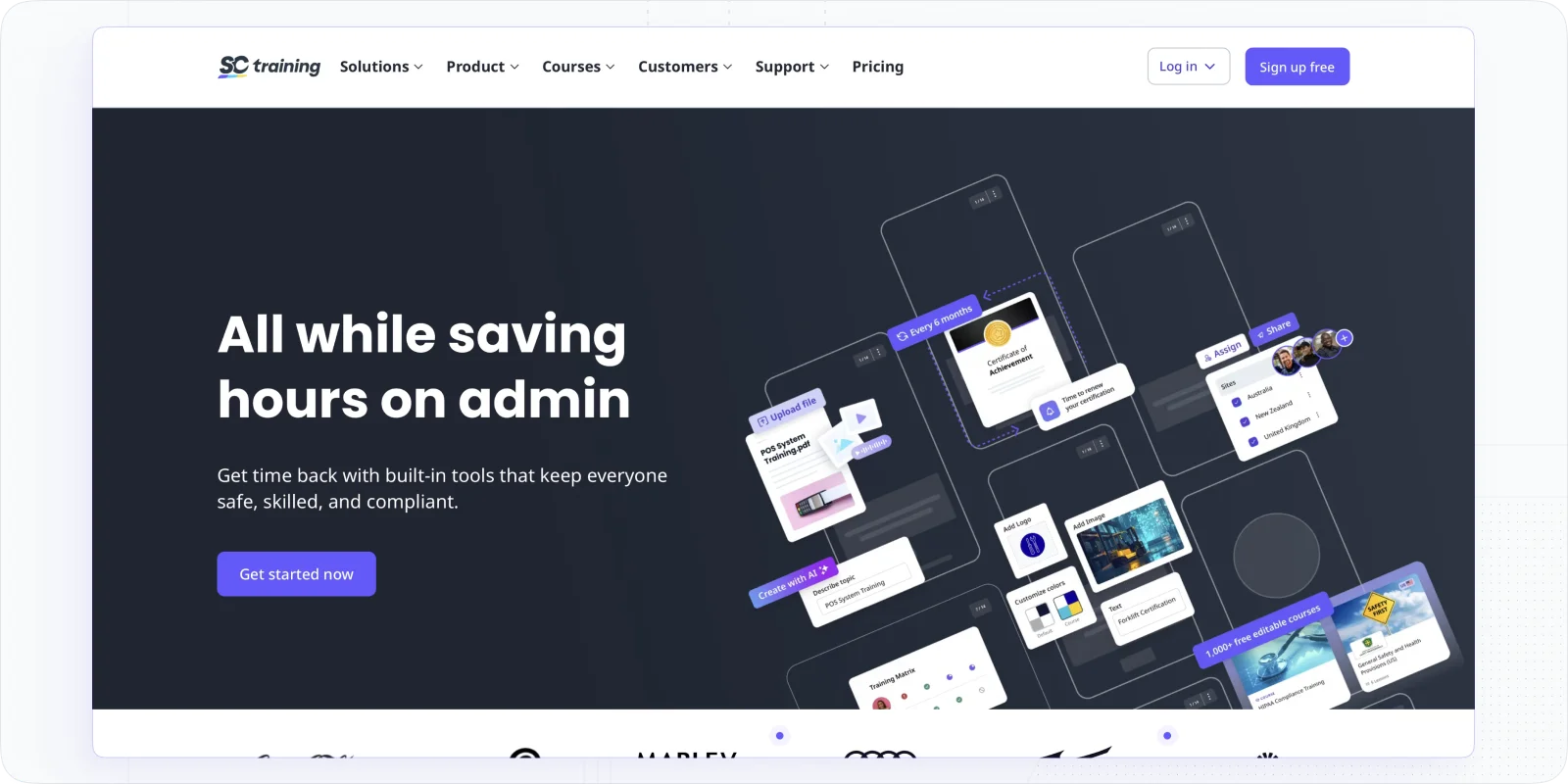
SafetyCulture stands out as a powerful tool for social learning, specifically tailored to enhance retail operations through collaborative and data-driven training. It integrates robust management and compliance tools, allowing retailers to enhance employee product knowledge, streamline operations, and maintain high standards.
Pricing: Free Plan — unlimited number of lessons and unlimited users; Do it yourself — $2.95 per active user/month; Managed — $2.95-$5.95 per user/ month; Enterprise — custom pricing.
Key Features
- Social Learning: Employees can discuss issues, share solutions, and collectively address challenges, fostering a collaborative learning environment.
- Safety and Compliance Tracking: Implement and monitor safety procedures with built-in audits and risk assessments. Track compliance with regulations and standards to ensure a safe and efficient working environment.
- Integration: Easily integrates with G-Suite; Microsoft; Canva; BambooHR; Xero; Deputy; SSO; Zapier; Public API; SCORM and AICC Import / Export.
- Real-Time Feedback and Collaboration: Utilize in-build games; achievements; real reward; spaced repetition; push notifications; certificates; assignments; discussion forum; Brain Boost spaced repetition tool; stars & prizing draws; peer authoring;
- Customizable Assessments and Checklists: Create and deploy customized assessments and checklists that align with your brand’s standards and procedures.
- Visual Campaigns and Communication: Quickly roll out promotional and merchandising initiatives with visual content that captures attention and improves understanding.
- Onboarding and Training: Accelerate the onboarding process with digital assessments and training modules.
AI features: SafetyCulture's training tool (SC Training, formerly EdApp) offers Create with AI, which converts existing PDFs, slides, or docs into mobile-first microlessons with images and AI narration — squarely aimed at deskless, on-the-floor learning.
💡Further Reading: 11 Best Social Learning Platforms for 2026 [+Features Guide]
Learn Amp – Best LMS for Community Based Learning
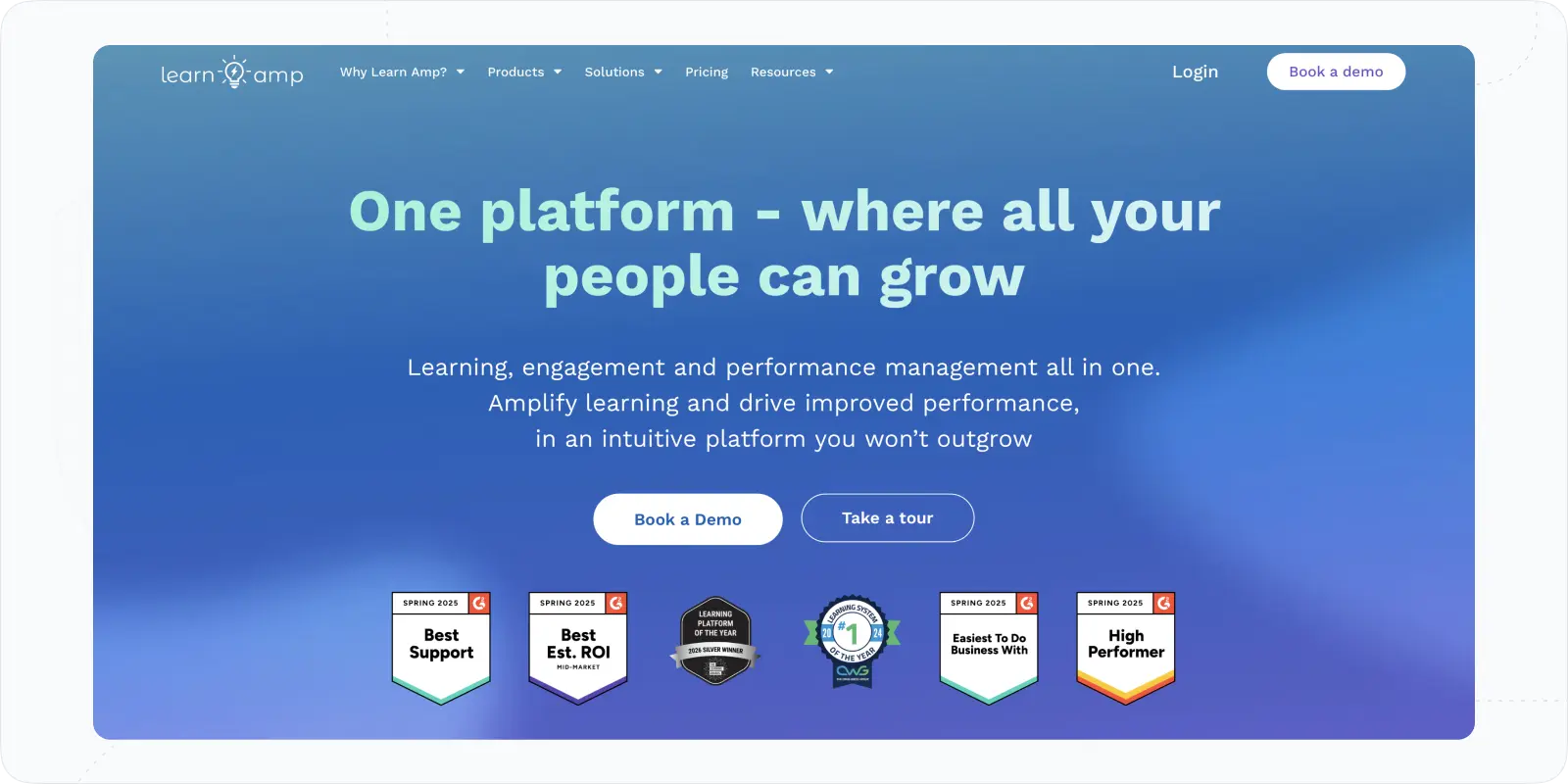
Learn Amp is a retail learning management system designed to cultivate a strong sense of community within retail organizations. It empowers employees to share knowledge, collaborate on learning, and engage with content in meaningful ways. By leveraging social learning principles, Learn Amp enhances the learning experience through community-driven interactions and insights.
Pricing: To get prices for Learn Amp you need to contact their sales department.
Key Features
- Community Building: Create vibrant learning communities by setting up cohort-based groups for onboarding, leadership, or other training initiatives.
- Centralized Content Assignment: Provide a single, consolidated view where learners can access all necessary resources.
- Engagement Tracking: Track progress, task completion, and participation levels to ensure learners are actively involved and on track with their development goals.
- Pulse Surveys and Feedback: Use quick pulse surveys and feedback mechanisms to gauge employee satisfaction and engagement.
- Content Sharing and Collaboration: Allow them to recommend resources to peers, contribute to discussions, and post questions that can be answered by experts or fellow learners.
- Dynamic Group Management: Create and manage dynamic groups based on various attributes such as location, language, or role.
- Kudos and Recognition: Recognize and reward learners for their contributions and content uploads. Use Kudos and ratings to highlight popular content and encourage active participation.
AI features: A broad, branded set — Volt (a multi-agent AI assistant), an AI Tutor, an AI content creator and editor, AI-powered search, and predictive skills tagging. It leans toward skills-based employee development more than frontline retail specifics.
Expert LMS – Best LMS for Microlearning
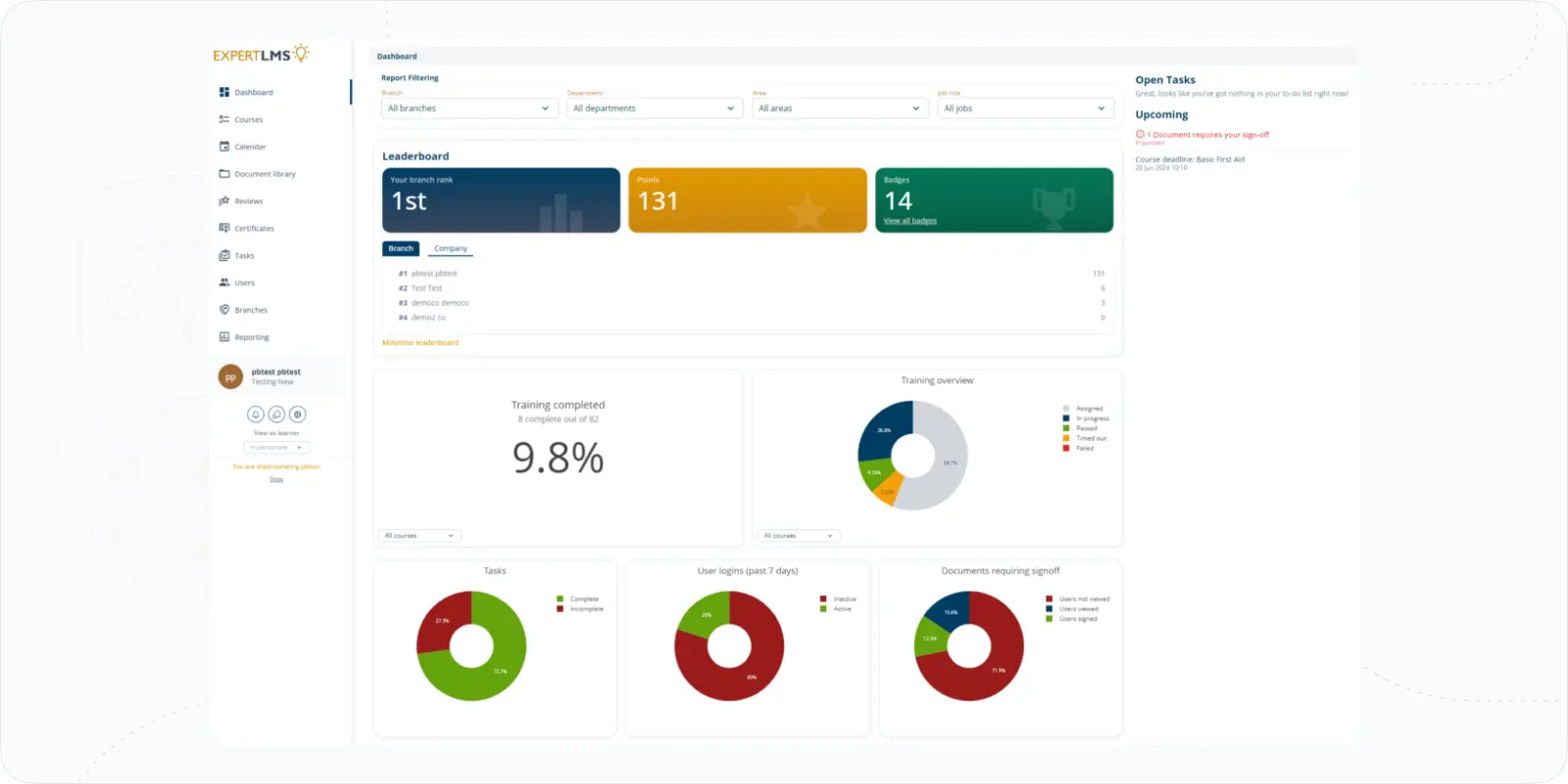
Expert LMS is one of the best retail LMS online learning, engineered to support retail organizations with a dynamic, all-in-one training solution that emphasizes microlearning. The platform provides employees with easily accessible, bite-sized learning modules through a native mobile app.
Pricing: $3.50 per active account
Key Features
- Easy Course Building: Develop engaging, short courses with images, text, files, quizzes, and SCORM-compliant materials.
- Interactive Quizzes and Assignments: These features promote active engagement and help reinforce knowledge through practical application.
- Career Pathways: Define clear, microlearning-driven career paths to motivate employees and guide their development.
- Automations: Enroll users into relevant courses based on their role, location, or department, reducing administrative overhead and ensuring timely access to learning materials.
- Smart Notifications: The platform prioritizes in-app alerts for immediate updates and uses email as a backup when the app is not installed.
- Performance Reviews: Conduct performance reviews directly through the app and automate recurring evaluations to support continuous development.
- Integration Capabilities: Seamlessly integrate Expert LMS with other platforms like HR systems (e.g., Planday, S4Labour) and document management tools (e.g., SharePoint, Google Drive). The open API facilitates endless integration possibilities.
AI features: AI here is essentially one capability — an AI course builder that turns PDF documents into editable course content. Useful for quick authoring, but not a developed AI suite or a retail-specific differentiator.
Which Retail LMS Should You Choose?
There's no single best retail LMS — only the best fit for your three constraints. Weight turnover-proof onboarding if you hire in seasonal waves and need people productive in days; Academy Ocean, Axonify, and EducateMe are strongest there. Weight deskless and mobile-first if most learning happens on the floor; Axonify and SC Training are built for it. Weight multi-store rollout if you're pushing identical training across dozens of locations and need per-store proof it landed; Docebo, EducateMe, and 360Learning handle that cleanly.
If you want AI woven into onboarding and real customer-conversation practice from day one (without enterprise overhead or long setup timelines) EducateMe is our pick for retailers in the 50–1,000-employee range. Whichever two or three you shortlist, run a 30-day pilot in one store or region against your own turnover and completion numbers before you commit chain-wide. The best platform is the one your floor staff actually open on a busy shift.
Still unsure about which option to choose? Book a demo with our EducateMe LMS expert - and get all the answers in 30 minutes:)
Frequently asked questions
In retail, LMS (Learning Management System) is a digital platform used to deliver and manage training programs for employees. It helps in streamlining employee education, tracking progress, and improving overall performance within the retail environment.
Retail companies use LMS to efficiently train and develop their employees, ensuring they are knowledgeable about products, customer service, and company policies. It also helps in tracking training progress, standardizing learning materials, and improving overall staff performance.
LMS (Learning Management System) focuses on delivering and managing employee training and development, while sales enablement provides tools, resources, and strategies specifically designed to enhance sales performance and support sales teams. LMS is broader in scope, covering various training areas, whereas sales enablement is more targeted toward improving sales effectiveness.
Retail LMS costs typically range from $1,000 to $10,000 per year, depending on the features and number of users. For more advanced or customizable solutions, prices can exceed $20,000 annually.