
Top 10 Docebo Alternatives and Competitors for 2026

By Roman GryshukRoman GryshukCorporate Training Expert & Content EditorHi, I’m Roman, a content specialist with over 5 years of experience in content writing and marketing. At…Read more
Corporate Training Expert & Content Editor
10 min read
For many corporate training providers, balancing cost and advanced features is a challenge, and Docebo doesn't always hit the mark.
While it’s a leading LMS thanks to its AI-powered skill development, automation, and scalability, it comes with a significant price tag. Moreover, limited engagement and reporting tools can negatively affect the training experience.
Want to explore Docebo alternatives that prioritize flexibility, ease of use, and training effectiveness? Let's dive into options that might better suit your organization’s goals.
The best Docebo alternatives offer comparable AI features at lower cost or with faster implementation — a bar that rose when Docebo shipped AgentHub in April 2026. EducateMe is the top alternative for teams that want AI-native course creation and roleplay coaching without Docebo's pricing complexity. 360Learning leads for collaborative learning; TalentLMS is the budget pick.
Why Look for Docebo Alternatives?
Subject to many reviews, Docebo software appears as one of the most comprehensive and feature-packed LMS for training and upskilling. Yet, let’s consider what it is good for and where it can lack functionality.
Docebo is a powerful LMS with advanced AI-backed management and recommendations, great automation, and solid gamification, making it great for continuous corporate training, great L&D efforts, and a centered training approach within enterprises.
As of April 2026, the AI part is even truer: at its Inspire event, Docebo launched AgentHub — AI agents that run enrolment campaigns and content workflows on their own — plus a skills engine from its 365Talents acquisition and an MCP server that connects the LMS to tools like Claude.
So why leave? Because every layer of that power adds cost and setup weight. Pricing starts enterprise-high, reporting still frustrates admins, and mid-sized teams end up paying for knowledge infrastructure they never switch on.
Here’s a breakdown of the reasons:
Docebo pricing is high
So here is the main issue: Docebo pricing structure can be a challenge for many organizations. Starting at $16,000 annually, the cost varies based on your organization’s size and needs, but exact pricing requires negotiating with a sales representative.
Some features are limited
Docebo covers enormous ground, but not every feature earns its keep.
Users report that reporting stays inflexible — scheduling and customizing reports is fiddly, and export options are poor. Gamification and analytics still don’t reach the mobile apps.
The new AI carries an asterisk too. AgentHub and its agents target enterprise knowledge programs, often gated behind higher tiers and add-ons. If what you need is fast course creation and clean tracking, you’re buying a data platform to get an LMS.
Docebo is not very intuitive
Another significant issue is that Docebo’s wide range of features can overwhelm users and bring bugs. So yes, the learning curve is steep and it is easy to get lost.
Best Docebo Alternatives
Considering these reasons, we’ve prepared a list of top Docebo competitors that can be more cost-effective, offer more intuitiveness, or simply bring more in terms of content creation and authoring.
AI is now table stakes in this category, so I re-checked every platform’s AI capabilities in July 2026 — what’s listed below is what ships today. Most vendors quote custom pricing; we flag the ones that publish real numbers.
| Platform | Best For | Key Features | Pricing |
|---|---|---|---|
| EducateMe | Onboarding, partner training and continuous upskilling | AI course creation, AI roleplay coach, automated enrolments, advanced reporting, white-label portals | from $239/mo (80 users); ~$3/user/mo billed annually |
| Cornerstone OnDemand | Enterprise skill development and performance management | Skill mapping, analytics, content library | Quote-based, enterprise-tier pricing |
| Absorb LMS | Customizable employee training with pre-made content | Gamification, content diversity, customizable dashboard | Quote-based, flexible plans |
| Litmos | Blended learning and ILT coaching programs | Automation, e-commerce, SCORM support | Quote-based, with e-commerce features |
| TalentLMS | Simple, budget-friendly training for growing teams | TalentCraft AI authoring, course library, branches | Free plan; paid from $119/mo |
| LearnUpon | Training at scale with custom portals | Custom portals, gamification, surveys | Quote-based, per-learner license |
| Bridge LMS | Video-based employee development and analytics | Video tools, performance reviews, author collaboration | Quote-based, can be expensive |
Not all of the Docebo competitors are as comprehensive, yet, they are pretty flexible and can be used for various training needs.
#1. EducateMe: Best AI-Native Docebo Alternative
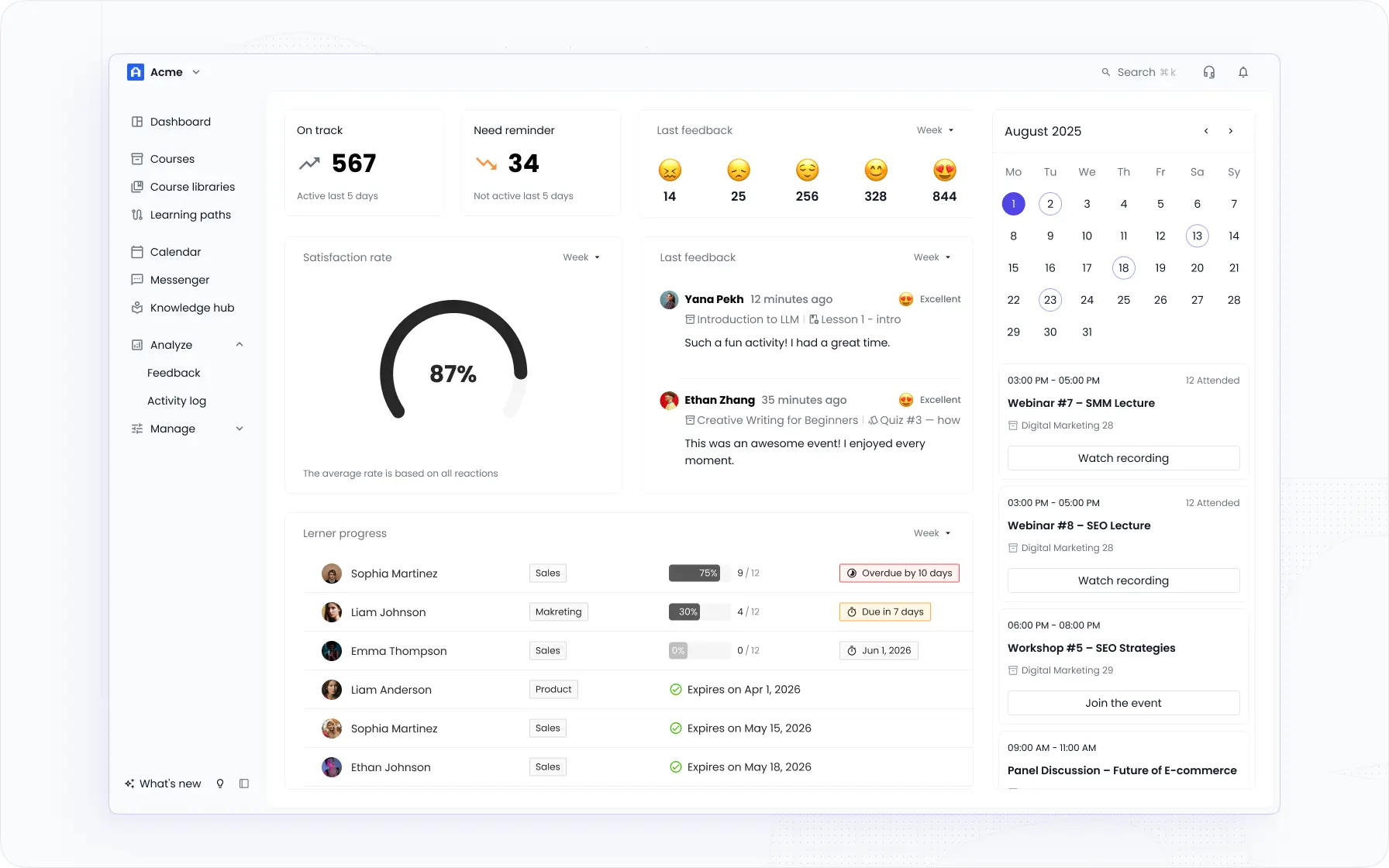
EducateMe is the strongest Docebo alternative for companies that want AI genuinely built into the training workflow, not AI bolted onto an otherwise traditional LMS. Where Docebo charges enterprise-tier prices and requires significant implementation time, EducateMe gets mid-sized L&D teams running in hours: courses generated from a prompt or document, automated enrolments by role or department, and multi-tenant portals with full white-label branding per client or team. Where Docebo’s new AgentHub points its AI at enterprise knowledge sprawl, EducateMe keeps AI on the training work itself: building courses, running practice, reading results.
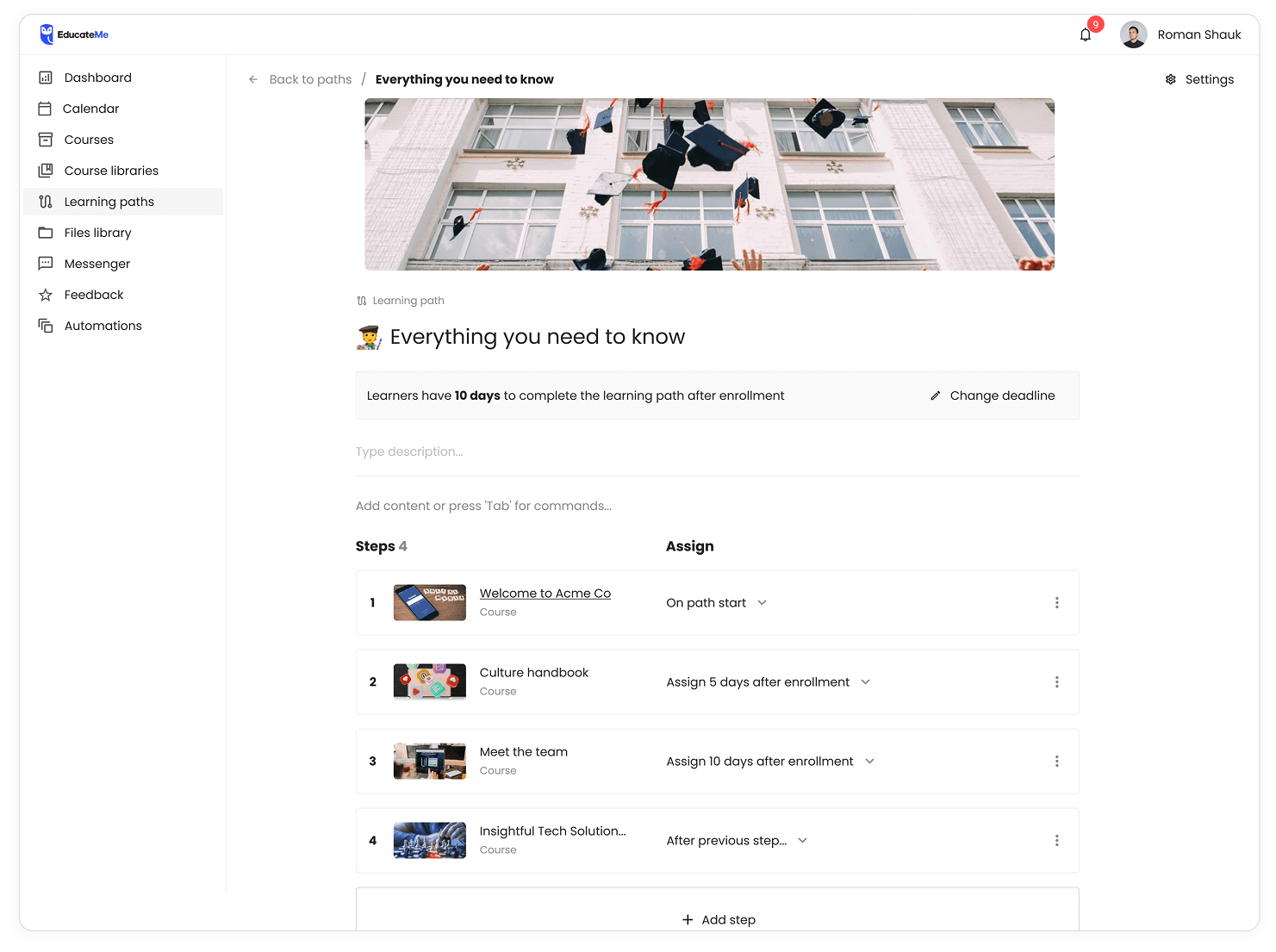
The reporting is solid, including completion rates, skill gap detection, and per-manager dashboards, and the pricing is transparent from the start (from $239/month, or about $3 per user monthly billed annually), which is the most common frustration Docebo customers raise when they look for alternatives. I'd recommend it to any L&D team running onboarding, upskilling, compliance, or partner training at a company between 50 and 1,000 employees.
EducateMe offers a free trial with full access to every feature — including its AI assistant — so you can test it before committing.
Best for: diverse corporate training, continuous education programs, onboarding, and upskilling.
Key features of this Docebo alternative:
- AI Course Creation. Generate full courses from a text prompt, URL, or uploaded file. The AI builds module content and quizzes, not just outlines. Customer data shows 3x faster course creation than manual builds.
- AI Roleplay Coach. Sales and customer-facing teams run practice scenarios against AI-generated responses with rubric feedback, scales coaching without needing a human present every time.
- Multi-tenant portals. Separate branded learning spaces per department, client, or partner — each with its own curriculum, branding, and access controls — managed from one account.
- Ask AI + AI Assessment. Learners get instant answers from their enrolled course content, and adaptive assessments score open-ended work against your rubric.
- Transparent pricing. Pro starts at $239/month for 80 users — about $3 per user monthly billed annually — with a 14-day free trial. No multi-year negotiations.
G2 review and rating: “Customizing is very cool, and it’s packed with handy tools for upskilling our team: flexible roles, automatic reminders, and content that adapts to what our people need.” - 4.7/5
Pros:
- AI native across course creation, quiz generation, and roleplay coaching
- Multi-tenant white-label architecture for separate team or client portals
- Transparent, predictable pricing, no enterprise negotiation required
- Faster implementation: courses live in hours, not weeks
Cons:
- No mobile app, though it remains mobile-friendly.
#2. Cornerstone on Demand: Main Docebo Competitor
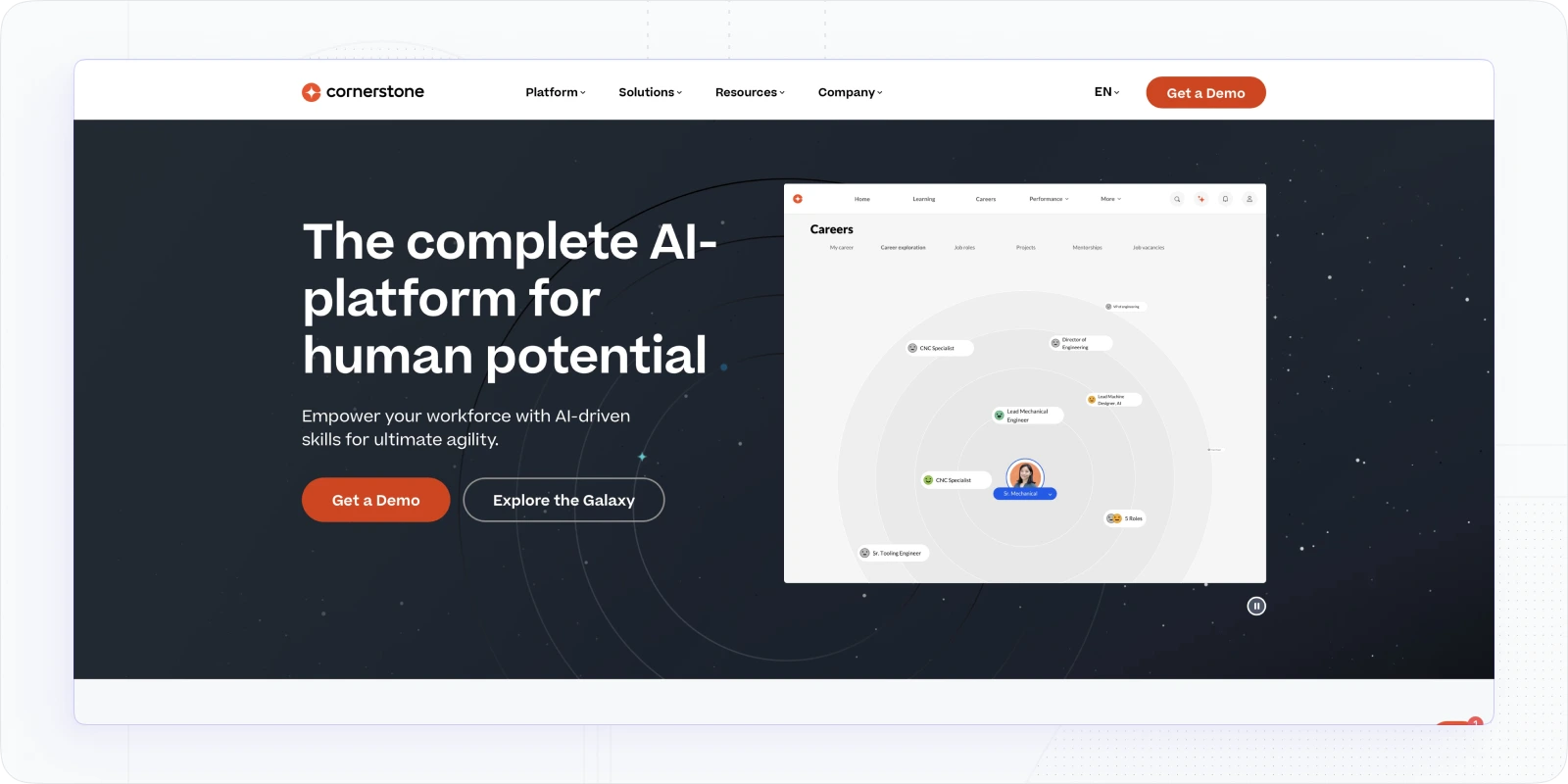
Cornerstone on Demandis the main Docebo competitor in terms of comprehensiveness and training management.
Cornerstone matched Docebo’s AI move early: its Galaxy platform added an Adaptive Learning Agent and an AI Course Assistant in the Spring 2026 release, layered on skills intelligence trained on data from 140M+ learners. The trade-off hasn’t changed — this is heavyweight enterprise software, and admins feel that weight daily.
Best for: large organizations looking to upskill, reskill, and close skill gaps.
Key features of this Docebo alternative:
- Skills Intelligence. Focusing on performance, Cornerstone provides automated skill assessments and course assignments to bridge skill gaps.
- AI agents (2026). The Adaptive Learning Agent personalizes paths and the AI Course Assistant drafts content — both shipped in the Spring 2026 release.
- Social Learning Tools. Notably, this LMS offers gamification elements, peer interactions, and discussion forums to affect learning engagement.
G2 review and rating: "It's a great platform when you want to demonstrate compliance - but that's it…It has a horrible end-user interface.” – 4.1/5
Pros:
- Comprehensive platform with a focus on data and skill gap identification.
- Automated, personalized learning at enterprise scale.
- Powerful analytics and reporting capabilities.
Cons:
- Expensive pricing structure.
- Dated end-user interface.
- Long, resource-heavy implementations.
Pricing: Available upon request.
Read more: Best Training Management Systems
#3. Absorb LMS: Comprehensive Solution with Powerful Course Creation
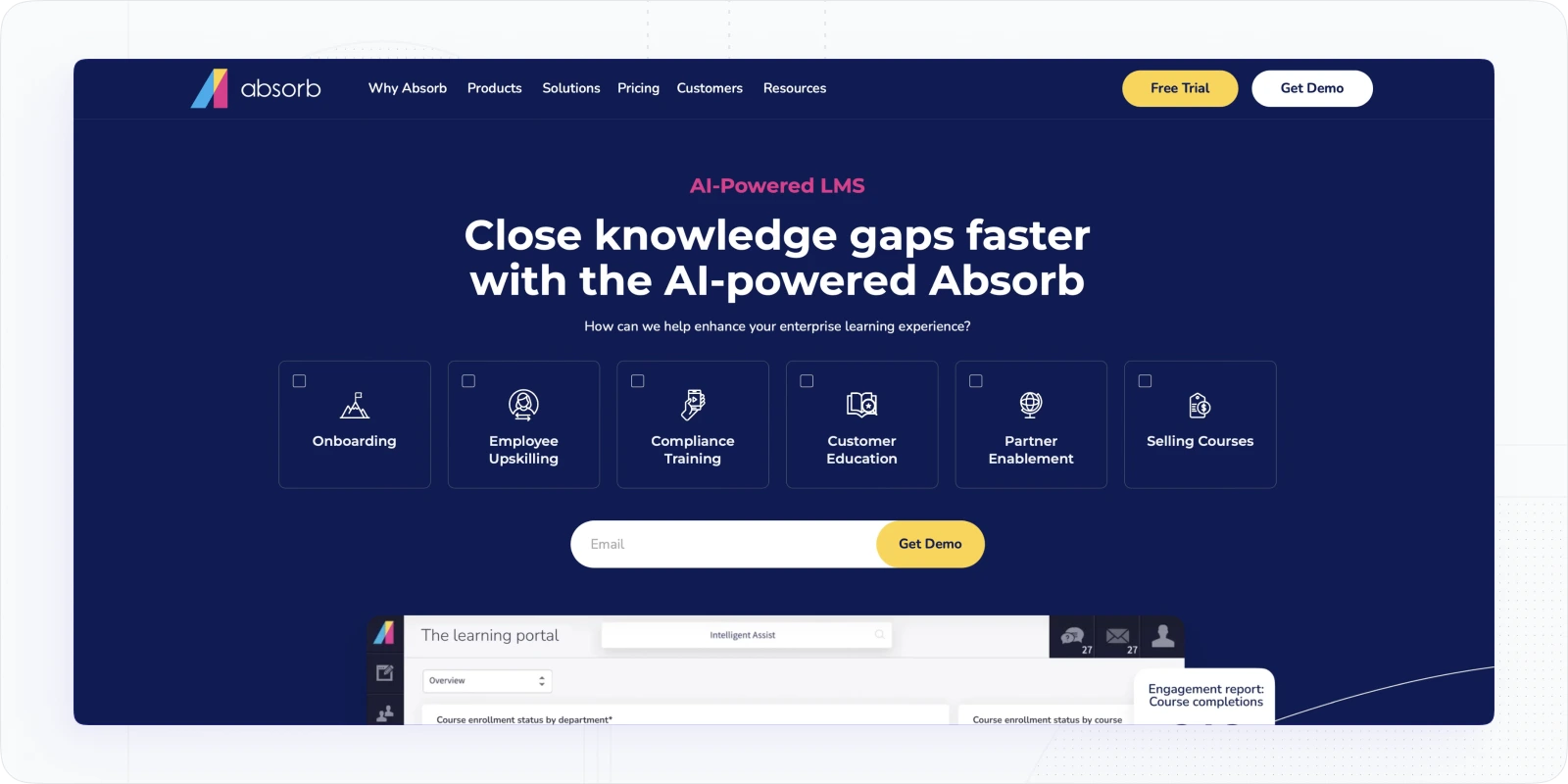
Absorb LMS is another alternative to Docebo, bringing an intuitive platform with powerful tools for course creation and management.
Its AI story got serious over the past year. Absorb Intelligence now spans Create AI for building courses, an AI Coach for learners, and Intelligent Assist — admins type “enroll the sales department in the new training program” and it happens. Absorb Aura, the newest agent layer, extends that across customer and partner training.
Best for: engaging employee training programs within middle and large organizations.
Key features of this Docebo alternative:
- Gamification. AbsorbLMS provides badges, progress charts, and certifications to support engagement.
- Pre-Made Materials. This platform offers access to a vast content library with ready-to-use courses to speed up course development.
- Create AI + AI Coach. Courses generated from your material, with a real-time coach guiding learners through them.
G2 review and rating: “Manager Dashboard is an amazing feature! Yet, some reporting could be more specific to courses.” – 4.6/5
Pros:
- Intuitive interface and interactive user experience.
- Highly flexible and customizable platform.
- SCORM support with diverse content formats.
Cons:
- Can be expensive.
- Limitations related to reporting capabilities.
Pricing: Available upon request.
Read more: Docebo vs. Absorb LMS: Which is better for your business?
#4. Litmos: Flexible Learning Management System for Blended Learning/Training
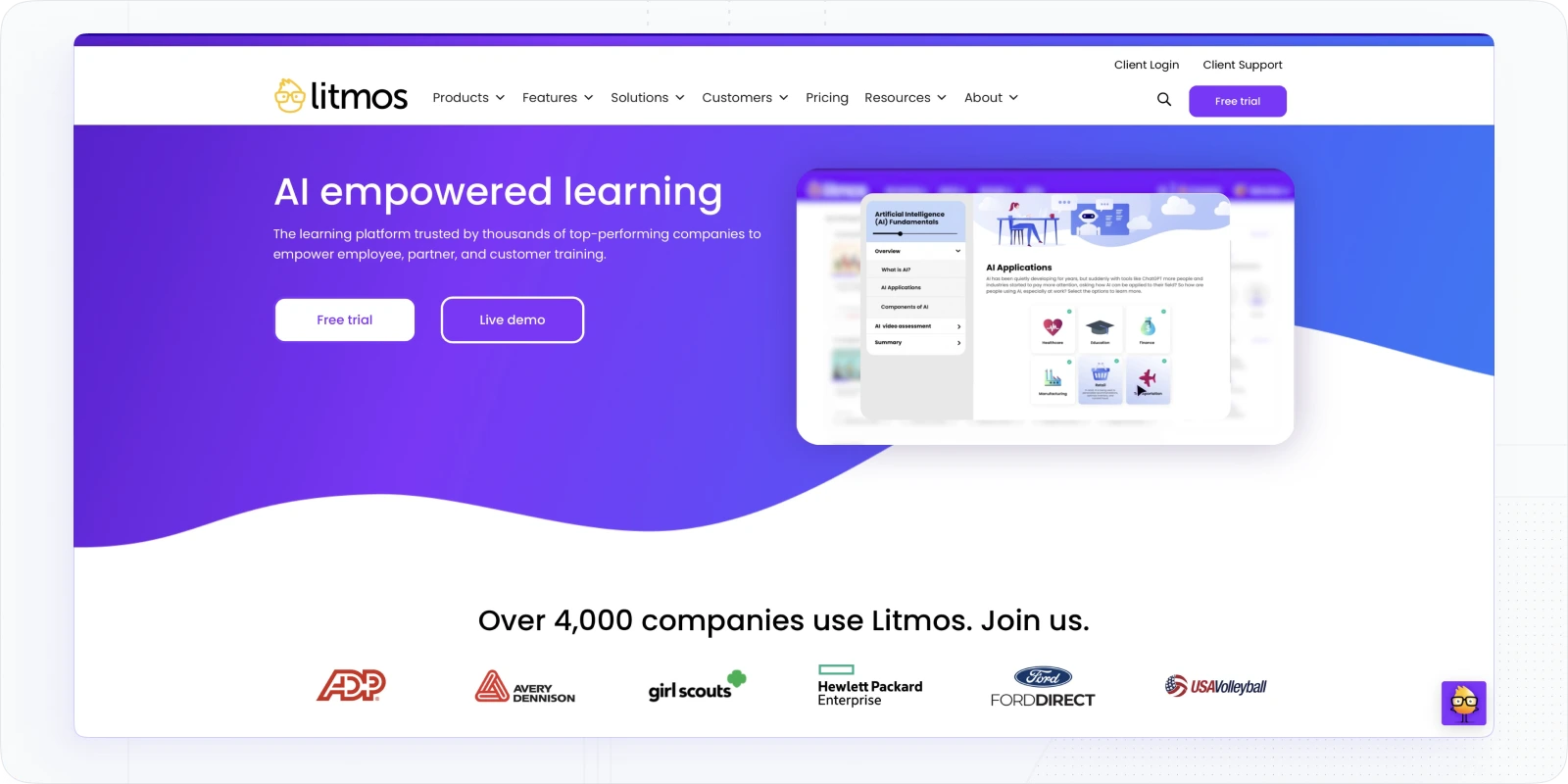
Litmos is a flexible LMS with strong workflow automation and management features and diverse content options, including video assignments. Importantly, another distinctive feature is its instructor-led module that integrates with multiple apps and automates attendance tracking.
The embedded AI Assistant is the differentiator now: it’s trained only on your own learning content, so answers and recommendations come from your material rather than the open web — and it works the same on desktop and in the mobile app.
Ideal for: Blended corporate learning strategies and instructor-led coaching programs.
Key features of this Docebo alternative:
- AI support and automation. Litmos provides automated enrollments, assignments, and alerts. At the same time, its AI is a useful tool for video assignments and knowledge retention.
- Reporting. Also, the platform offers comprehensive analytics with in-built reports, yet, they can be difficult to navigate.
- Commerce Features. Notably, Litmos supports e-commerce functionality for training programs.
G2 review and rating: “Litmos provides a streamlined process for creating course content…However, reporting is a challenge…” – 4.3/5
Pros:
- Great automation features for efficient management.
- Intuitive platform with a vast library of pre-built courses.
- Supports SCORM content and video assessments.
Cons:
- Bugs and occasional difficulty in use.
- Reporting features can be clunky.
Pricing: Available upon request.
Read more: Docebo vs Litmos: Which LMS Should You Choose?
#5. TalentLMS: Simple, Budget-Friendly Docebo Alternative
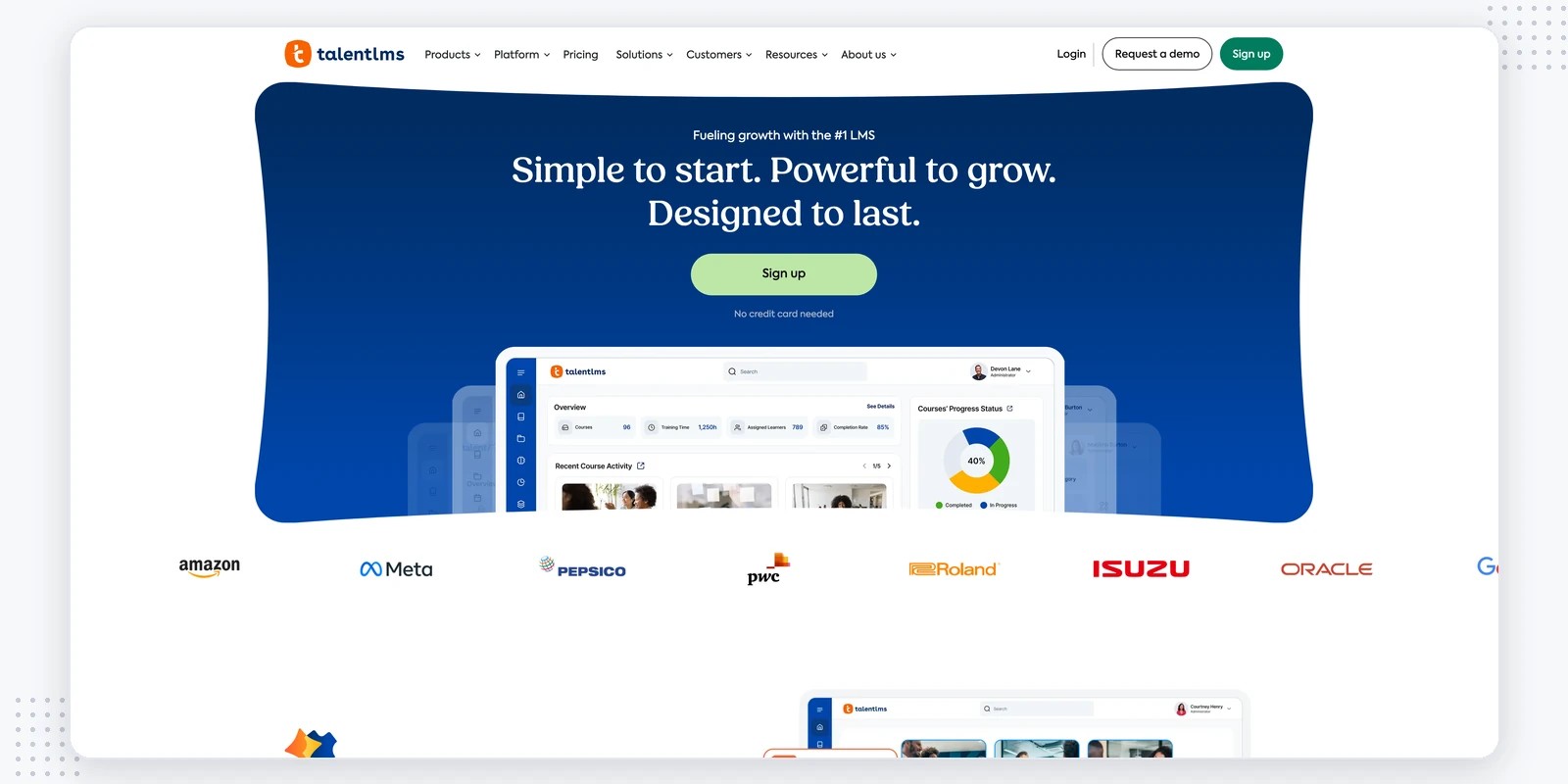
TalentLMS shows up on nearly every Docebo alternatives shortlist, and for a simple reason: it’s the opposite trade. Where Docebo sells depth and charges for it in complexity, TalentLMS sells speed — a small team can build a portal, load courses, and enroll learners the same afternoon.
Its TalentCraft authoring tool covers the AI basics well: courses generated from prompts or documents, interactive video, and an AI Playground, all metered by credits that scale with the plan. I wouldn’t pick it for deep skills programs or heavy compliance reporting — that’s where it thins out.
Best for: small and growing teams that want training live this week, not this quarter.
Key features of this Docebo alternative:
- TalentCraft AI. Generate courses from a prompt or an imported document, with interactive video and AI credits included on paid plans.
- Branches. Separate portals per team, client, or brand — a lighter take on enterprise multi-tenancy.
- Course library. Ready-made TalentLibrary content covers soft skills and compliance basics.
G2 review and rating: reviewers consistently praise its setup speed and value for money across 700+ reviews – 4.6/5
Pros:
- Free plan and published pricing — no sales call to see numbers.
- Fast setup with almost no learning curve.
- Branches make multi-team or multi-client training affordable.
Cons:
- Reporting depth is limited compared to enterprise platforms.
- AI credits run out quickly on lower tiers.
Pricing: Free plan available; paid plans start at $119/month (Core), with TalentCraft AI credits scaling by tier.
Read more: Docebo vs TalentLMS: Which LMS Is Better?
#6. LearnUpon: Easy-to-Use Alternative With Great Customization
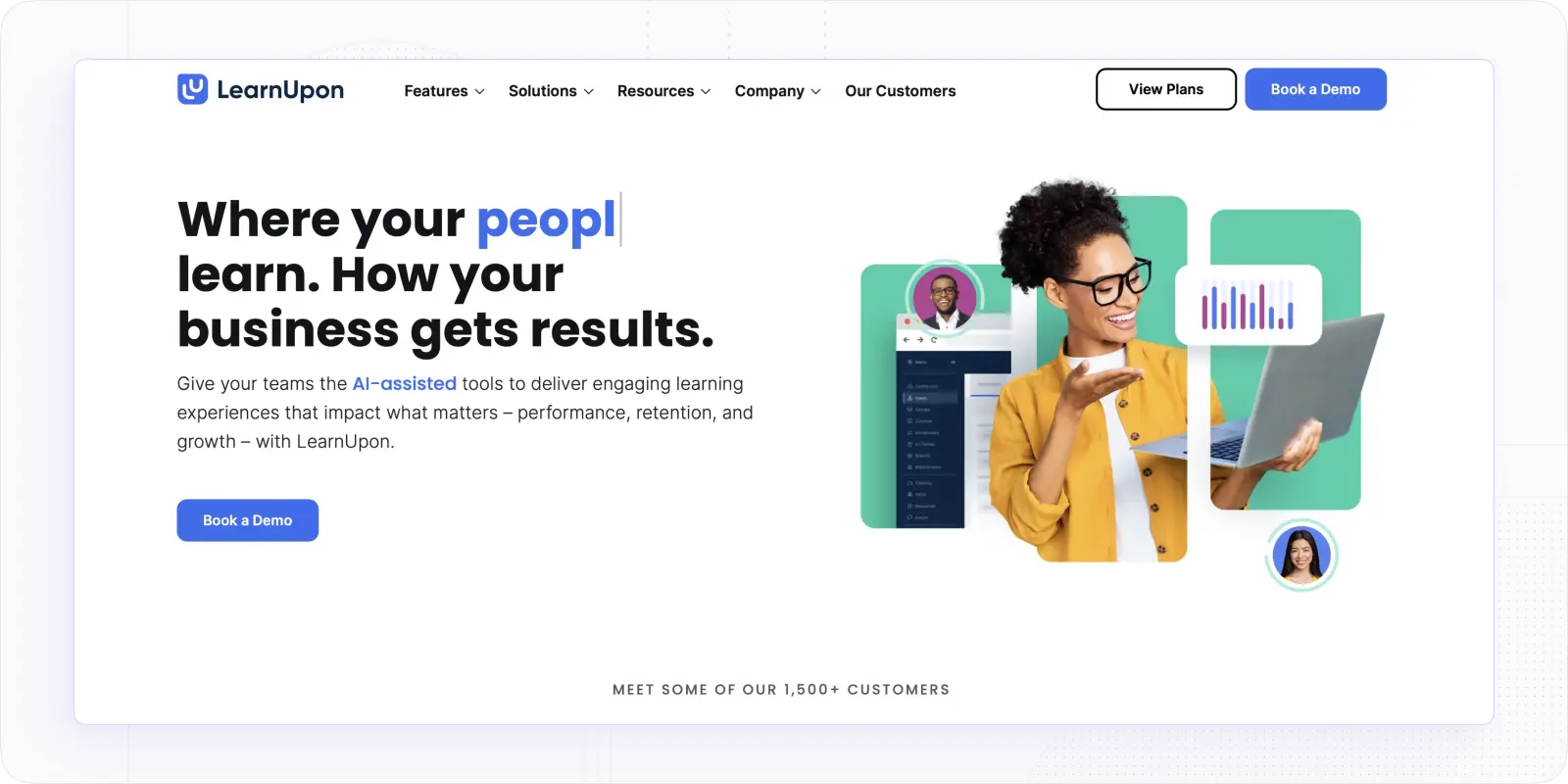
LearnUponis a straightforward and intuitive LMS that offers responsive and clear design, excels in portal customization, and brings solid gamification features.
The old knock on LearnUpon — basic authoring — died in early 2026 when it acquired Courseau and shipped Create+: drop in a PDF, video, or document and it comes back a structured course, translated into 120+ languages, with AI audio narration if you want it.
Best for: large organizations with various branch or department-specific learning.
Key features of this Docebo alternative:
- Learning Portals. Thanks to LearnUpon’s portal customization, you can create custom learning spaces for different departments or audiences. With it, it is easier to scale programs and group learning.
- Create+ AI authoring. Documents and videos become structured courses, with translation and AI narration built in.
- Engagement Tools. LearnUpon offers powerful gamification features for better user engagement and interaction, in particular, badges, points, leaderboards, forums, banners, and reminders.
G2 review and rating: “Our experience with LearnUpon has been largely positive…yet, setting up a single course can be quite time-consuming…” – 4.6/5
Pros:
- Easy to use and navigate for both learners and admins.
- Powerful customization options for learning spaces and branding.
- Flexible course editor and strong integration capabilities.
Cons:
- Course setup can still be time-consuming.
- Issues with email notifications reported by users.
Pricing: Available upon request.
#7. Bridge LMS: Corporate Learning Management Platform with Video Tools
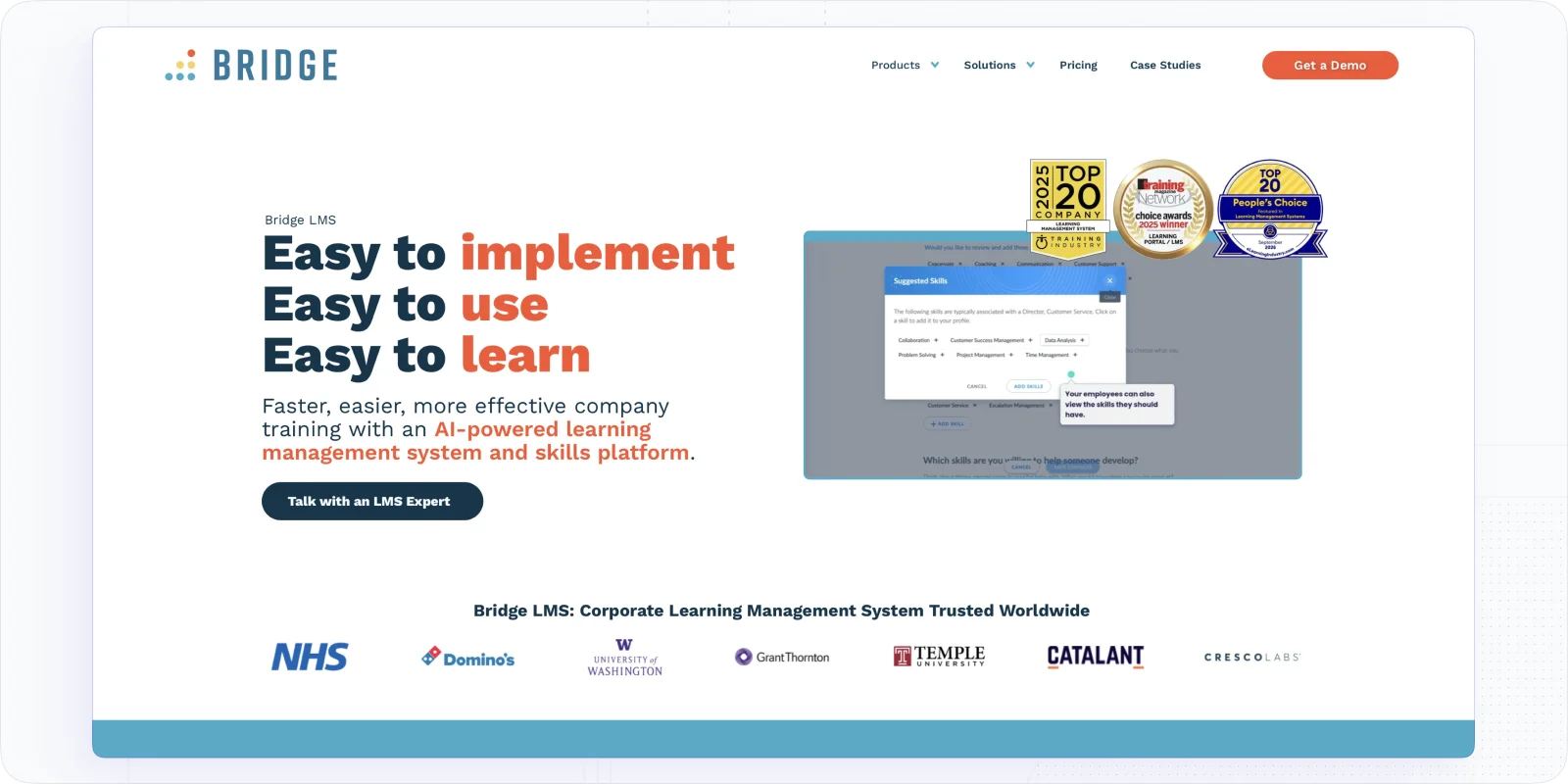
Bridge is a corporate learning platform that pairs solid performance management with unusually good video tools.
Its AI now reaches further than most mid-market rivals: courses generated and translated in one click, plus a skills taxonomy built on Lightcast’s labor-market data — 30,000+ skills mapped against real hiring demand rather than a static list.
Best for: continuous skill development, large training programs, and on-demand upskilling.
Key features of this Docebo alternative:
- Video Tools. GetBridge LMS offers excellent opportunities to record, edit, and catalog video content with advanced in-moment commenting and auto-captioning.
- AI course generation. Full courses drafted and translated in one click, with objectives and summaries auto-generated.
- Performance Reviews. Bridge LMS offers separate tools for manager-led conversations, talent reviews, and goal setting.
G2 review and rating: “We are using Bridge for all of our employee training. It is a great repository for training content...yet, the search functionality could really use some attention.” – 4.2/5
Pros:
- Intuitive and responsive platform with a mobile app.
- A comprehensive approach to employee development.
- Smooth integration with other business tools.
Cons:
- Can be pricey, especially for smaller actors.
- Limitations in customization and reporting capabilities.
Pricing: Available upon request.
#8. Tovuti LMS: Well-Packed Alternative for Online Training
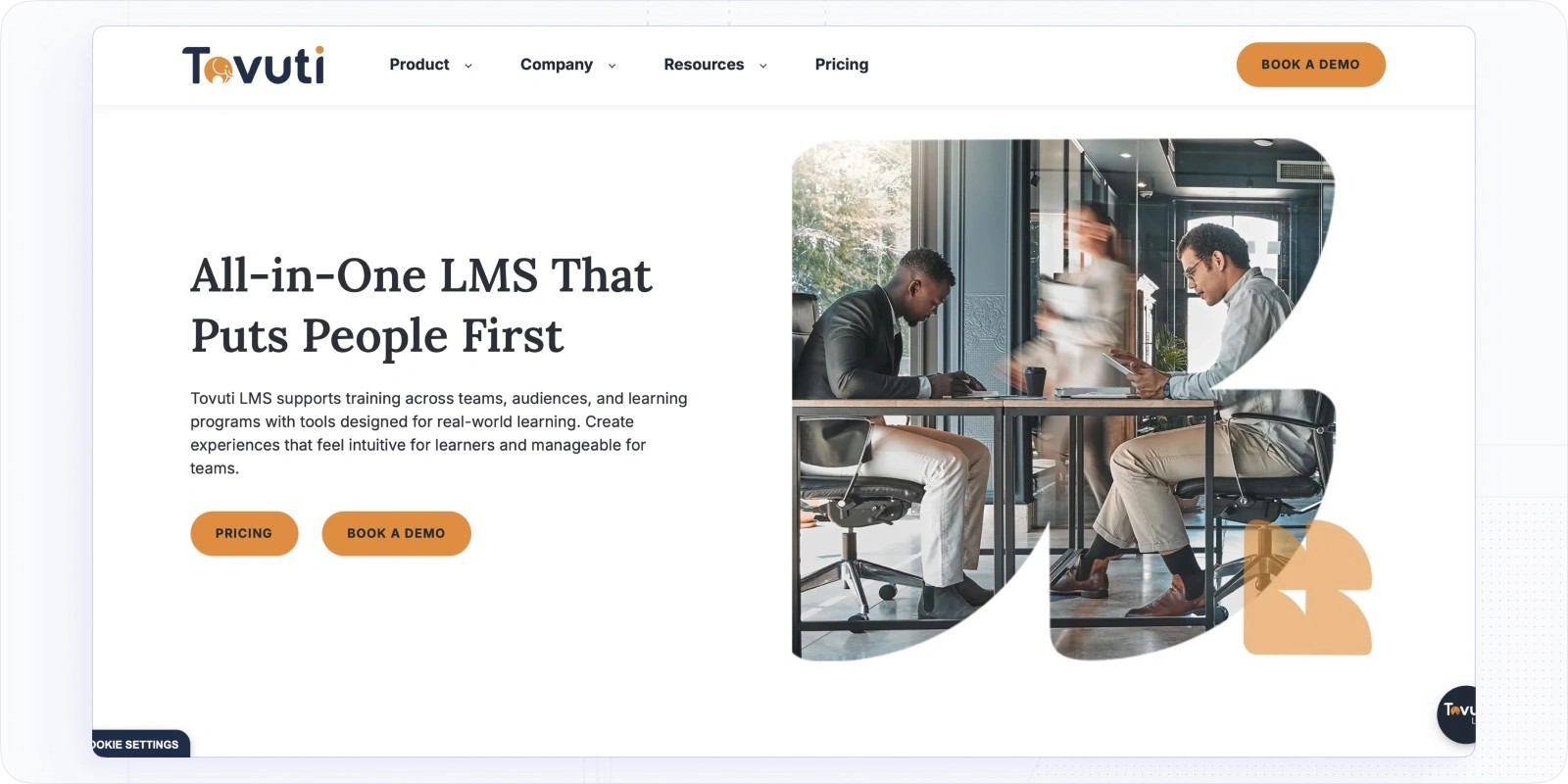
Tovuti LMS is a standard training platform that focuses on content management and creation, with a great variety of integrations into business and HR software.
It stands out with an onboarding checklist feature, e-commerce tools to sell programs, and support for 40+ content types. Its newer WayPoints tool adds standalone AI course authoring on top — a lighter lift than anything in Docebo’s stack.
Best for: online training and coaching sessions.
Key features of this Docebo alternative:
- Content Partners. Access to partners’ pre-built training content across industries.
- Interactive Content. Other than that, Tovuti provides decent gamification elements and tools to create engaging, interactive learning experiences and handle discussion.
- E-commerce Tools. In the end, it offers basic marketing and sales tools that help manage course sales, subscriptions, and promo codes.
G2 review and rating: “Tovuti has really helped to transform the training process at my company… Yet, the system could be a bit more intuitive or easy to use…” – 4.6/5
Pros:
- Great video options and support for diverse formats like SCORM.
- Industry-specific features and strong content authoring tools.
- Extensive integrations with a great variety of tools via native connection, API, or Zapier.
Cons:
- Not very intuitive, with a steep learning curve.
- Advanced features are only available in higher-tier plans.
Pricing: custom quote — tailored to learner count and feature needs (the earlier $199/month Lite plan is no longer offered).
#9. eFront: Customizable Alternative Built for Enterprise Training
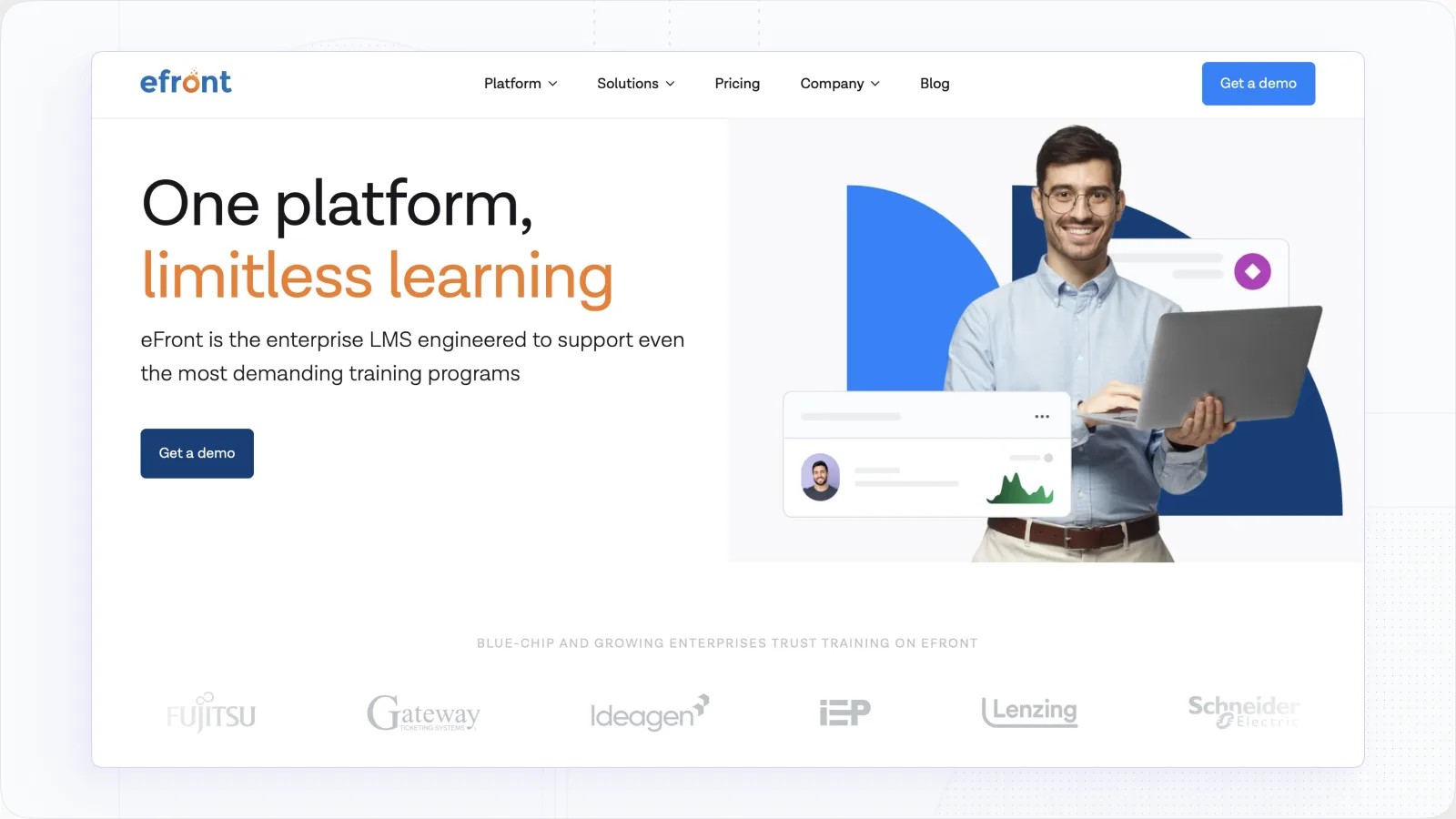
eFront is a powerful enterprise-grade LMS with a decent multi-tenant approach, learning path customization, and course marketplace.
Unlike Docebo, eFront is easier to tailor to specific use cases, and it now ships an AI course generator for first drafts. It comes from Epignosis — the company behind TalentLMS — but aims at the opposite end of the market: strict compliance, multi-tenancy, and enterprise control.
Best for: partner training and enterprise training in high-compliance industries.
Key features of this Docebo alternative:
- Multi-tenancy. This platform offers architecture to manage separate portals and training groups, and customize learning spaces and paths for them.
- Content library. A huge library of pre-made courses linked to skills, plus OpenSesame integration.
- Built-in gamification and engagement tools. Also, it offers a basic set of gamification tools and collaborative elements to engage with employees.
G2 review and rating: “It's customizable and very easy to use. On top of that, the support is great!... Yet, some aspects of the interface are quite dated…” – 4.5/5
Pros:
- Highly customizable for enterprise use
- Strong data security and compliance support
- Suitable for multiple audiences and partner training
- Rich content options due to the library and third parties
Cons:
- High starting price
- Course authoring tools are pretty basic
Pricing: starts at $720/mo for 300 registered users; Active plan is $1,600/mo for 100 active users (billed annually).
#10. 360Learning: Collaborative Docebo Alternative
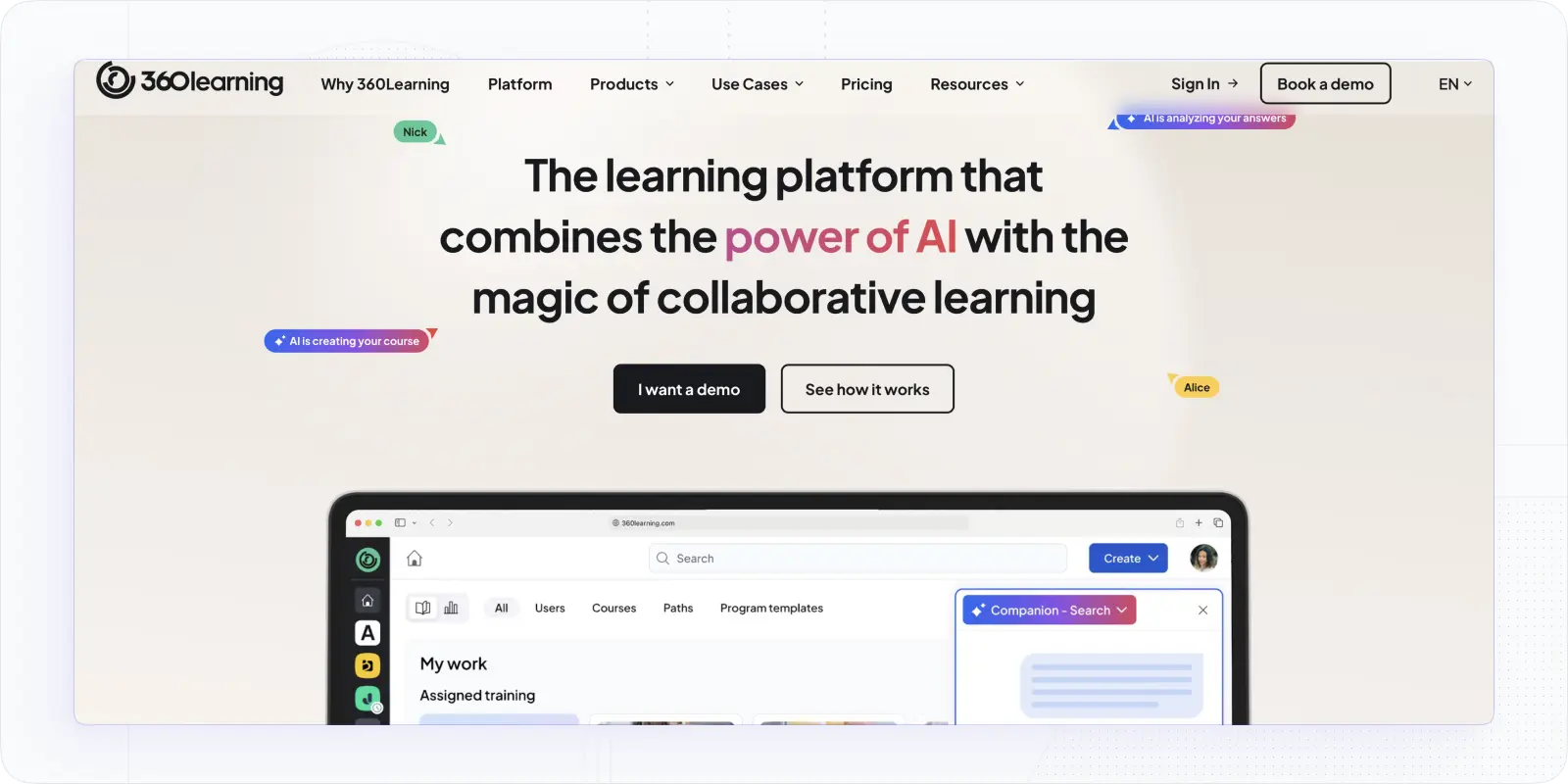
360Learning is a collaborative learning platform with powerful LMS and LXP features to support peer-driven learning, fast course creation, and training management.
Unlike Docebo, 360Learning puts internal knowledge sharing at the center of training, helping teams co-create courses and respond quickly to skill gaps.
Best for: onboarding and employee training in mid-sized and large organizations.
Key features of this Docebo alternative:
- AI-powered tools. With the AI features 360Learning provides, trainers support outline and course creation as well as quiz generation.
- Collaborative tools for sharing and editing. One of the key 360Learning’s strengths lies in collaborative features like forums, learning needs, comments, shared editing, and knowledge sharing.
G2 review and rating: “The platform's design is exceptionally user-friendly… Yet, I feel the current learning content is somewhat limited. I wish there was a broader range of topics…” – 4.6/5
Pros
- Intuitive platform offering fast and easy content creation with built-in AI tools
- Supports effective peer learning and collaboration, provides collaborative editing
- The mobile app supports the frontline and remote team
- Strong group-based user management
Cons
- Reporting lacks depth
- Pricing is pretty high
- Advanced features come with extra costs
Pricing: Team Plan starts at $8/user/month (up to 100 users); Enterprise pricing is available upon request (annual commitment).
Final Thought on Best Docebo Alternatives: Picking The One
Docebo is more capable than ever — the April 2026 AgentHub release made its AI genuinely deep — but steep pricing, inflexible reporting, and a heavy admin experience still push mid-sized businesses toward Docebo LMS alternatives.
- There, if you prioritize ease of use, flexibility, and cost efficiency, EducateMe should be your first choice, offering AI-native course creation, roleplay practice, and white-label portals — with pricing you can read without a sales call.
- If skill development is at the center of your training process, Cornerstone On Demand and Bridge LMS provide serious tools for performance management and upskilling, while eFront provides powerful customization.
- For content-rich experiences, Tovuti and 360Learning shine with their interactive and collaborative features.
- Lastly, LearnUpon, TalentLMS, and Litmos stand out with their intuitive navigation and easy day-to-day use — TalentLMS is the budget pick when speed matters more than depth.
If you are still in doubt, book a demo and find out how you can use EducateMe for your learning needs and training strategies.
Frequently asked questions
EducateMe is the strongest pick for teams that want AI built into course creation, practice, and analytics, with published pricing from $239/month. 360Learning fits companies built on collaborative, peer-driven learning, and Absorb LMS suits enterprises with heavy compliance needs. Most Docebo switchers are mid-sized teams that no longer want enterprise overhead — match the tool to that reality, not the feature list.
Docebo's main competitors are Cornerstone OnDemand and Absorb LMS at the enterprise end; LearnUpon, Bridge, and 360Learning in the mid-market; and TalentLMS on budget. Litmos, Tovuti, and eFront compete in specific niches like commerce-driven or multi-tenant training. Which one wins depends on whether you're leaving Docebo over price, complexity, or reporting.
For large enterprises running skills programs across thousands of employees, often yes — especially after the April 2026 AgentHub release added AI agents and skills intelligence. Contracts typically start around $16,000 per year, and add-ons raise that quickly. Teams under roughly 1,000 employees usually pay for depth they won't use, which is why mid-sized companies shortlist alternatives first.
Yes. SCORM and xAPI packages move directly, and learner records export as CSV. Courses built in Docebo's native editor need rebuilding, though AI authoring tools make that fast — EducateMe generates courses from your existing documents and includes white-glove migration on its Scale plan. Plan two to four weeks for a typical switch, and run both systems in parallel for one cycle.