
Top 7 Franchise Training Software For Your Business

By Roman GryshukRoman GryshukCorporate Training Expert & Content EditorHi, I’m Roman, a content specialist with over 5 years of experience in content writing and marketing. At…Read more
Corporate Training Expert & Content Editor
13 min read
If you're running training out of a shared Google Drive folder for 15 locations, you already know where this breaks down: one franchisee gets the updated safety protocol, three don't, and nobody can prove who saw what when corporate asks. I've watched this exact scenario play out with L&D teams more times than I can count, and it's the reason franchise training software exists as its own category instead of "just use whatever LMS HR already has."
The stakes here are bigger than one bad onboarding week. The International Franchise Association's 2026 economic outlook puts total US franchise establishments at roughly 845,000, supporting close to 8.9 million jobs. At that scale, training inconsistency isn't a minor inconvenience — it's a brand-protection and compliance problem.
Meanwhile, ATD's 2026 State of the Industry report found companies spent an average of $846 per employee on direct training in 2025, using 16.7 formal learning hours per person.
Franchises are competing for a slice of that budget against every other people-development priority, which is exactly why the right franchise training LMS needs to earn its keep fast.
What Franchise Training Software Actually Needs to Handle
A franchise training with LMS covers whatever training a franchisor delivers to franchisees and their staff under the franchise agreement — brand standards, service protocols, product knowledge, compliance requirements. Franchise training software is the system that runs that program: it centralizes content, tracks who's completed what, and keeps every location working from the same playbook.
Four use cases show up in almost every franchise training brief I've reviewed:
- Standardized training: every location needs the same brand guidelines, service protocols, and safety standards delivered the same way, whether that's a five-location regional chain or a 200-unit national brand.
- Partner and employee onboarding: franchise owners and their staff need a fast, repeatable onboarding path (self-paced modules, instructor-led sessions, or a mix of both) that doesn't require a corporate trainer flying to every new location.
- Compliance and certification: food safety, workplace safety, data handling — whatever regulations apply to your industry, you need proof that every location met them, not just a verbal assurance from a manager.
- Ongoing training and performance improvement: new products, updated sales scripts, seasonal promotions. Without a system built for this, updates either don't reach the field or reach it three weeks late.
Key Features to Look for in Franchise Training Software
Based on those four use cases, here's what I'd actually check for before signing a contract:
- Multi-tenant architecture: separate training portals per franchisee, region, or department, so you can assign the right courses to the right group without building seven different systems.
- Compliance and certification tracking: automated assignment, renewal reminders, and reporting that holds up if a regulator or franchisee ever asks for proof.
- Mobile-friendly delivery: most franchise employees are frontline and deskless — if training doesn't work on a phone during a shift, it won't get done.
- Customizable learning paths and integrations: role-based paths for owners, managers, and frontline staff, plus the ability to connect the tools you already use for HR and communication.
- Advanced reporting and analytics: real-time completion rates and engagement data by location, so you can spot the underperforming unit before it becomes a bigger problem.
| Platform | Best for | Multi-tenant / multi-brand | Starting price |
|---|---|---|---|
| EducateMe | Multi-tenant, AI-native franchise training | Yes | $239/mo (Pro plan) |
| TalentLMS | Gamified training with branch management | Yes | Free plan for up to 5 users; paid plans from roughly $149/mo |
| CYPHER Learning | Global, multi-language franchise training | Yes | Custom quote |
| Litmos | Fast, simple rollout with a large content library | Yes | Available on request |
| Kallidus | Compliance tied to performance management | Yes | Custom quote |
| 360Learning | Collaborative, peer-authored training | Yes | From $8/user/mo (Team plan) |
| iTacit | Mobile-first training for frontline staff | Yes | Custom quote |
#1. EducateMe: Multi-Tenant Franchise Training Built Around AI
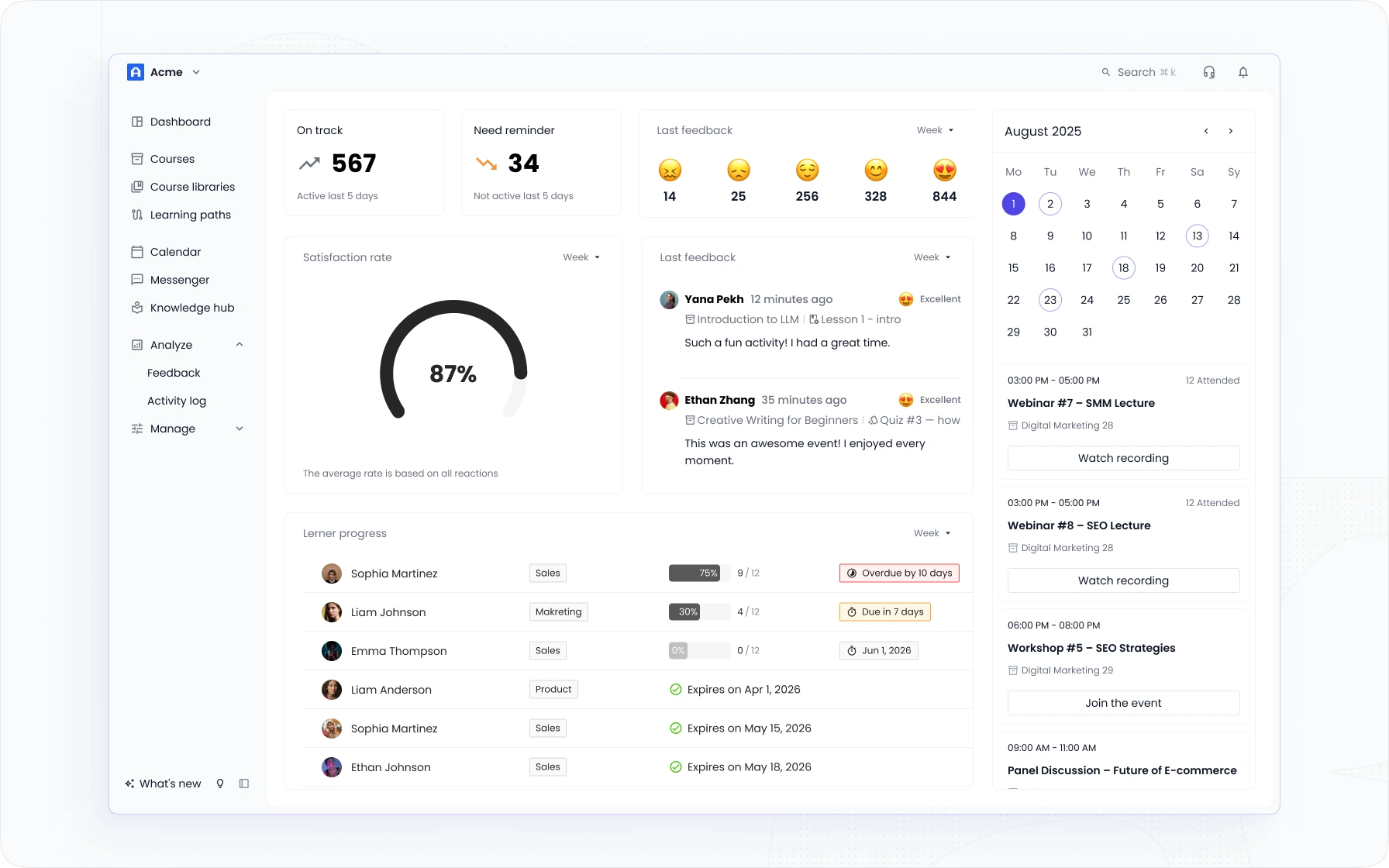
I ranked EducateMe first because it's the only platform on this list with AI built into most of the training workflow — course creation, roleplay practice, and knowledge search are native. The AI Assistant builds a full course from a prompt, URL, or file, and the AI Roleplay Coach runs scored practice scenarios for franchisee and frontline staff. Multi-tenancy rounds it out with separate branded portals per location, franchisee, or region, all managed under one account.
Key features for franchise training
- Multi-tenant portals: separate training spaces per location, franchisee, or region under one account.
- Smart automation and AI assistance: automate course enrollments, scheduling, reminders, and content generation thanks to triggers and AI tools.
- AI Roleplay Coach: scored practice for sales, service, and onboarding conversations, no regional trainer required.
- Real-time analytics: 10+ metrics to spot which location is falling behind.
- Auto-enrollment: by role, location, and seniority, live in under an hour.
Where it's strong: AI-native tools that go deeper than a chatbot, fast setup, and pricing that adjusts as you add locations.
Where it's not: no dedicated mobile app, limited gamification, and some integrations take setup time.
#2. Talent LMS: Gamified Training with Branch Management
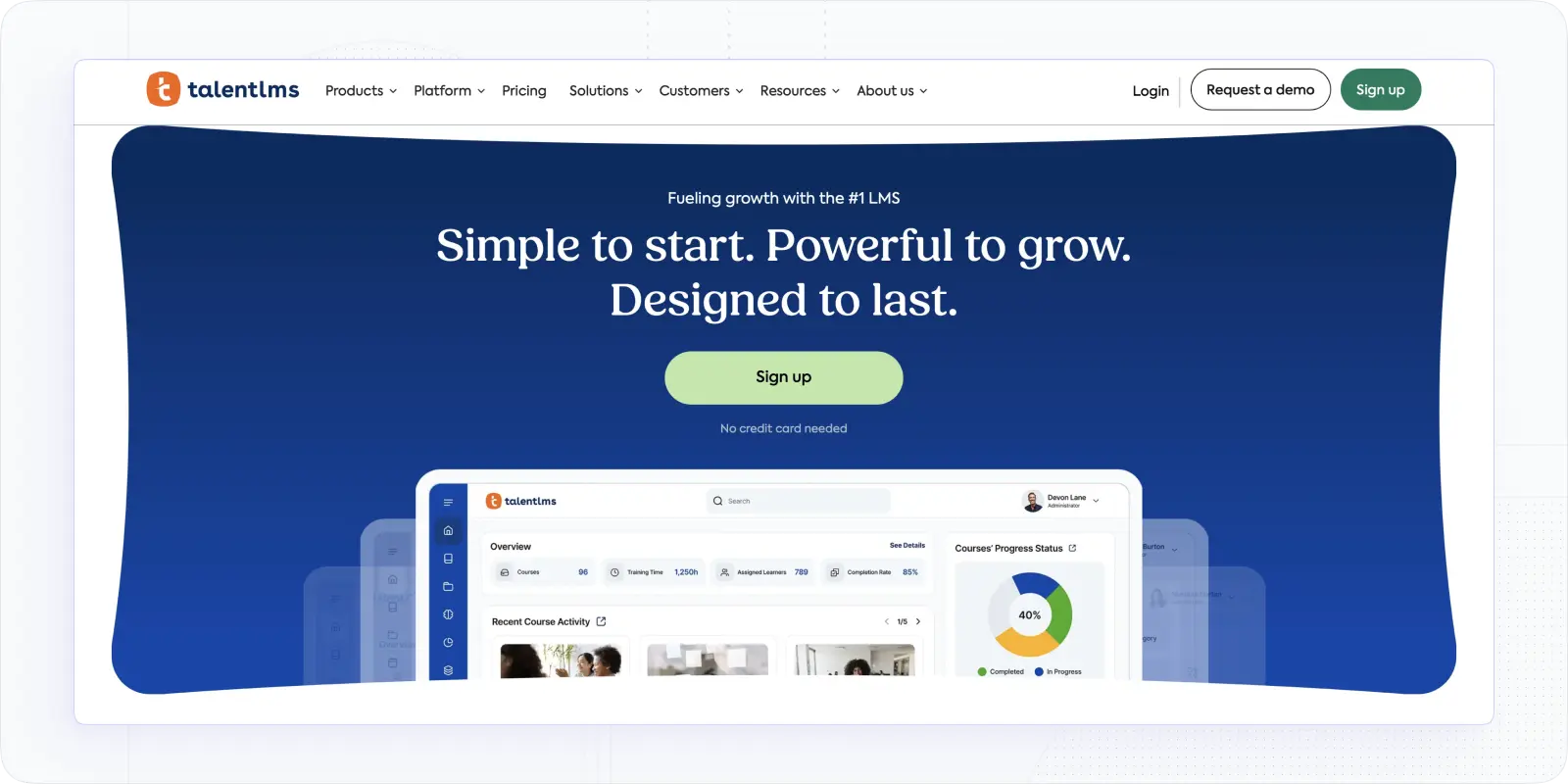
TalentLMS is the one I'd point to if engagement is your bigger problem than compliance. Branch management lets you create separate portals per franchise location, each with its own branding, and the gamification layer (points, badges, leaderboards) does real work getting frontline staff to actually finish courses instead of abandoning them halfway.
Key features for franchise training
- Branch management: separate learning portals per franchise team, each with its own branding and course assignments.
- Gamification: points, badges, and leaderboards built specifically to drive completion.
- TalentCraft AI course creator: turns a prompt or an existing document (PDF, deck, doc) into a structured course with quizzes, and can auto-translate a course into another language for multi-region franchisees.
- Custom reporting: a training matrix, activity logs, and custom reports for tracking compliance and performance.
Where it's strong: genuinely strong gamification, solid branch customization, wide content variety through the course store.
Where it's not: social learning tools are fairly basic, and pricing climbs quickly — each additional branch requires a higher-tier plan.
Pricing: a free plan covers up to 5 users; paid plans start around $149/month, with higher tiers required for more branches or users.
#3. CYPHER Learning: Multi-Language Franchise LMS
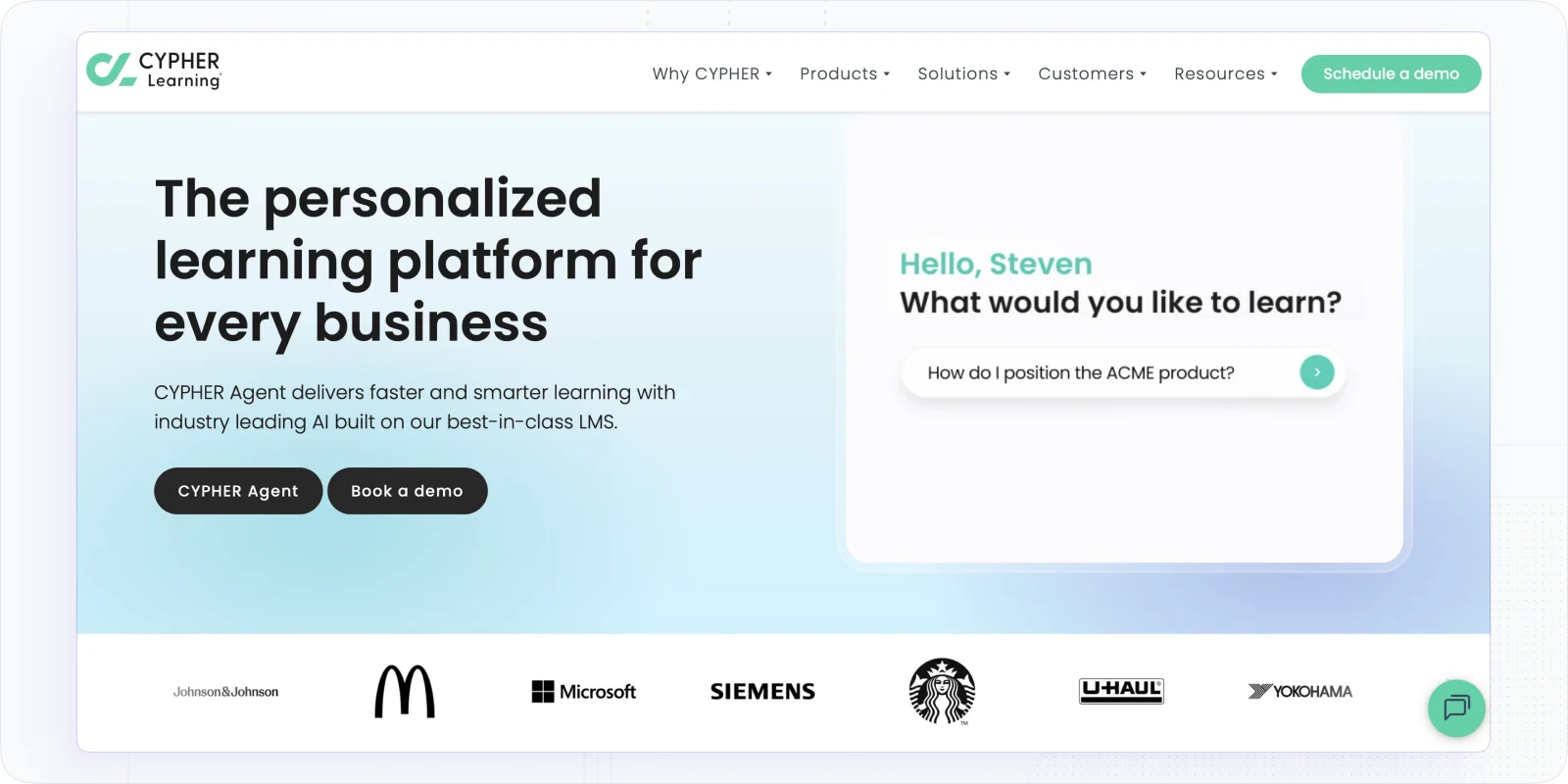
If you're franchising internationally, CYPHER Learning is worth a serious look — it's built AI and multi-language support into the core of the platform rather than bolting them on later. Skills-based training and automated content recommendations make it well suited to franchise systems that need to train in more than one language without maintaining separate content libraries.
Key features for franchise training
- AI-powered course creation: automates content development and skills mapping, then recommends courses to learners based on their profile and completion history.
- Multi-brand, multi-language support: separate portals with support for more than 50 languages.
- Gamification and social learning: badges, leaderboards, and discussion boards for engagement.
- Third-party integrations: connects with HR and CRM systems, plus content providers like LinkedIn Learning and Coursera.
Where it's strong: automation genuinely saves time on content creation, it's well suited to global franchise networks, and the third-party content integration is deep.
Where it's not: cost runs high for smaller franchise systems, and the learning curve is steep enough that some teams need real ramp-up time before they're using it well.
Pricing:offers custom pricing based on franchise size and training needs.
#4. Litmos: Simple and Easy-to-Use with Content Variety
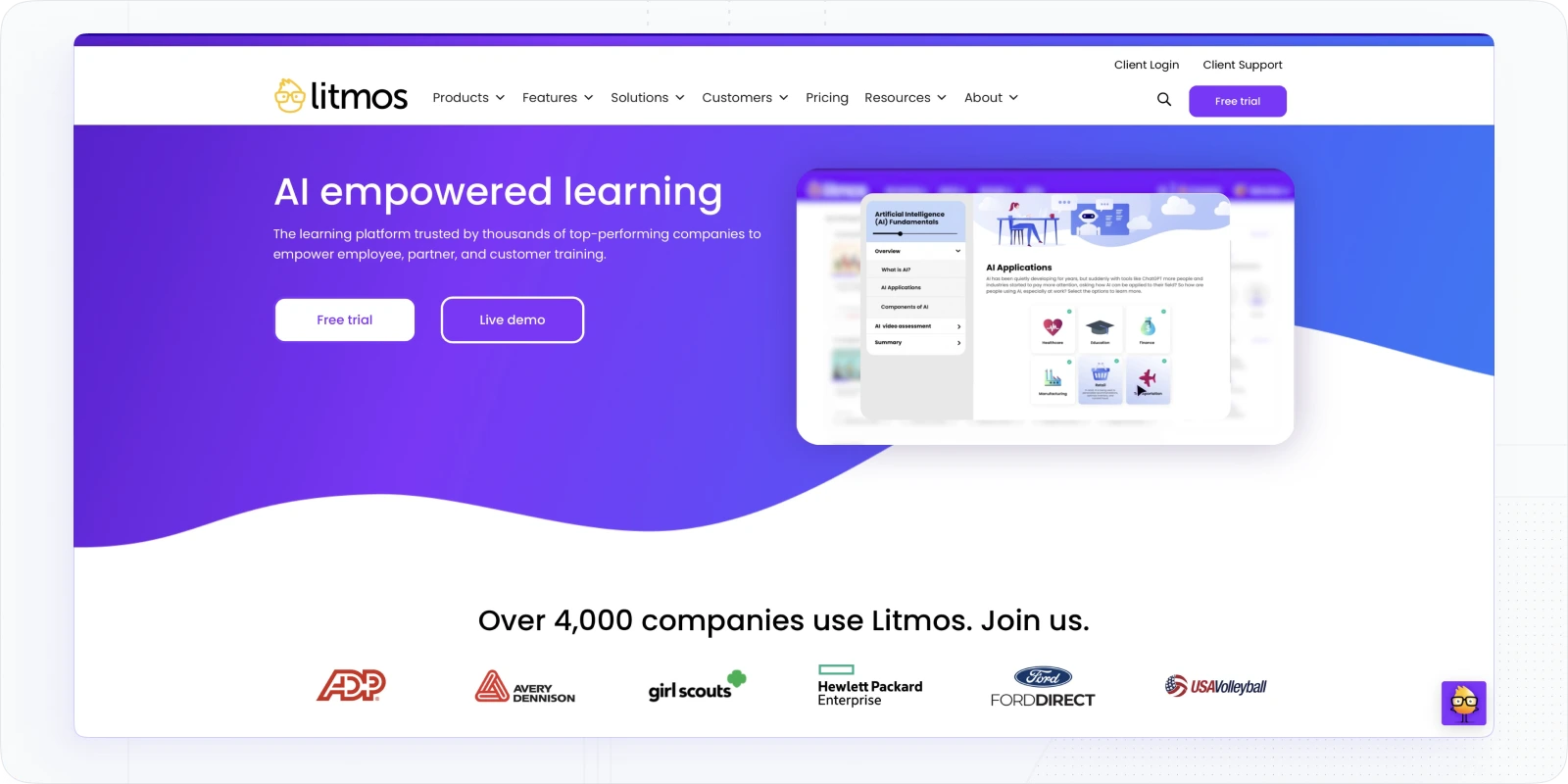
Litmos earns its spot here on pure ease of use. If your franchise system needs something a manager can set up without a training department behind them, this is the one I'd trial first — the content library alone covers a lot of ground you'd otherwise have to build from scratch.
Key features for franchise training
- Built-in content library: more than 2,000 training modules covering compliance, leadership, and soft skills.
- AI Assistant: answers learner questions using retrieval-augmented generation trained only on your own content, not the open internet — useful for franchisee-specific policy questions.
- AI video assessments: analyzes learner video submissions for tone, pacing, and keyword accuracy, so role-play and service-script practice gets scored without a manager watching every clip.
- AI content authoring: suggests structure, tone, and relevant material while you build a course.
Where it's strong: genuinely simple to use, a large pre-built course library, decent automation out of the box.
Where it's not: reporting is clunky and hard to navigate, and customer support response times can be slow.
Pricing: available only upon request
#5. Kallidus: Compliance Training LMS for Franchises
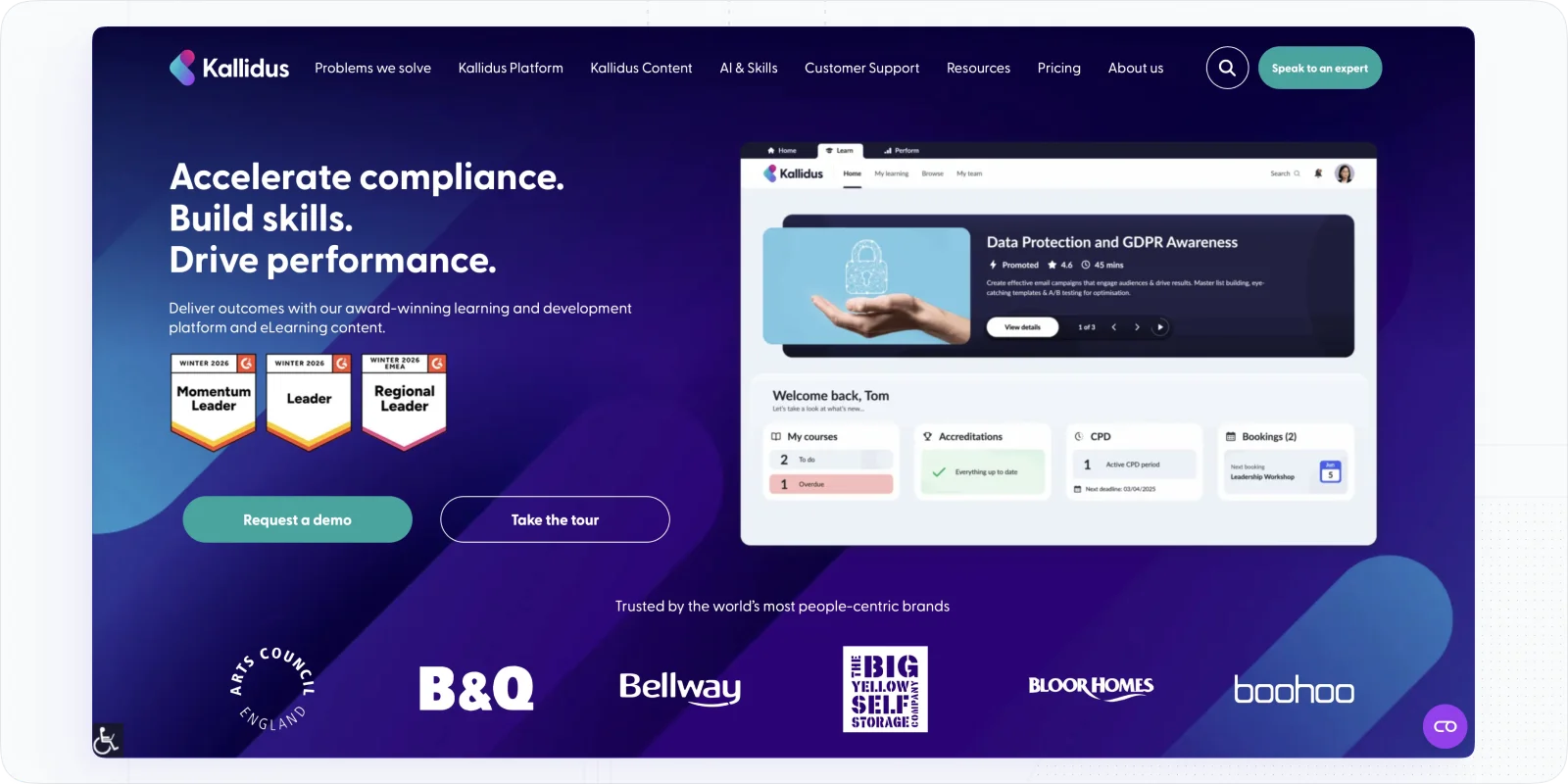
Kallidus is the pick for franchise systems where compliance and performance tracking need to live in the same system — it connects training completion directly to performance goals, which matters if you're trying to prove training actually changed behavior, not just checked a box.
Key features for franchise training
- Performance-linked training: connects training objectives to performance goals with shared progress tracking.
- AI Course Recommender: suggests relevant courses based on a learner's activity and what similar learners in other locations have completed.
- AI Skill Manager: builds skills taxonomies, tags content against specific skills, and feeds skills data into learner, manager, and admin dashboards.
- Reporting and analytics: dashboards, drill-down views, and Power BI integration for deeper analysis.
Where it's strong: a genuinely all-in-one solution for compliance and performance tracking, with solid automation and reporting.
Where it's not: pricing is steep enough that it suits larger businesses better than small franchise systems, customization is limited, and course-building tools are thinner than competitors'.
Pricing: starts at £300/mo (content only); £1,250/mo (Advanced plan with automation).
#6. 360Learning: Collaborative Course Creation for Franchise Teams
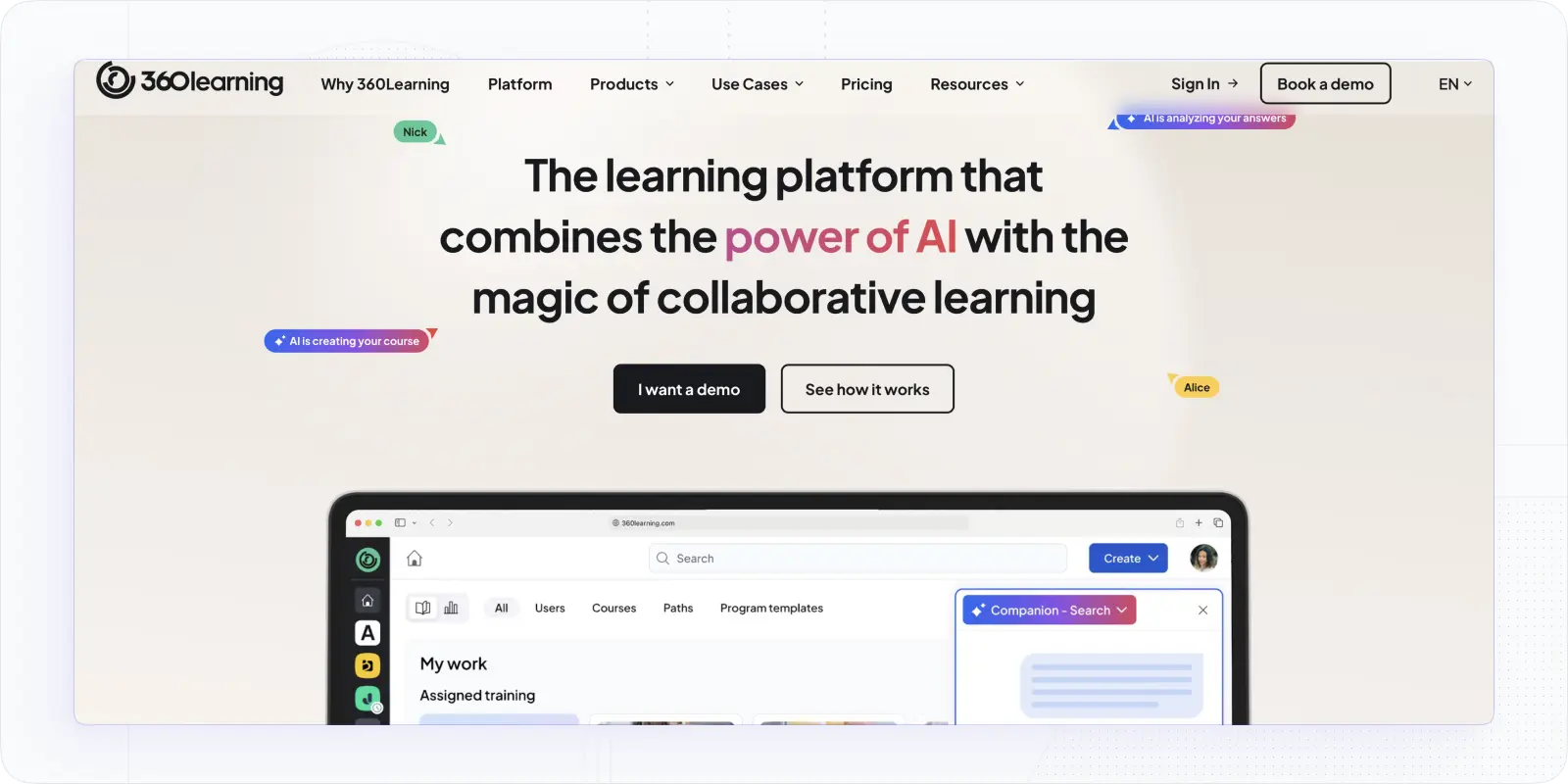
360Learning takes a different approach than the rest of this list: instead of a training team building courses top-down, franchisees and experienced employees co-author and update content together. For franchise systems where the best training material genuinely lives with your top-performing locations, that's a real advantage.
Key features for franchise training
- Collaborative authoring: franchisees and employees co-create and update courses together.
- AI Content Builder: turns a prompt or an existing document into a structured course, and generates quizzes and key takeaways automatically.
- AI Companion for admins: bulk-updates tags, ownership, and catalog settings across up to 500 courses at once — handy when a brand standard changes across every location's course library.
- Gamification and social learning: badges, leaderboards, video responses, and real-time feedback.
Where it's strong: genuinely strong collaborative tools for both admins and learners, solid engagement features, decent mobile learning.
Where it's not: reporting is limited compared to more analytics-heavy platforms, and pricing gets expensive as you scale past the entry tier.
Pricing: starts at $8/mo per user.
#7. iTacit: Comprehensive LMS with Automated Learning Paths
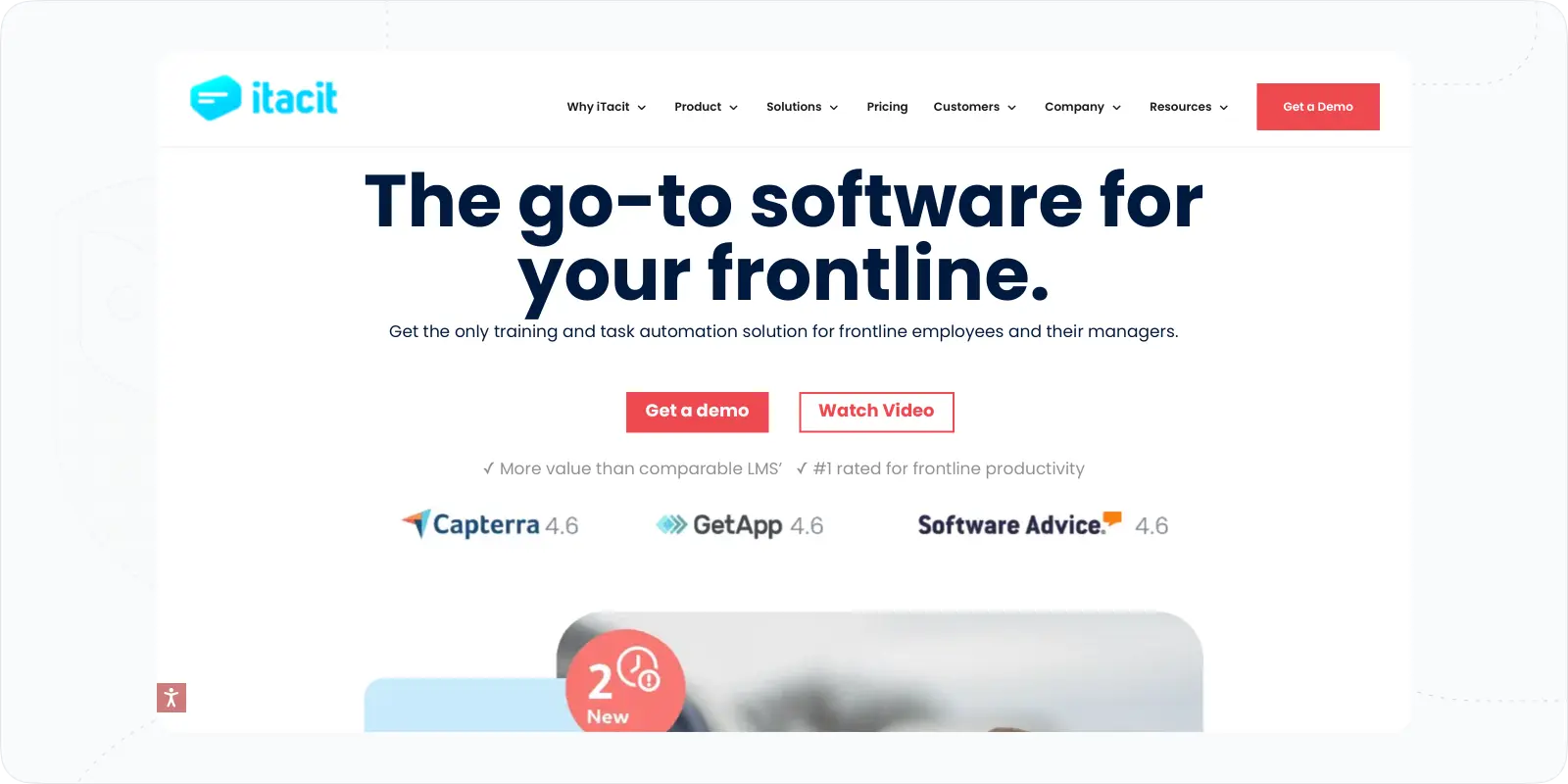
Even though iTacit works great as a frontline for online franchise training, it provides excellent features for franchises to handle onboarding, compliance, and skills development.
It’s possible due to interactive learning paths, automated tracking, and solid collaboration tools.
Moreover, it has great mobile learning capabilities, a social intranet in particular. At the same time, it provides great learning paths and an easy-to-use course builder with eLearning integrations.
Key features for franchise training
- Mobile-first delivery: a mobile app and internal hub that functions like an internal social feed.
- AI-powered frontline Q&A: lets a store associate or location manager ask a question by voice on their phone and get an answer pulled only from iTacit's own knowledge base, not the open internet.
- Compliance automation: automated mandatory-training assignment, certificate issuance, renewal reminders, and real-time tracking.
- Blended learning formats: supports in-person, virtual, and self-paced training, plus SCORM, AICC, and PowerPoint content.
Where it's strong: a genuinely strong mobile training app, solid automated compliance tracking, and decent content flexibility.
Where it's not: it's thinner on advanced course-building and collaboration tools, and the interface isn't as intuitive as some competitors'.
Pricing: custom pricing is available upon contact with a team.
How to Choose the Right Franchise Training LMS
1. Match the LMS to your role-based training needs. Before you shortlist anything, figure out what franchise owners, managers, and frontline staff each need to see. That determines how much admin-level customization you actually require. EducateMe and TalentLMS both handle role-based admin levels well; Kallidus stands out if you specifically need training tied to performance goals.
2. Prioritize multi-tenant support over everything else. More franchisees means more training spaces, which means you need multi-location support, custom branding, and separate portals from day one — not as a future upgrade. Retrofitting multi-tenancy onto a platform that wasn't built for it is a bigger headache than switching platforms later.
3. Decide how much engagement and gamification you actually need. Some franchise training is genuinely just compliance — clear, simple, and done. If that's your situation, don't overpay for gamification you won't use. If retention and completion rates are a real problem, 360Learning's collaborative tools and EducateMe's peer-review and feedback features are worth the extra attention.
4. Confirm compliance and automation are built in, not bolted on. TalentLMS, Litmos, and CYPHER Learning all ship with sizable pre-built compliance course libraries you can adapt rather than build from zero.
5. Insist on real-time reporting. You need to see completion rates, engagement, and compliance status by location — not a monthly export you have to reformat yourself. This is where you'll actually catch the underperforming location before it becomes a support or compliance issue.
Which Franchise Training LMS Is Right for You?
Franchise training needs vary enough by industry and business model that there's no single universal answer here. Regulated industries need stricter compliance tracking; fast-growing franchise systems care more about onboarding speed and engagement.
Grouping the seven platforms above by what they're actually built for:
- EducateMe and CYPHER Learning are the strongest fit for scalable, multi-tenant training across medium and large franchise systems with diverse teams and locations.
- TalentLMS and 360Learning lean into engagement and collaborative course development — a good match if knowledge-sharing and content scale are your priority.
- Litmos, Kallidus, and iTacit prioritize compliance automation, certification tracking, and structured learning paths, which suits regulated industries and franchise systems with strict training standards.
If you're managing training across 10 or more locations and need a system that scales without turning into a second full-time job, EducateMe's corporate training platform is built around exactly that multi-tenant use case.
Frequently asked questions
Franchise training software is an LMS built to deliver consistent training across multiple franchise locations from one central system. It typically includes multi-tenant portals so each location gets its own branded space, plus compliance tracking, certification management, and reporting that shows completion rates by location. Platforms like EducateMe handle this through separate portals per franchisee under one account.
Pricing varies widely by platform and franchise size. Entry-level plans start around $8-12 per user per month for smaller systems, while enterprise-grade platforms with deeper compliance and analytics features typically move to custom, quote-based pricing once you're managing dozens of locations. Always ask what's included per location before comparing sticker prices.
A franchise training LMS is built around multi-tenant architecture (separate branded portals for each franchisee, region, or team) while a standard corporate LMS usually assumes one company, one set of employees, one training library. Franchise-specific platforms also weight compliance and certification tracking more heavily, since franchisors need proof that every location met required standards, not just their own staff.
Most platforms can get a first location live within days once content is uploaded, though full multi-location rollout depends on how much content you're migrating and how many roles need separate paths.