
10 Best AI Tools for Employee Onboarding in 2026

By Alexa BerezinaAlexa BerezinaL&D Specialist & CSM LeadMy name is Oleksandra (Alexa), and I’m a certified Learning & Development specialist focused on turning complex knowledge…Read more
L&D Specialist & CSM Lead
9 min read
Onboarding is where most companies lose new hires before they've really started. According to Gallup, only 12% of employees strongly agree that their organisation does a great job onboarding, and I'd argue the problem isn't effort, it's tooling. Most HR teams are still stitching together spreadsheets, email chains, and PDF handbooks and calling it an onboarding process.
The right AI onboarding tool changes that. Not by adding more steps, but by automating the repetitive ones, personalizing the experience for every new hire, and giving HR real visibility into what's actually happening in those critical first few months.
I've split this list into two categories, because they solve different problems. The first five are AI-powered LMS platforms, where structured learning, course creation, and training delivery live. The second five are AI HR and onboarding workflow tools, where process automation, document management, and new hire engagement happen. Most teams need something from both categories.
What to Look for in an AI Onboarding Tool
Before comparing platforms, it's worth being clear about what separates a good AI onboarding tool from an expensive checklist app.
The best tools don't just automate tasks like sending forms or scheduling meetings — they personalize the onboarding journey based on role, location, or seniority. They use AI to create and adapt training materials, provide instant answers to new hire questions, and flag completion gaps before they become performance issues.
I'd also pay close attention to compliance. If your team operates across multiple jurisdictions, the tool needs to handle compliance training delivery and documentation without requiring a full-time admin to chase it. And for any platform dealing with employee data, SOC 2 certification isn't optional — it's the baseline.
Part 1: Best AI-Powered LMS Platforms for Employee Onboarding
A learning management system handles the content side of onboarding — the structured training paths, compliance modules, role-specific courses, and the data that tells you whether any of it is actually landing. These five do it with AI built in, not bolted on.
1. EducateMe
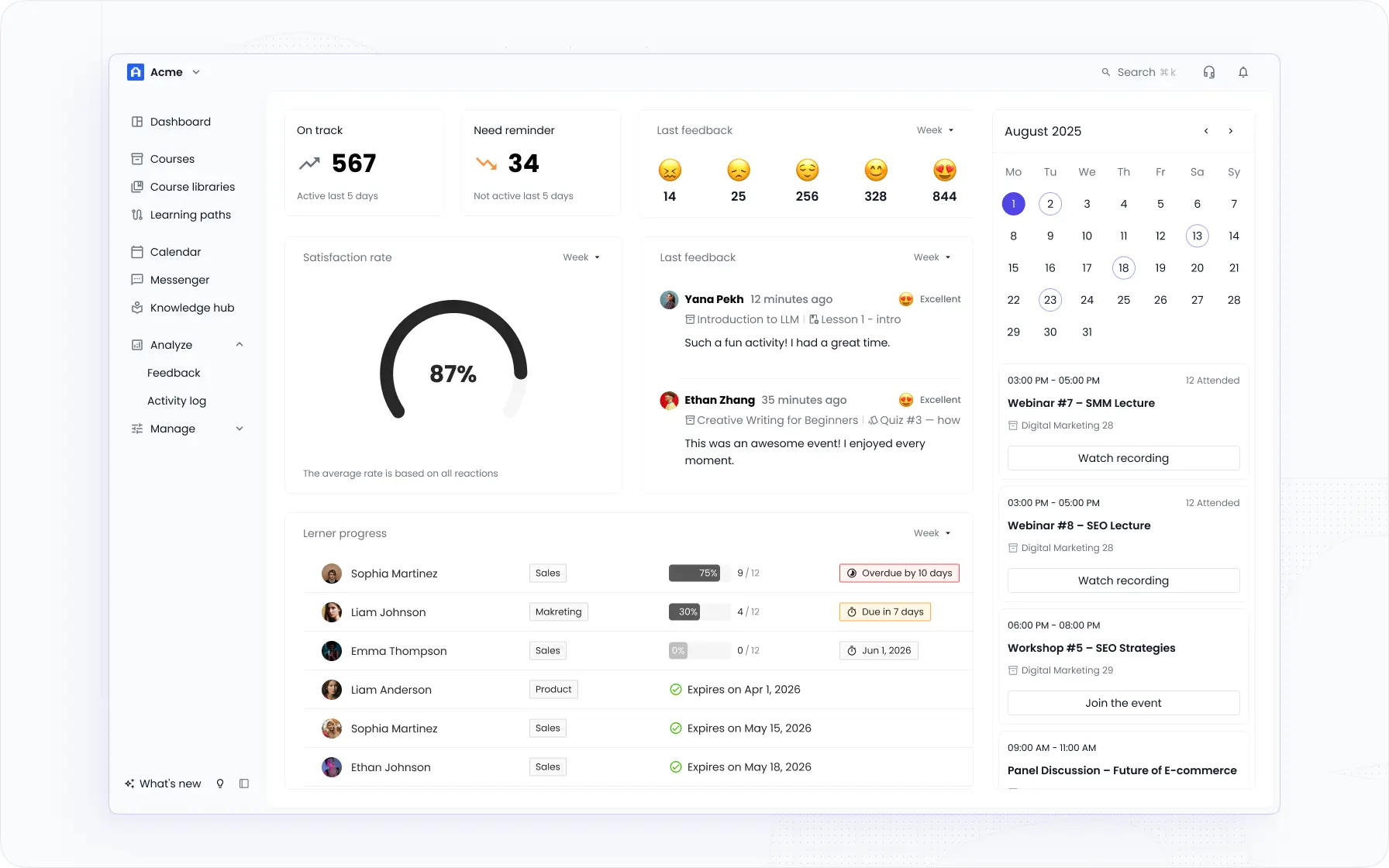
EducateMe is an AI-powered LMS built specifically for employee onboarding and structured training across roles and departments. Its AI Assistant generates complete course content from a prompt, a URL, or an uploaded file, reducing course creation time by 3x. I'd recommend it first for mid-sized teams that need to launch a complete onboarding program fast, without leaning on a dedicated instructional designer.
What sets it apart for onboarding specifically is the combination of auto-enrollment logic and the AI Roleplay Coach. New hires get automatically assigned to the right learning path based on role, seniority, or region, and for any role where communication or process matters (sales, customer success, support), the Roleplay Coach lets them practice real scenarios with rubric-based AI feedback before they're ever in front of a customer.
- AI Assistant — builds full onboarding courses from a document, URL, or text prompt in minutes; no instructional design background needed
- AI Roleplay Coach — new employees practice job-specific scenarios with consistent AI feedback, eliminating social risk during early skill development
- Auto-enrollment — automatically assigns onboarding paths by role, seniority, or department without HR manual intervention
- Analytics dashboard — tracks completion rates, skill gaps, and individual progress across every new hire cohort
- White-label portals — supports separate branded environments per department or client under a single account
Best for: Mid-sized companies (100–1,000 employees) running structured onboarding across multiple roles or regions. Especially strong for teams blending cohort-based and self-paced learning in a single programme.
2. TalentLMS
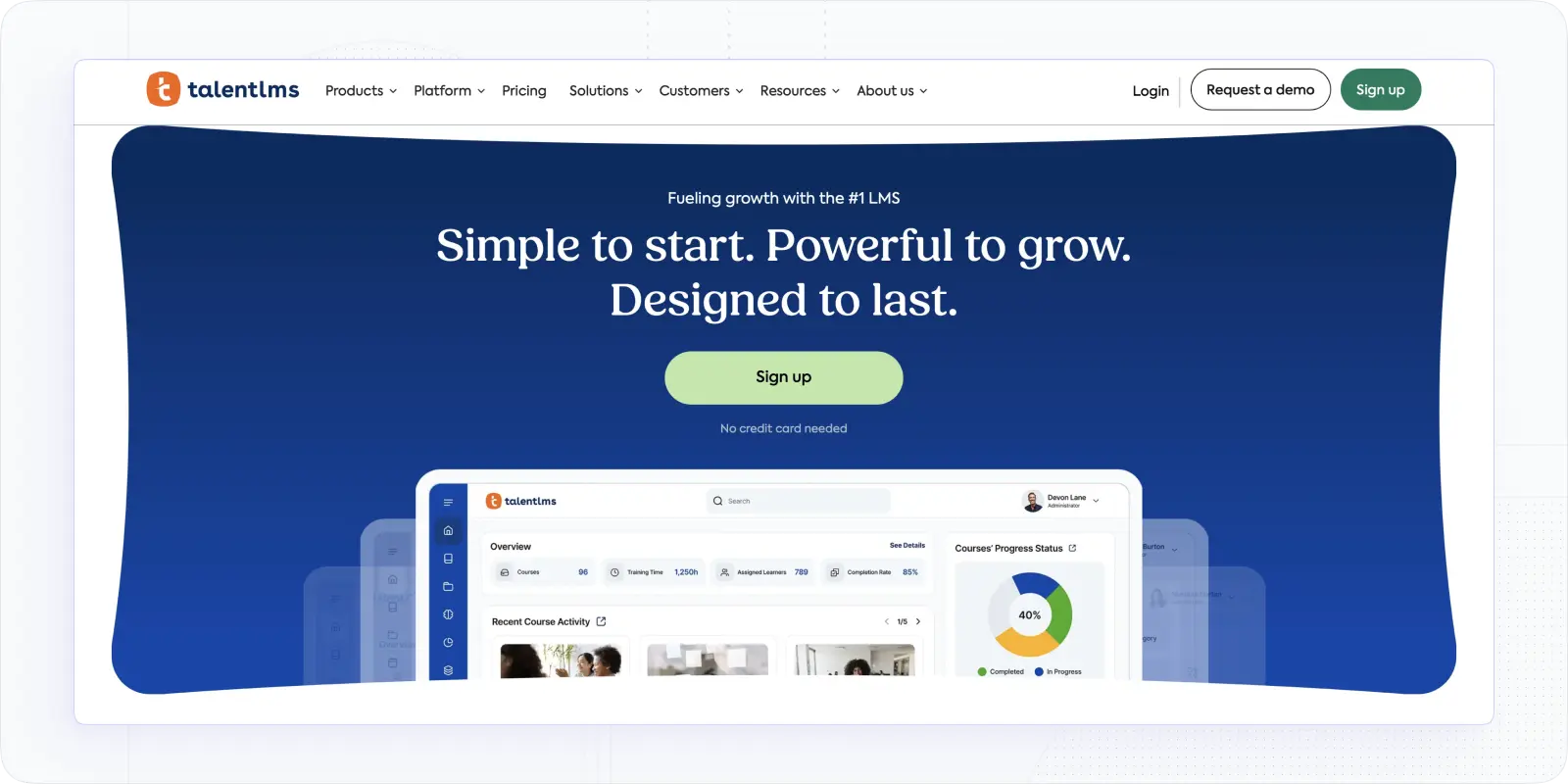
TalentLMS is one of the most widely deployed cloud LMS platforms globally, and its onboarding use case is well-established. It's not the most AI-powered onboarding tool on this list (its AI capabilities are more recent additions), but its strength is reliability and ease of setup. Most HR teams can have a basic onboarding program live within a day, which matters more than it sounds when you're hiring fast.
Its AI features focus mainly on content assistance and quiz generation rather than adaptive learning or automated path logic. For teams that already have onboarding content and need a dependable platform to deliver it at scale, TalentLMS earns its place.
- AI content assistant — helps draft course text, generate quiz questions, and restructure existing onboarding materials
- Branching learning paths — assigns different onboarding tracks by role, department, or location
- SCORM and xAPI support — imports existing e-learning content from any authoring tool without rebuilding from scratch
- Gamification — badges, points, and leaderboards to keep new hires engaged through compliance-heavy onboarding modules
- Reporting suite — tracks onboarding completion, time-on-course, and assessment scores per learner
Best for: SMBs and growing teams that want a proven, easy-to-configure LMS with solid onboarding delivery and budget-friendly pricing.
Pricing: Free plan available for up to 5 users. Paid plans from $149/month.
3. Absorb LMS
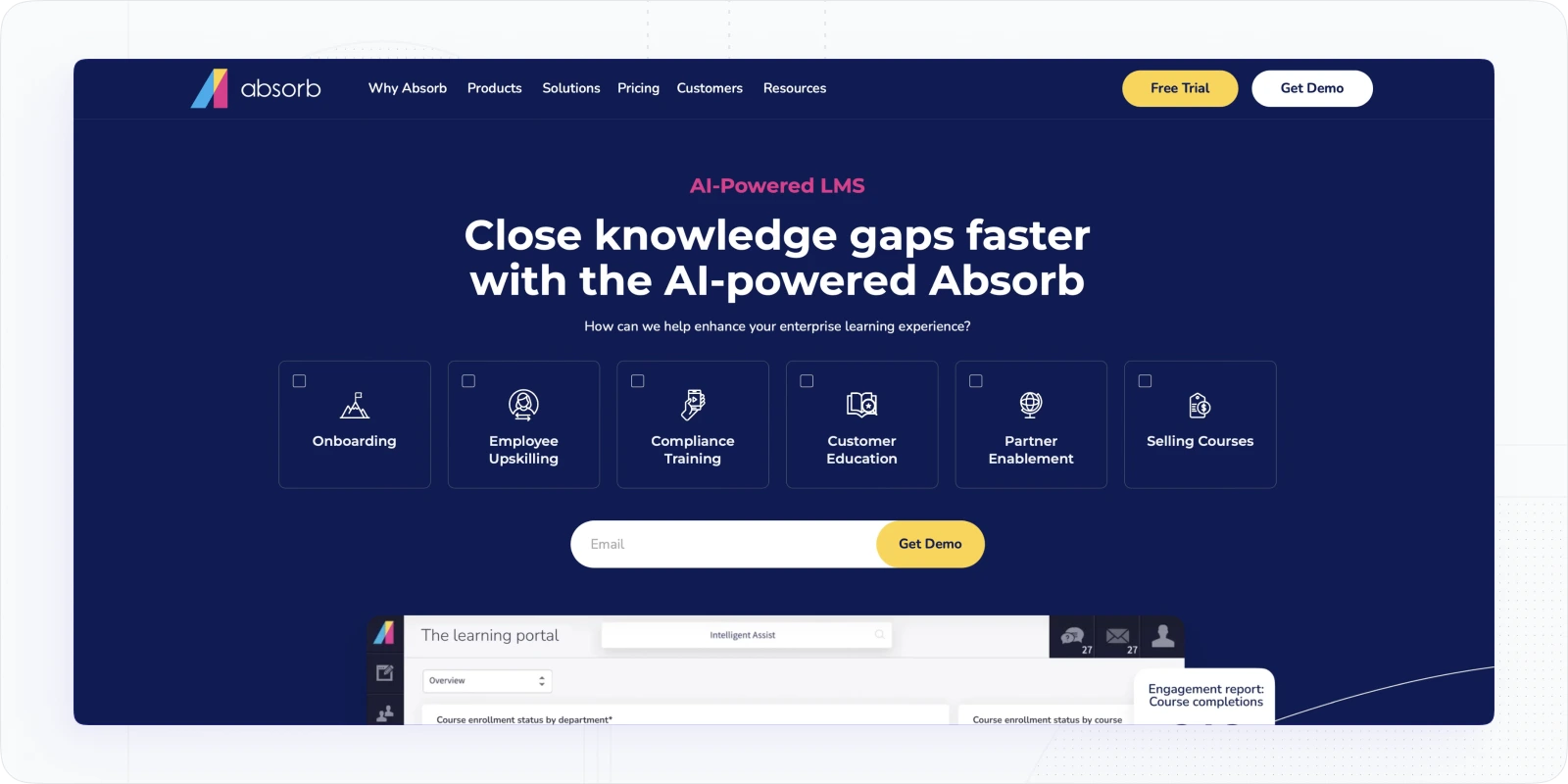
Absorb LMS sits in the mid-market to enterprise tier and positions itself around intelligent automation and learner engagement. Its AI capabilities include an "Intelligent Assist" feature that surfaces recommended content to learners, and its admin automation tools handle a lot of the repetitive course assignment and re-enrollment work that typically falls to HR. It's a mature product with a strong compliance training record.
Where I think it outperforms simpler tools is in reporting depth — Absorb's analytics are genuinely useful for L&D managers who need to report onboarding completion and skill development data upward to leadership.
- Intelligent Assist — AI-powered content recommendations delivered to learners based on role and previous activity
- Automated admin — automates onboarding task assignment, reminder sequences, and compliance re-enrollment without HR input
- eCommerce module — useful for organisations that monetise training externally alongside internal onboarding
- Custom learner portals — branded onboarding environments per department or business unit
- Advanced reporting — pre-built and custom reports for onboarding completion, engagement, and certification tracking
Best for: Mid-market and enterprise L&D teams that need deep analytics, compliance management, and scalable automation across large new hire cohorts.
Pricing: Custom pricing. Demo required for a quote.
4. Docebo
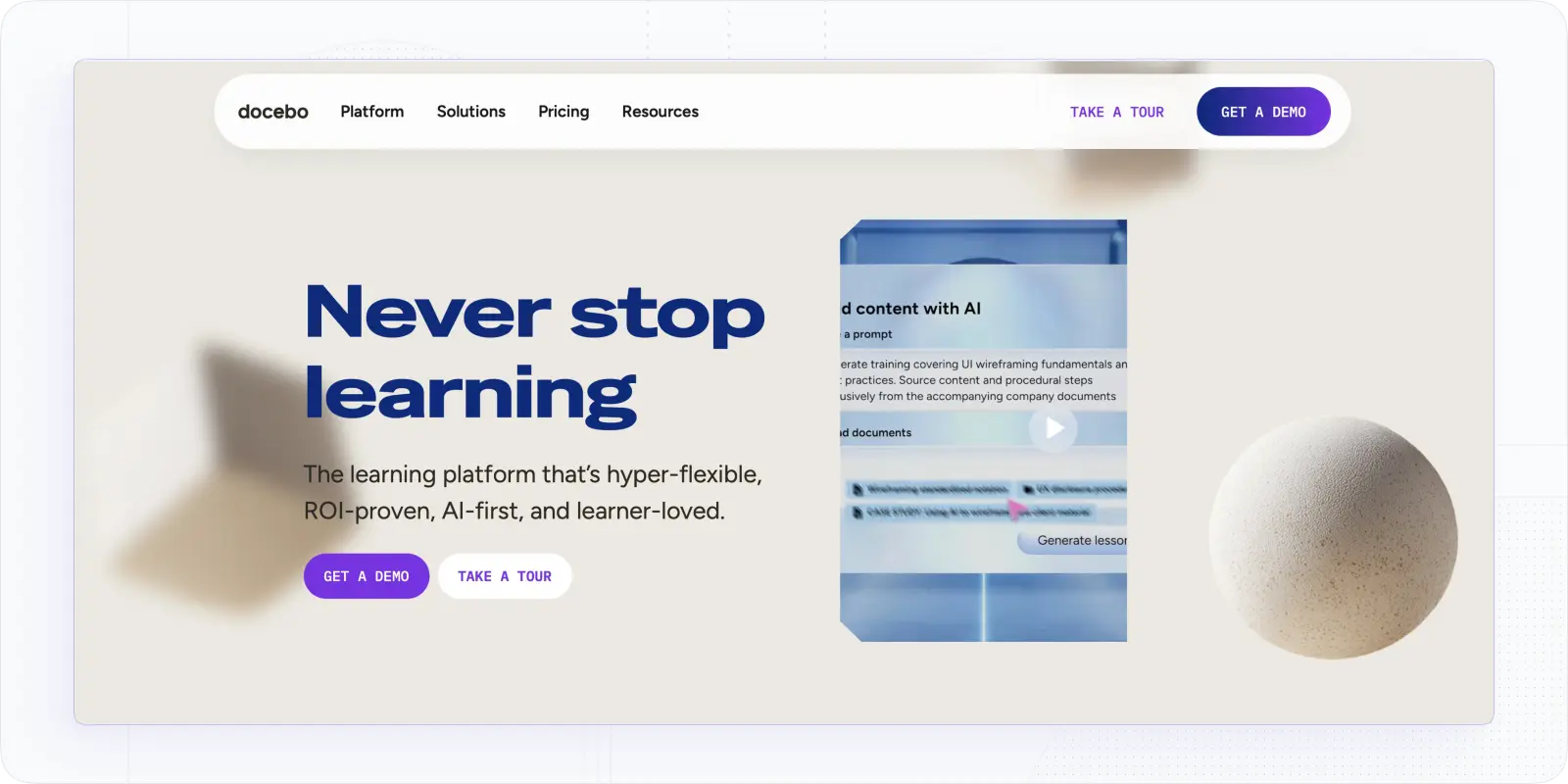
Docebo is an enterprise-grade LMS with some of the most developed AI capabilities in the learning platform space. Its "Learn" platform uses AI to surface relevant content, personalise learning flows, and power its social learning features. For large organisations running onboarding across multiple geographies and business units, Docebo's scale and integrations are hard to match.
That said — it's a heavy platform. Implementation takes longer than simpler tools, and its pricing reflects that enterprise positioning. I wouldn't recommend it for teams under 500 employees unless they have a dedicated L&D function and a clear migration plan.
- AI-powered content discovery — recommends onboarding content to new hires based on role profile and learning behaviour
- Shape (AI authoring) — generates onboarding course content from existing documents, slides, or web pages
- Social learning — peer learning channels, leaderboards, and collaborative exercises built into the onboarding experience
- Multi-audience portals — separate onboarding environments for employees, partners, and customers from a single platform
- Enterprise integrations — native connections with Salesforce, Workday, and major HCM platforms
Best for: Enterprise L&D teams (500+ employees) with a dedicated implementation resource and complex multi-audience onboarding requirements.
Docebo pricing: Custom. No free trial — demo required.
5. iSpring Suite
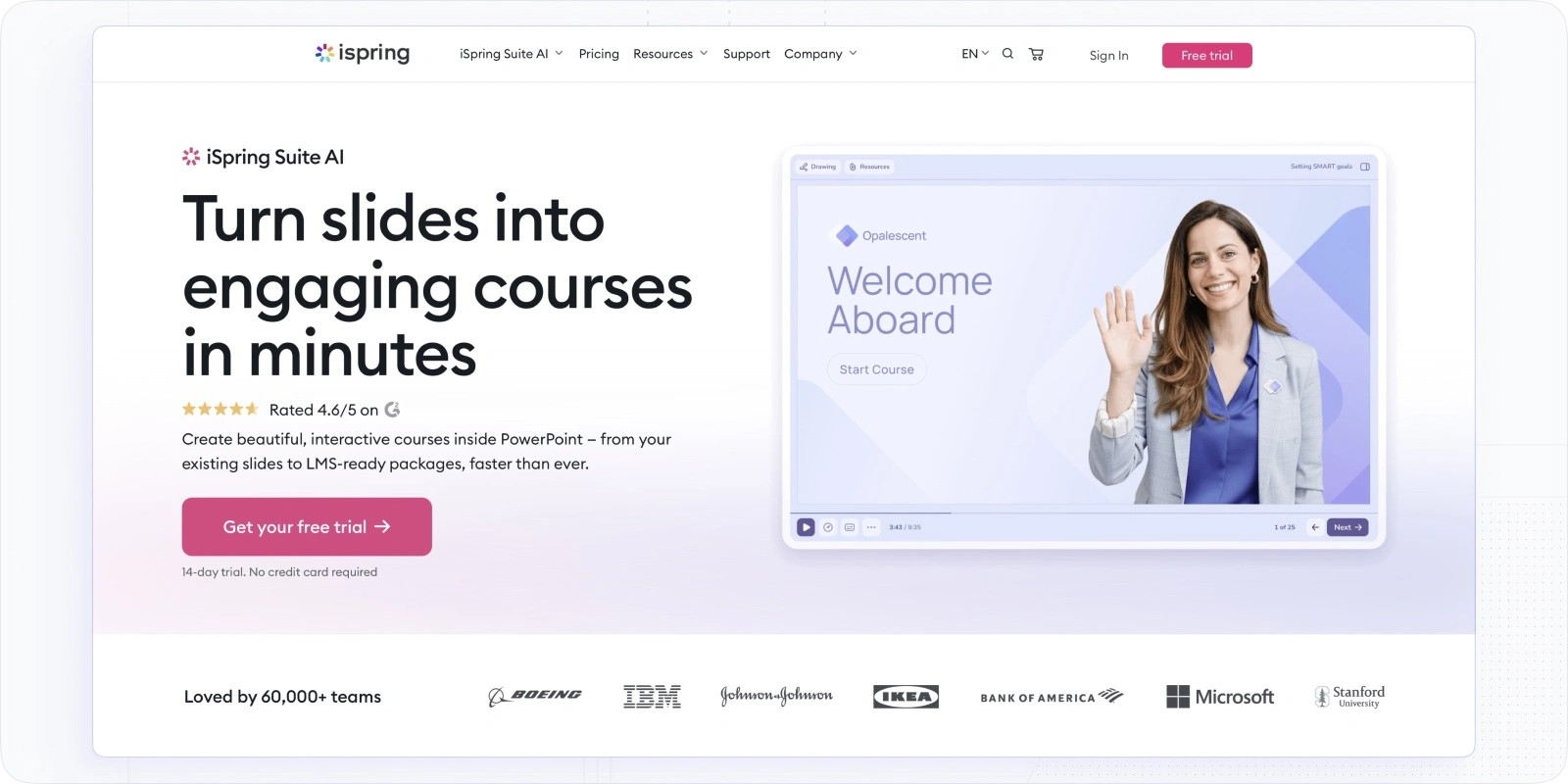
iSpring Suite is a course authoring tool with a built-in LMS component, and it deserves a place on this list because of how it handles onboarding content creation speed. It runs as a PowerPoint add-in, which means L&D teams that already live in PowerPoint can convert existing slide decks into interactive onboarding modules in under an hour. The AI features are newer (they assist with content writing and quiz generation) but the core value is the authoring speed.
For small-to-mid HR teams without dedicated instructional designers, this is often the most practical entry point into structured onboarding.
- PowerPoint-native authoring — converts existing slide decks into interactive onboarding courses with quizzes, branching, and audio voiceover
- AI content assistant — helps write and improve onboarding course text and assessment questions
- iSpring Space (cloud LMS) — delivers and tracks onboarding courses without needing a separate LMS platform
- Role-play simulations — builds dialogue-based scenarios for practising onboarding conversations or product knowledge
- SCORM export — publishes content to any third-party LMS if you outgrow iSpring's native delivery environment
Best for: SMBs and L&D teams with existing PowerPoint-based training materials who need a fast path to interactive digital onboarding.
Pricing: iSpring Suite from $790/author/year. iSpring Learn LMS from $2.99/user/month.
| Platform | Pros | Cons | Pricing |
|---|---|---|---|
| EducateMe | AI course creation, Roleplay Coach, auto-enrollment, strong analytics, fast setup | No native mobile app | From $239/month, 14-day free trial |
| TalentLMS | Easy setup, gamification, SCORM support, free plan available | AI features less developed than newer platforms | Free up to 5 users; from $149/month |
| Absorb LMS | Deep analytics, intelligent content recommendations, strong compliance tools | Higher cost; overkill for small teams | Custom |
| Docebo | Enterprise-grade AI, social learning, multi-audience portals | Heavy implementation; not suited for smaller teams | Custom |
| iSpring Suite | PowerPoint-native, fast content turnaround, good for content-rich teams | LMS component is basic; best as authoring tool | From $970/author/year |
Part 2: Best AI HR and Onboarding Workflow Tools
These tools don't deliver training content — they automate the processes around onboarding: task routing, document collection, new hire communication, and system provisioning. The distinction matters. An LMS handles what new hires learn; these tools handle everything that needs to happen before, during, and around that learning.
6. BambooHR
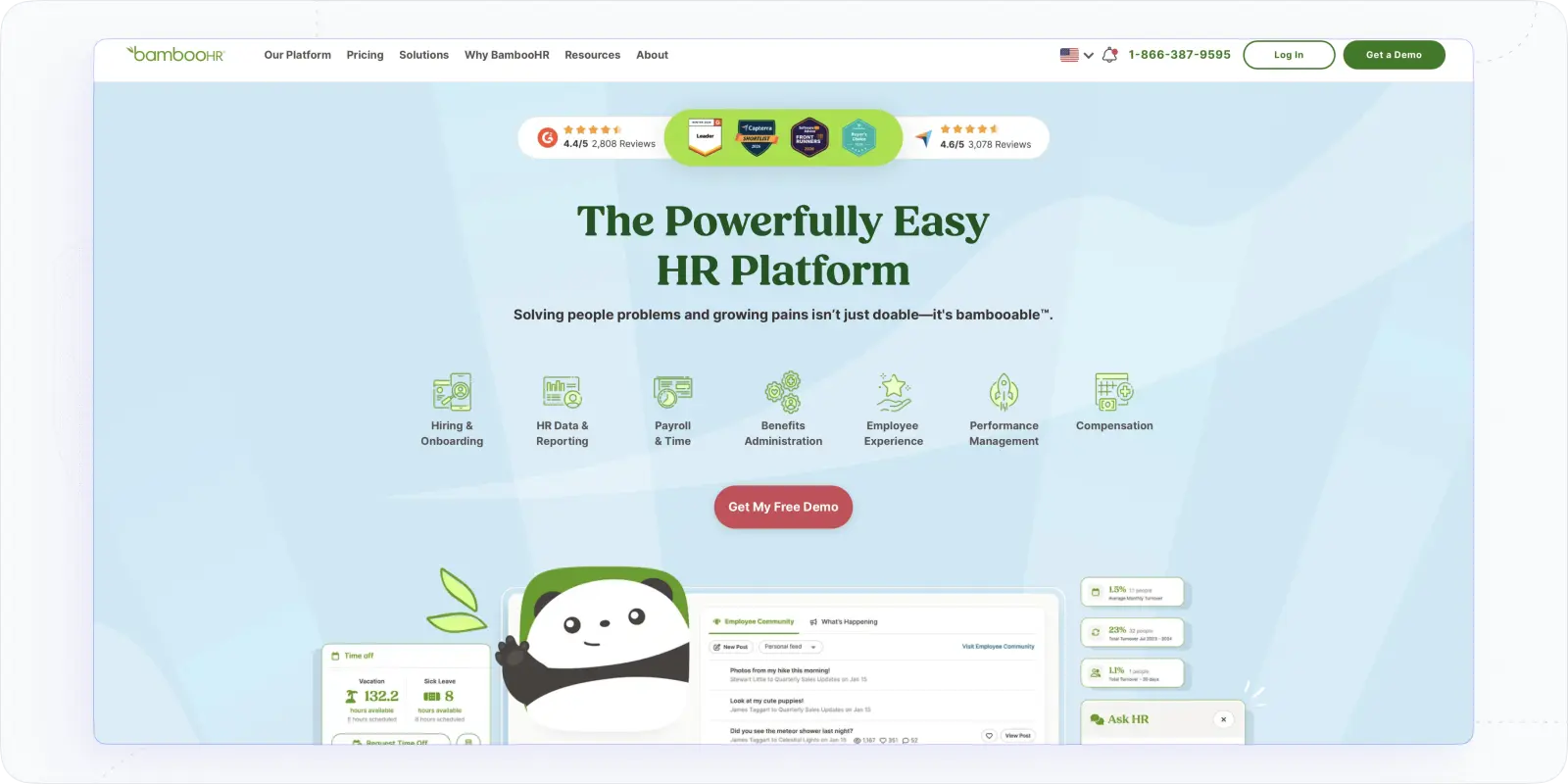
BambooHR is the most common entry point for HR teams building their first structured onboarding workflow. It's not the deepest AI tool on this list, but it handles the fundamentals reliably: sending welcome emails, collecting e-signatures, assigning onboarding tasks to HR and IT, and tracking completion. Its newer AI capabilities include predictive analytics that flag early attrition risk based on onboarding engagement patterns — which I think is one of the more genuinely useful applications of AI in HR right now.
For teams that want a dependable all-in-one HRIS with solid basic automation and don't need enterprise-scale complexity, BambooHR is usually the right call.
- Automated task assignment — onboarding checklists automatically routed to HR, IT, and hiring managers at the point of hire
- E-signature collection — gathers contracts, NDAs, and policy documents digitally without manual chasing
- Predictive analytics — flags retention risk based on onboarding completion and early engagement data
- Employee self-service — new employees complete their own profile, emergency contacts, and employee benefits selections independently
- Onboarding reporting — tracks completion rates and time-to-productivity across every new hire cohort
Best for: SMBs and HR generalists who need a reliable all-in-one HRIS with solid onboarding automation and a manageable learning curve.
Pricing: Custom pricing based on headcount. Free trial available.
7. Rippling
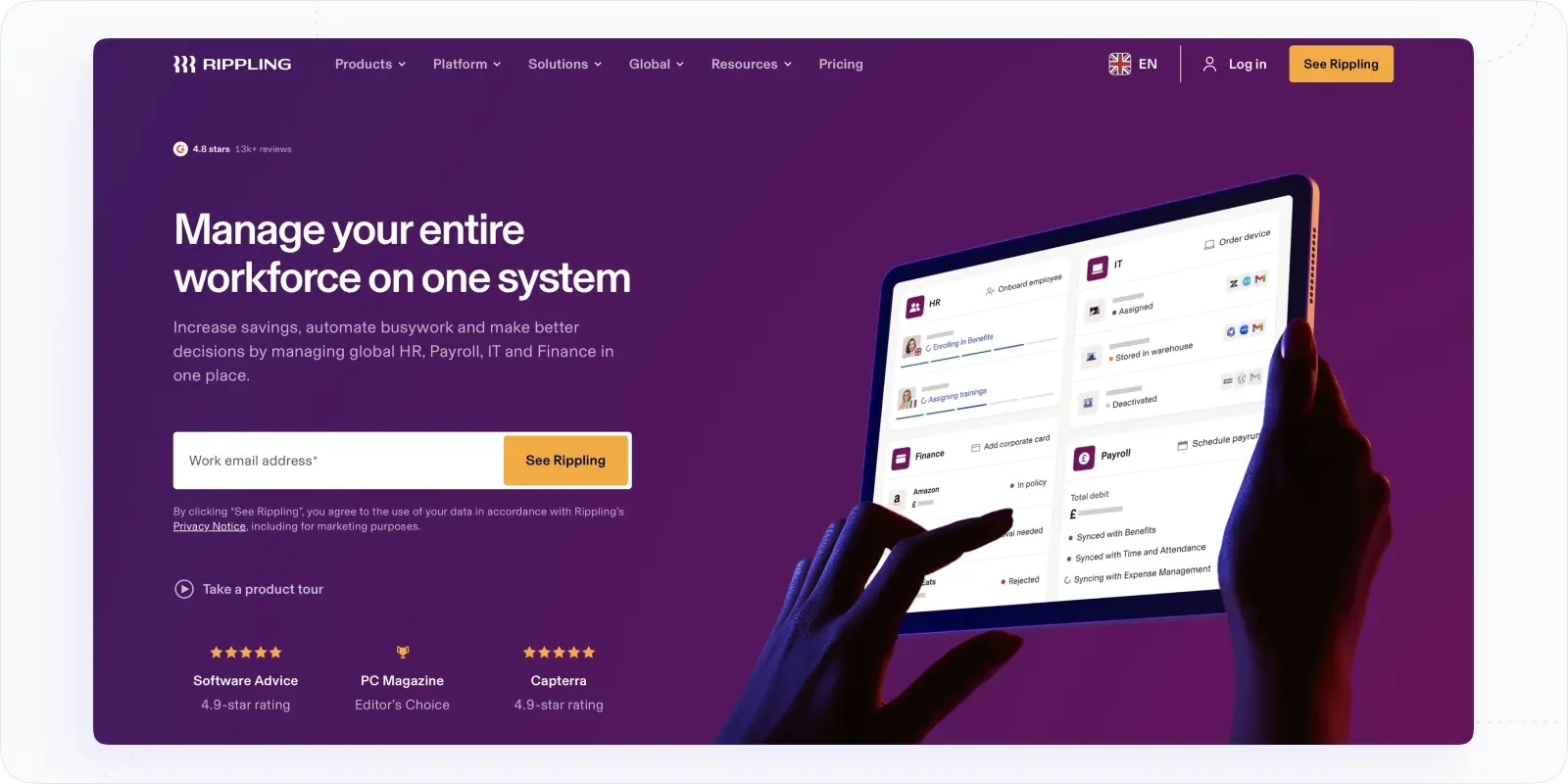
Rippling treats onboarding as both an HR and an IT problem — which, if you've ever waited three days for a new hire's laptop to be set up or their Slack access to come through, you'll immediately understand the appeal. The moment you create a new employee record, Rippling can provision their device, set up their software access, add them to payroll, and assign their compliance training, all through a single workflow. It's one of the few tools that genuinely makes IT and HR feel like the same onboarding process.
- Unified HR + IT provisioning — automates device management, app access, and payroll setup alongside HR onboarding in one workflow
- Process automation — workflow automation triggers across every department from a single hire event, no manual handoffs
- Compliance training — assigns compliance modules automatically based on role, location, and regulatory requirements
- Global onboarding — supports onboarding in 140+ countries with localised compliance, payroll, and employee data management
- App integrations — connects with 500+ tools to automate every provisioning task across the new hire's full tech stack
Best for: Tech-forward companies where IT and HR onboarding are currently separate, manual processes — and the cost of that gap is measurable.
Pricing: Custom plans, from $8/user/month.
8. Leena AI
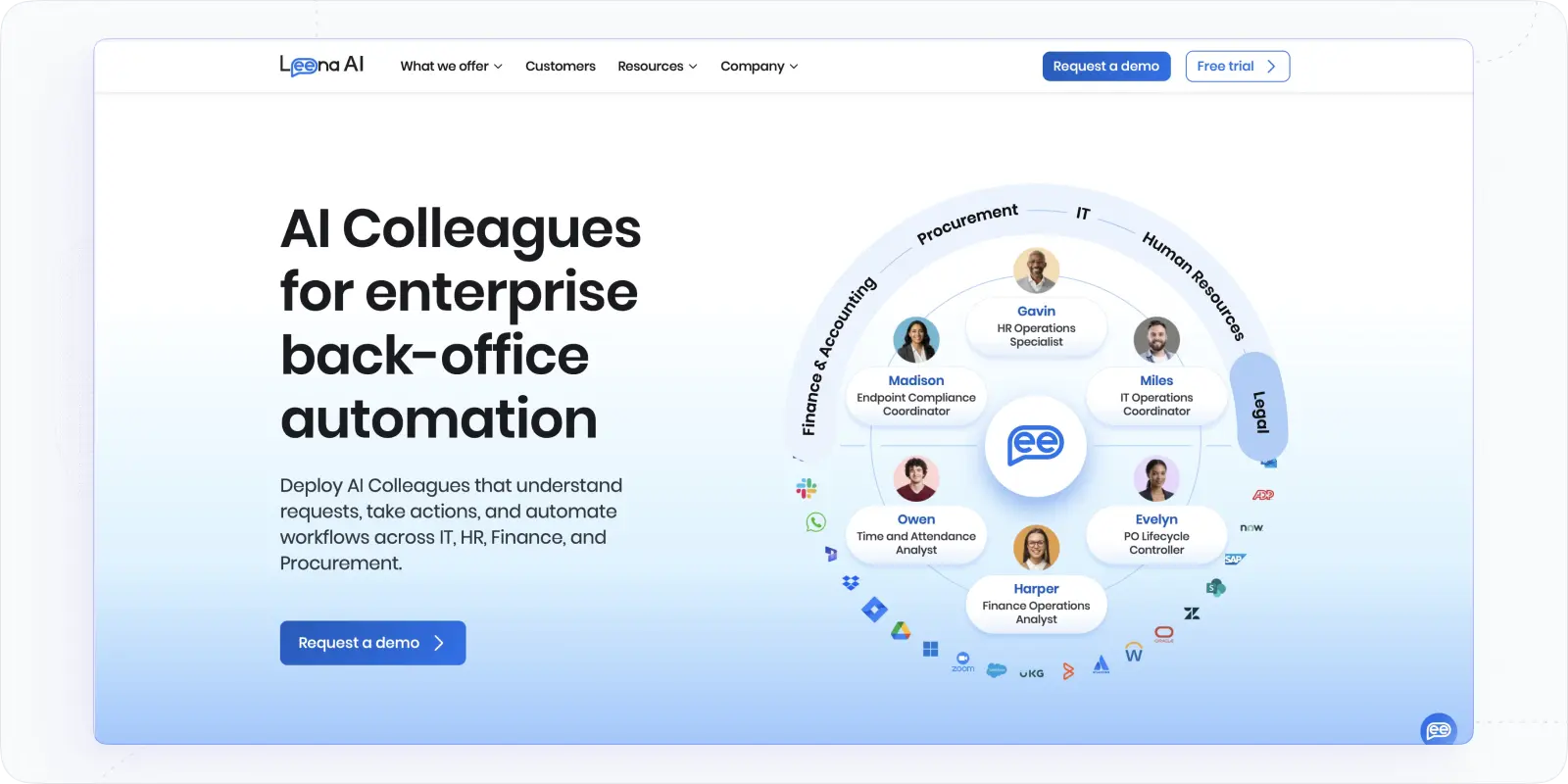
Leena AI is an AI HR assistant that focuses specifically on answering new hire questions and deflecting repetitive HR tickets during the onboarding period. Its chatbot interface integrates with Slack, Teams, and web portals, and can respond to questions about policies, benefits, and procedures 24/7 without routing every query to an HR team member. For high-volume hiring periods, this kind of AI assistant layer makes a real difference to HR bandwidth.
Where Leena AI falls short is on the learning delivery side — it's not built to replace an LMS. I'd pair it with a platform like EducateMe for employee training delivery and use Leena as the support layer that handles what comes after.
- AI chatbots — conversational interface that provides instant answers to new hire questions across Slack, Teams, or web 24/7
- Document automation — generates and sends offer letters, NDAs, and policy documents automatically without HR involvement
- Ticket deflection — resolves common HR queries using a built-in knowledge base, reducing HR support load during onboarding
- Multi-language support — responds to new employees in 100+ languages, useful for globally distributed onboarding
- HRIS integration — pulls employee data from your existing HR system to personalise every AI interaction
Best for: Organisations with high-volume hiring or distributed HR teams where new hire question volume creates a significant support bottleneck.
Pricing: Custom pricing. Demo required.
9. Enboarder
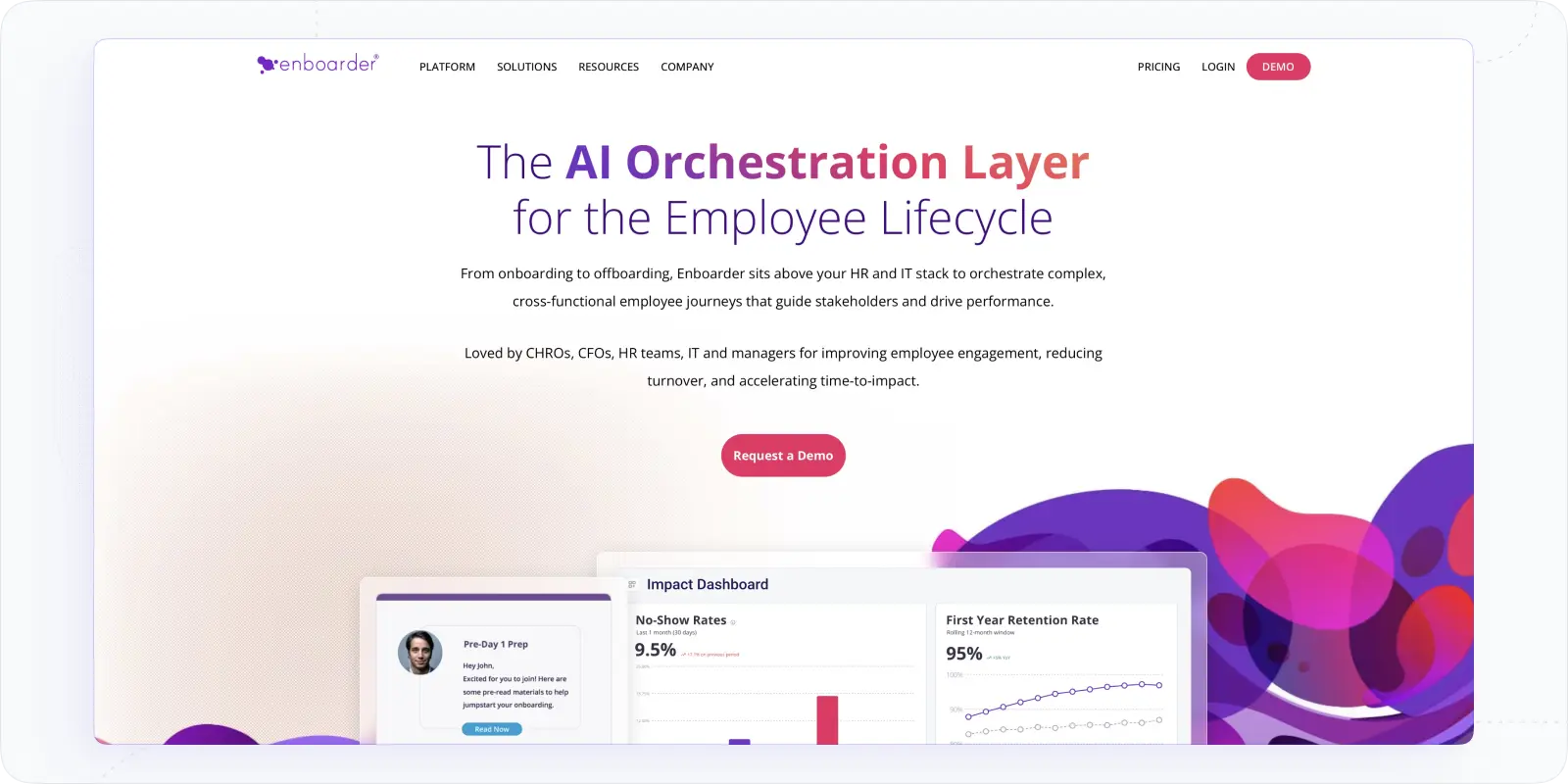
Enboarder focuses on the part of onboarding most tools completely ignore: the emotional and relational experience. It uses AI to personalise communication timing, nudge managers to check in at the right moments, and adapt the onboarding journey based on how new hires actually respond. I think of it as an engagement orchestration layer — it doesn't replace your LMS or your HRIS, but it makes sure new hires feel connected and informed throughout the onboarding journey.
The pre-boarding capability is particularly useful. New hires who are engaged before their start date show up on day one ready, rather than anxious — and Enboarder automates that entire pre-boarding sequence.
- Experience workflows — multi-step onboarding journeys with conditional paths based on hire type, location, or survey responses
- Manager nudges — automated prompts to managers for introductions, check-ins, and milestone conversations at the right time
- AI personalisation — adapts content and communication cadence based on individual engagement signals and learning style preferences
- Pre-boarding sequences — engages new employees before their start date to reduce no-shows and first-day anxiety
- Integration ecosystem — native connections with Workday, SAP SuccessFactors, Greenhouse, and major ATS platforms
Best for: People-focused HR teams that want to improve the human side of onboarding (manager accountability, new hire engagement, and connection) rather than just task completion.
Pricing: Custom enterprise pricing. Free demo available.
10. Zavvy (by Deel)
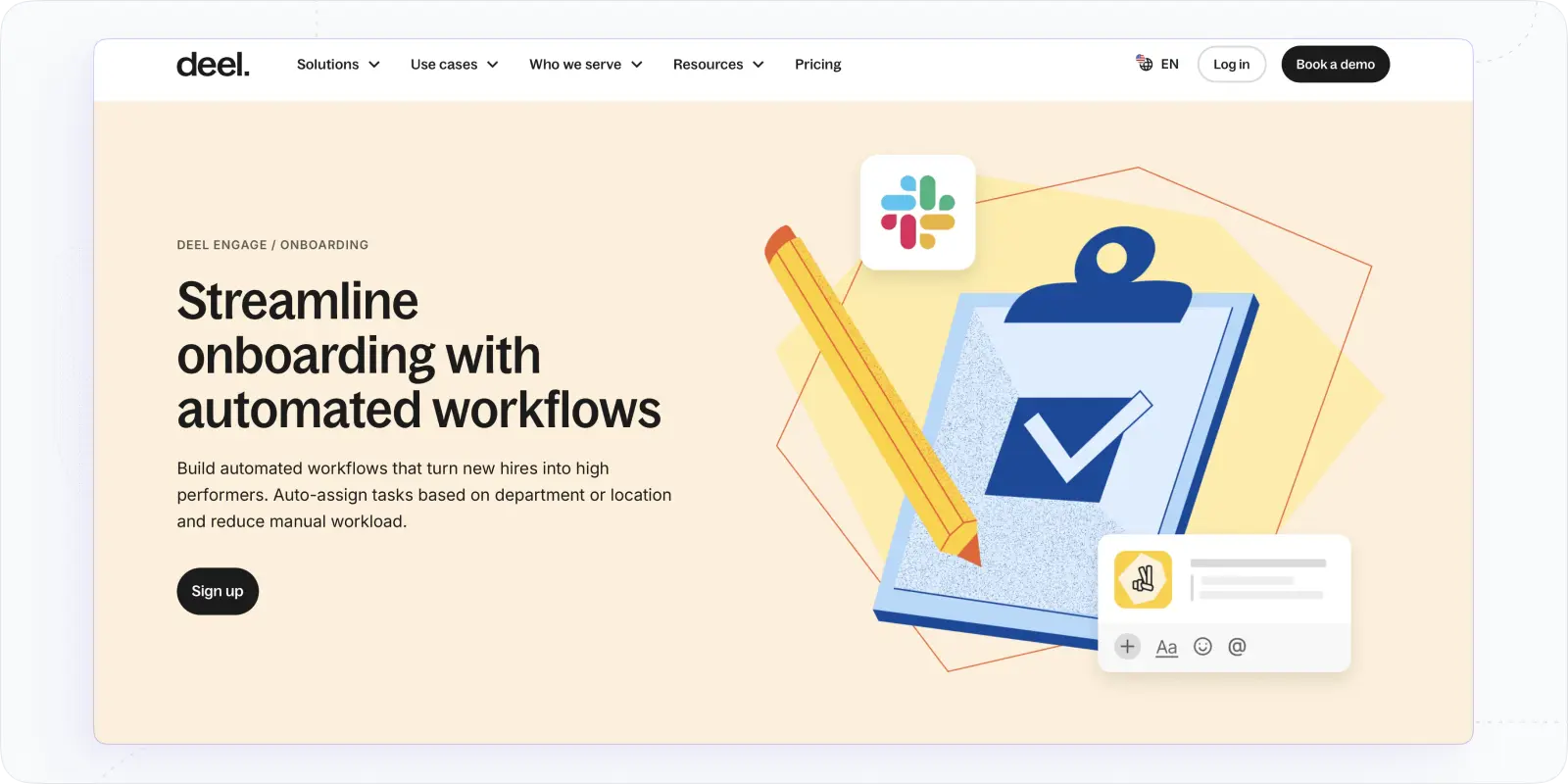
Zavvy (now integrated into Deel's HR platform) was built specifically for onboarding and employee development journeys. Its AI capabilities help HR teams design structured 30-60-90 day onboarding programs with automated check-ins, peer buddy assignments, and milestone-based content delivery. For remote-first companies where the social and relational elements of onboarding are hardest to replicate, Zavvy's journey-builder logic genuinely helps new hires feel less isolated in those first few months.
The main consideration: Zavvy's value proposition is strongest if you're already on Deel for global payroll or HR. If you're not, you're paying for a lot of platform you won't use.
- Journey builder — creates complete 30-60-90 day onboarding paths with automated milestones, content delivery, and feedback loops
- AI content suggestions — recommends onboarding tasks and training materials based on role, department, and company culture
- Buddy system — automatically matches every new hire with an onboarding buddy and schedules their first meeting without HR involvement
- Structured feedback — collects feedback at every milestone to continuously improve the onboarding program
- Deel integration — full access to Deel's global HR, payroll, compliance, and contractor management infrastructure
Best for: Remote-first or globally distributed companies already using Deel for international payroll and HR management.
Pricing: Included in Deel HR plans. Pricing varies by bundle — contact Deel for specifics.
| Tool | Pros | Cons | Pricing |
|---|---|---|---|
| BambooHR | Easy to use, predictive attrition signals, solid all-in-one HRIS | Basic onboarding automation; not built for complex learning delivery | Custom |
| Rippling | Unified IT + HR, 500+ integrations, global payroll, process automation | Complex to set up; can be overkill for smaller teams | From $8/user/month |
| Leena AI | Strong AI chatbots, multi-language, 24/7 ticket deflection | Not a learning platform; needs an LMS alongside it | Custom |
| Enboarder | Best-in-class employee experience design, manager nudging, pre-boarding | Not built for training content delivery | Custom |
| Zavvy / Deel | 30-60-90 journey builder, buddy matching, strong Deel integration | Best value only if already on the Deel platform | Bundled with Deel HR |
How to Choose the Right AI Onboarding Tool
The right combination depends on where your current onboarding breaks down most visibly.
If new hires are completing tasks but not retaining anything — the content and learning delivery side is the problem. That's where an AI-powered LMS like EducateMe or Docebo earns its place. If new hires are confused, asking the same questions repeatedly, or falling through process gaps — the workflow and communication side is the problem. That's where tools like Rippling, Leena AI, or Enboarder make the difference.
Most teams at scale use AI onboarding platforms from both categories. The AI in your LMS handles what new hires learn and whether they're progressing. The AI in your HR workflow tool handles everything happening around that learning — documents, tasks, system access, and manager accountability.
See how fast you can build an onboarding programme. Most EducateMe customers have their first course live within a day. No instructional designer needed — just a prompt, a doc, or a URL. Start your free trial →
Key Takeaways
- AI onboarding tools fall into two distinct categories: LMS platforms for structured learning delivery, and HR workflow tools for process automation. Most organisations need both.
- The best AI onboarding platforms don't just automate tasks — they personalise the onboarding experience for every new hire based on role, location, and engagement signals.
- For structured learning delivery with AI-generated content and role-based training paths, EducateMe is the strongest all-in-one option for mid-sized teams.
- For IT and HR unification in a single onboarding workflow, Rippling removes more manual steps than any other tool on this list.
- Start with where your onboarding breaks down most — that's the tool category to prioritise first.
Frequently asked questions
For small HR teams, the best AI onboarding tool is one that reduces manual admin without a lengthy implementation project. EducateMe and BambooHR both work well here — EducateMe for teams that want to build and deliver structured training content fast, BambooHR for those who need a full HRIS with solid basic automation. Both offer free trials, so you can test before committing.
AI in employee onboarding typically works across three areas: automating tasks like document collection and system provisioning, personalizing training content based on role and learning behaviour, and answering new hire questions in real time via chatbots or AI assistants. More advanced platforms also use AI and machine learning to flag onboarding completion gaps and predict early attrition risk based on engagement patterns in the first few months.
Yes — and it's one of the strongest use cases for AI in HR. AI-powered onboarding platforms like EducateMe automatically assign compliance training by role and region, track completion with audit-ready reporting, and re-enrol employees when policies are updated. For organisations in regulated industries, that's significantly more dependable than manually managed compliance workflows.
The future of onboarding is adaptive — not just personalised at the start, but continuously adjusted based on how each new hire is actually progressing. AI can analyze engagement signals in real time and surface targeted support before a new hire falls behind. Predictive analytics, AI roleplay for skills practice, and automated workflow orchestration across HR and IT will become standard rather than premium features within the next few years.