
Paradiso LMS Pricing in 2026: Models, Costs & AI Features

By Sofia KondratSofia KondratCorporate Training Expert & Content EditorHey there! I’m Sofi Kondrat, your go-to corporate training advisor here at EducateMe. I’ve been navigating the highs…Read more
Corporate Training Expert & Content Editor
8 min read
Paradiso LMS pricing is harder to compare than most because Paradiso doesn't sell one price — it sells three different pricing models, then layers AI, analytics, and white-labeling on top as paid add-ons. So the per-seat number a rep gives you is rarely what you'll actually pay. This guide breaks down the three models, what's bundled versus billed extra, the AI features you're evaluating, and roughly what Paradiso costs once the add-ons stack up.
I checked Paradiso's own pricing pages and the main review sites in August 2026, so the figures below reflect where things stand now.
How Paradiso LMS Pricing Works

Paradiso pricing is quote-driven, and the first thing to understand is that "quote" can mean three different things depending on which model you're put on:
- Pay per user — you're charged for every registered user, whether or not they log in. Simple to reason about, but you pay for dormant accounts.
- Pay per active user — you're charged only for users who actually log in and engage. Better if you have a large roster but low concurrent usage.
- Licensing (flat fee) — a fixed fee for unlimited users over a set term (monthly or annual), with standard features, training, and support included.
On top of those models, the product is split into two plans: Growth, aimed at 1–500 seats and priced per user per month, and Enterprise, for larger deployments at a fully custom rate. Paradiso does put an "LMS cost calculator" on its site, but it asks for your details before it shows real rates, and the sample figure it displays doesn't line up with the tiers third-party directories quote — so I'd treat that calculator as a lead-capture estimate, not a rate card.
The practical takeaway: before you can even compare Paradiso to another vendor, you have to know which of the three models you're being quoted on, because the same headcount produces very different totals across them.
The key point: Paradiso doesn't publish one price — it sells across three models (pay per user, pay per active user, and a flat license), split into a Growth plan and a custom Enterprise plan, so always confirm which model your quote uses.
What Drives Your Paradiso Quote: Seats, Model, and Add-Ons
Once you've picked a model, the quote itself is built from three inputs — and the third is where budgets drift.
The first two are predictable: how many seats you need, and which pricing model you're on. The third is the add-on stack, and Paradiso is notably modular here. Based on its own pricing pages, several capabilities buyers often assume are included are actually billed separately:
- AI tools — the AI features are an add-on, not baked into every tier.
- Advanced analytics — deeper reporting beyond the standard dashboards.
- White-label branding — available on Growth as an add-on.
- Immersive learning and specialized integrations — priced per requirement.
- Implementation & migration services — a separate professional-services line, quoted after a needs assessment.
I flag this because it changes how you read a Paradiso quote. A low headline seat price can look competitive until you add the AI, the analytics, the branding, and the implementation your rollout actually needs — at which point the real number can be well above the sticker. When you request a quote, ask for it fully loaded: every add-on you intend to use, priced in, so you're comparing a complete Paradiso deployment against a complete rival, not a stripped base against a full one.
The key point: Paradiso's quote is seats × model, plus a stack of add-ons — AI, advanced analytics, white-label, integrations, and implementation are billed separately, so the base seat price is rarely the total.
Paradiso AI Features Overview
Paradiso markets itself as an AI-native platform, and its AI surface is genuinely broad. Here's what it describes as of August 2026:
- AI course creation — generates course drafts to cut manual build time.
- AI assessment generation — writes quizzes and tests from your content.
- Learning-path recommendations — suggests next courses per learner.
- Skill-gap identification — flags where individuals or teams need development.
- AI learner assistant — answers learner questions and provides support.
- AI proctoring — monitors online assessments for integrity.
- AI role-play simulations and AI coaching — let learners practice real-world scenarios with personalized feedback.
That's an ambitious list, and it's a real point in Paradiso's favor for teams that want practice-based and secure-assessment features in one place. The pricing caveat is the one from the last section: Paradiso's own pages list AI among the paid add-ons, so "AI-powered" branding doesn't guarantee the AI is included at your tier. Before you sign, confirm in writing exactly which AI features are in your quote and which cost extra. If AI is your main reason for evaluating Paradiso, it's worth seeing how it compares to the best AI LMS platforms that meter AI inside the subscription rather than bolting it on.
The Hidden Costs and a Worked Estimate
Because Paradiso negotiates most numbers, the most useful thing I can give you is a modeled estimate — clearly labeled as an estimate, because it's built from third-party figures rather than Paradiso's own rate card.
Third-party directories commonly cite annual tiers roughly like this, inclusive of support:
- 0–50 users: around $1,500/year
- 51–100 users: around $3,100/year
- 101–250 users: around $4,600/year
- 251–500 users: around $8,210/year
- 501–1,000 users: around $12,990/year
Separately, per-user pricing gets quoted around $25 per user per month in some sources — which doesn't reconcile neatly with those annual tiers, and that gap is exactly the point: Paradiso pricing is wide and model-dependent, so two buyers can hear very different numbers. On top of the license, add implementation, migration, and any add-ons (AI, analytics, white-label), all quoted per project after a needs assessment.
Put together, a small team might land in the low thousands per year for a lean deployment, while a mid-market rollout with AI, analytics, and professional services can climb well past $15,000–$20,000 all-in. Treat these as directional. To get Paradiso's real numbers you'll need a quote — then read it against these ranges, and against our guide to LMS pricing in 2026, so you know whether you're being quoted high. Paradiso does offer a 14-day free trial on request after a demo, which is the cleanest way to test before you commit to an annual number.
Is Paradiso Worth the Price, and Who It's For
For the right team, Paradiso's breadth earns its quote — I just wouldn't call it a universal fit. It's rated 4.1 out of 5 on G2 across 13 reviews (checked August 2026), and its recurring praise is consistent: a wide, flexible feature set, strong customization, gamification, mobile compatibility, and the sheer range of integrations, including a Salesforce-embedded option. You can also see reviews on Capterra for a second read.
The criticisms are just as consistent, and they matter for a value judgment. Reviewers report that the interface could be more polished and that performance and page speed can feel slow. Combined with the add-on model, that's the trade-off: you get enormous configurability, but you pay for it in both dollars and setup effort.
Paradiso fits best when you genuinely need that breadth — multi-audience training across employees, customers, and partners, heavy customization, or specific integrations like Salesforce — and you have the team to configure and maintain it. It's a weaker value if you mostly need to build and deliver internal training quickly, because you're buying a broad, add-on-priced platform to solve a focused problem.
Paradiso Pricing vs a Transparently-Priced Alternative
If the three-model math and add-on stack are the sticking points, the honest fix is a platform that publishes one all-in number. EducateMe is an AI-native LMS for modern training teams that launches fully branded training in hours — and unlike Paradiso, you can read every plan and try it without a demo call.
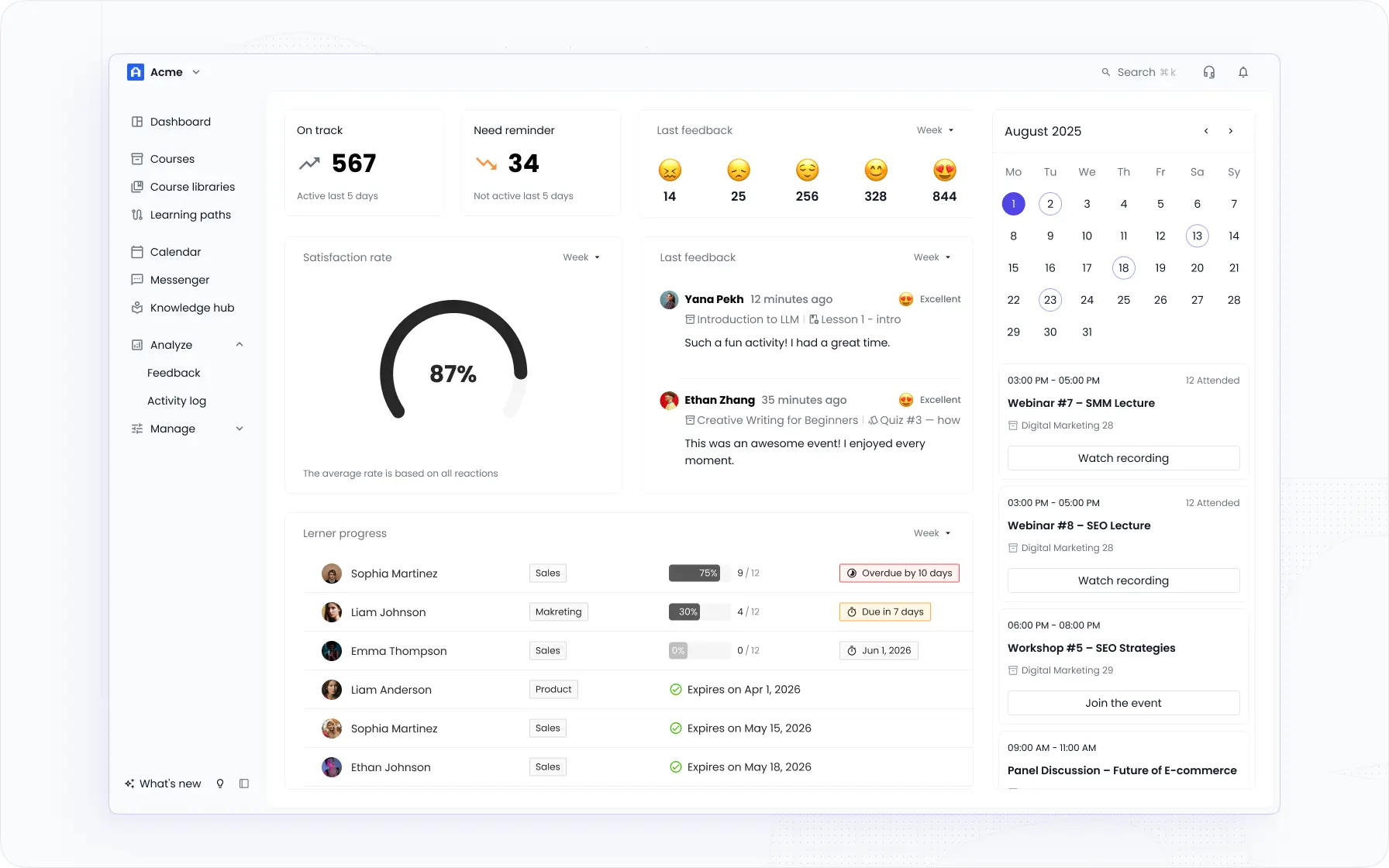
EducateMe publishes three plans: Pro at $239/month (80 users), Premium at $399/month (100 users), and Scale at $999/month (200 users), with a 14-day free trial. That works out to roughly $3–$5 per user — one figure, with AI creation and learner assistance included in the plan rather than quoted as separate add-ons.
The AI story is comparable in ambition. EducateMe's AI Assistant builds courses from a prompt, file, URL, or video, and its AI Roleplay Coach lets staff practice real conversations with scored, rubric-based feedback — the same practice-based idea as Paradiso's AI role-play, with customers reporting 3x faster course creation. Where Paradiso lists AI among paid add-ons, EducateMe states plainly that AI Roleplay sessions are metered per plan (10, 40, or 200 per month) and that the AI Assistant is included on every paid tier.
| Factor | Paradiso | EducateMe |
|---|---|---|
| Pricing model | Quote-only, three models + add-ons | Published plans, all-in per-user |
| Starting price | Not published (est. tiers from ~$1,500/yr) | $239/mo (Pro, 80 users) |
| Free trial | 14-day, on request after demo | 14-day trial; no free plan |
| AI | Broad, but sold as a paid add-on | AI Assistant included + AI Roleplay (metered per plan) |
| Best for | Multi-audience, heavy customization, integrations | SMB & mid-market training teams |
I'll be fair to Paradiso here: it offers things EducateMe doesn't — native mobile apps, a far broader integration catalog (including Salesforce-embedded), AI proctoring, and multi-audience configurability for organizations that need that range. EducateMe is mobile-responsive web only with no native app, and it's build-first with no pre-built course library. It's the stronger pick for corporate training teams that want AI-native creation and transparent, all-in pricing — not for teams whose priority is deep customization or an offline mobile app.
Frequently asked questions
Paradiso doesn't publish a fixed price — it quotes across three models (pay per user, pay per active user, and a flat license). Third-party directories cite annual tiers from roughly $1,500 (up to 50 users) to about $12,990 (up to 1,000 users), with per-user rates near $25/month cited elsewhere. AI, analytics, white-label, and implementation are add-ons, so confirm a fully-loaded quote.
Paradiso offers a 14-day free trial on request after a demo; some directories also list a free version, so confirm current terms with sales. If you want to test a full platform hands-on without a sales call first, EducateMe runs a 14-day free trial and publishes its plans openly, starting at $239/month for up to 80 users.
On Paradiso's own pricing pages, several capabilities are add-ons rather than bundled: AI tools, advanced analytics, white-label branding (Growth plan), immersive learning, specialized integrations, and implementation & migration services. Because these stack on top of the seat price, always ask for a quote that includes every add-on you intend to use so you compare a complete deployment.
EducateMe is an AI-native LMS that publishes its pricing all-in: Pro at $239/month, Premium at $399/month, and Scale at $999/month, roughly $3–$5 per user, with AI course creation included rather than sold as an add-on. It's web-only with no native mobile app and no pre-built course library, so it suits build-first SMB and mid-market teams over heavy-customization enterprises.