
Healthcare Onboarding Checklist and Best Practices: Role by Role, Week by Week, With the Sign-Offs That Gate Patient Contact

By Sofia KondratSofia KondratCorporate Training Expert & Content EditorHey there! I’m Sofi Kondrat, your go-to corporate training advisor here at EducateMe. I’ve been navigating the highs…Read more
Corporate Training Expert & Content Editor
11 min read
A medical assistant starts on Monday. HR has the forms, the badge and the benefits enrollment covered. What nobody has written down is the training path, the sign-off that clears them for patient contact, and who owns each week. That is what a healthcare onboarding checklist is for. This one is built by role and by week for RNs, medical assistants, providers and front-desk staff, with the practices that keep first-year hires.
A healthcare onboarding checklist has five parts: paperwork and credentialing before day one, safety and privacy training before the first shift, role training in weeks 1 to 4, a documented competency sign-off before independent patient contact, and check-ins at days 30, 60 and 90. The grid in this guide sets that out for RNs, medical assistants, providers and front-desk staff, with 6 practices that keep first-year hires.
What Should a Healthcare Onboarding Checklist Include?
A healthcare onboarding checklist covers five things: paperwork and credentialing before day one, safety and privacy training before the first shift, role training across weeks 1 to 4, a documented competency sign-off before independent patient contact, and check-ins at days 30, 60 and 90 with a named owner for each item.
Think of it as 4 gates every hire passes.
- Gate 1, paperwork cleared. Licenses verified, background check done, accounts live. This is HR's list, and the generic employee onboarding checklist covers it.
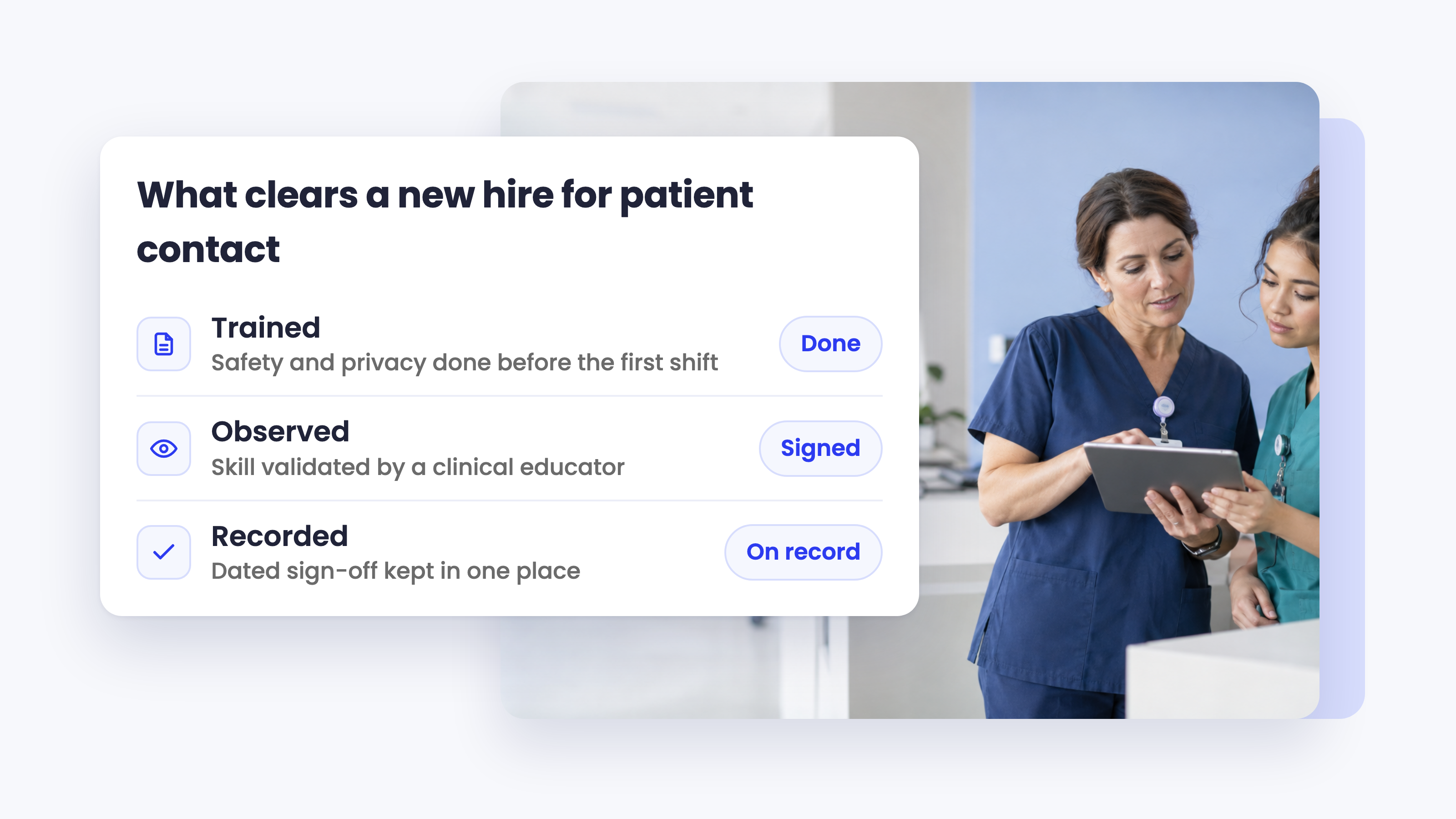
- Gate 2, trained before first exposure. Bloodborne pathogens, privacy, emergency codes, done before the first shift touches a patient or a record.
- Gate 3, competency validated. A named observer signs that the person can do the role's core tasks alone.
- Gate 4, retained at 90 days. The check-ins happened, and the hire is still there.
Most checklists on page one stop at gate 1, because credentialing and background-check vendors wrote them. I'd build the list from gate 3 backwards: decide what "cleared for patients" means for each role, then fill the weeks that get someone there.
Why the First 90 Days Decide Retention
The first year is where healthcare loses people. The first 90 days set it up. The 2026 NSI National Health Care Retention and RN Staffing Report, built on 527 hospitals in 40 states, puts first-year RN turnover at 22.7% and the cost of each RN departure at $60,090. The report states it plainly: "Over twenty-two percent (22.7%) of all newly hired RNs left within a year, with first year turnover accounting for twenty-nine percent (29.0%) of all RN separations."
Practices see the same pattern in different roles. In MGMA's May 2026 Stat report on turnover, a poll with 303 responses from practice leaders, medical assistants and front-desk roles remained the most common churn points, alongside nursing and revenue-cycle staff. The number I'd put in front of a board isn't overall turnover. It's the first-year share, because that's the part onboarding controls.
What Is the 30-60-90 Onboarding Rule, and Does It Fit Healthcare?
The 30-60-90 rule sets milestones at days 30, 60 and 90: learn the role, work with less supervision, then own it. In healthcare it fits as the check-in calendar, not as the readiness gate. Patient contact is cleared by a validated competency, which may come in week 2 for a front-desk hire and after day 60 for a new-graduate nurse.
The practice side agrees, as long as competency is written into each milestone. The same MGMA report puts it this way: "Structured onboarding with 30-, 60- and 90-day milestones: New staff should understand role expectations, provider preferences, and what competency looks like at each stage."
What two health systems do instead
Two health systems have taken the calendar out of the gate. At Presbyterian Healthcare Services, every new nurse spends the first week in a simulation lab working through validated competencies with clinical educators before taking a patient assignment, according to Becker's Hospital Review in July 2026. At Johns Hopkins Medicine, oncology onboarding moved off a fixed timeline. New nurses meet weekly with their preceptor, manager, clinical nurse specialists and educators, and they progress through clinical milestones rather than a preset number of weeks before higher-acuity assignments. Donna Berizzi, the associate chief nursing officer for the oncology service line at Johns Hopkins Medicine, told Becker's: "They don't get a full assignment for weeks."
Keep the 30-60-90 calendar for the conversations. I'd never let a date, rather than a signed competency, put someone in front of a patient.
The Sign-Off Before Patient Contact
Three rules turn the gate from a preference into a requirement, and they apply to a two-provider clinic as much as to a hospital.
What must be done before the first shift
The OSHA bloodborne pathogens standard requires training "At the time of initial assignment to tasks where occupational exposure may take place" and at least annually after that, so it sits before the first shift, not in week 3. The HIPAA privacy rule, at 45 CFR 164.530, requires privacy training for each new workforce member within a reasonable period of time after they join, and documentation that it happened. For accredited hospitals, The Joint Commission's Accreditation 360 transcript states: "Standard HR 11.04.01, EP 1 requires hospitals to assess staff competence initially as part of orientation and once every 3 years, or more frequently." State rules add to that floor. They never lower it.
Who signs, and what the record shows
A sign-off is a dated entry by a named observer with the background to judge the skill. For an RN that's a clinical educator or preceptor; for a new physician or nurse practitioner, a supervising provider; for a medical assistant, a lead MA or the practice manager; for front desk, the office manager. It names the task, the policy version it was trained against, and the date. It lives in one place per person, exportable by site. If a sign-off has no date and no named observer, I'd treat it as not done, and so will a surveyor.
The Healthcare Onboarding Checklist by Role and Week
Here is the grid. Rows are the stages, columns are the roles, and each cell names the training and the sign-off that ends the stage. HR's paperwork appears once, in the first row, so it doesn't crowd out the training.
| Stage | Registered nurse | Medical assistant | Provider (physician, NP, PA) | Front desk |
|---|---|---|---|---|
| Before day one | License verified, accounts live, unit and preceptor named, first-week schedule sent | Certification checked where required, accounts live, lead MA named, schedule sent | Credentialing and privileging in motion, EHR access, schedule template, mentor named | Background check done, accounts live, phone and scheduling logins, buddy named |
| Week 1 | Safety and privacy training before the first shift, unit orientation, shadow only. Sign-off: emergency codes and equipment | Safety and privacy training, clinic flow, rooming shadowed. Sign-off: vitals and infection control | Privacy and safety training, EHR workflows, observed visits. Sign-off: documentation basics | Privacy training, phone scripts, scheduling system, check-in shadowed. Sign-off: identity and insurance verification |
| Weeks 2 to 4 | Core skills observed one by one: medication administration, assessments, handoffs. Sign-off per skill, then a first partial assignment | Rooming, injections, specimen handling observed. Sign-off per skill, then own room with backup | Own panel at reduced volume, provider preferences, referral and coding workflows. Sign-off: independent charting review | Own queue with backup, payments, referrals, difficult-caller script rehearsed. Sign-off: end-to-end check-in and checkout |
| Day 60 | Full assignment on the unit, first competency review, 60-day check-in | Full room load, competency review, 60-day check-in | Full schedule, chart audit, 60-day check-in | Full queue, error review, 60-day check-in |
| Day 90 | Independent practice signed, 90-day conversation, annual training dates set | Independent practice signed, 90-day conversation, renewal dates set | 90-day review with the medical director, credentialing complete, first quality data | 90-day conversation, cross-training plan, renewal dates set |
How to read the grid
The first row is HR's. Every other row belongs to the manager or educator. Adapt it by setting: in home health, field ride-alongs replace unit shadowing and the sign-off happens at the client's door; in a dental group, week 1 adds OSHA and the office's own scripts, per office; in behavioral health, supervision hours run alongside the grid. The provider column covers physicians, nurse practitioners and physician assistants, with credentialing as HR's gate and clinical onboarding as the column. I'd rather you delete half the grid than run it once and drop it. A short list every hire completes beats a long one nobody finishes.
6 Healthcare Onboarding Best Practices
The practices are how the four gates get passed on time. Each one is a thing you can do this month, not a principle.
1. Start before day one
Send the first-week schedule, the preceptor's name and the login details before the start date, and put the first shadow shift on the calendar. The first hour on day one should be a shift plan on a screen, not a stack of forms in a break room, because the forms were done last week.
2. Separate the paperwork from the training
HR owns forms, badges, benefits and credentialing. The educator or manager owns the path and the sign-offs. Two owners, two lists, one record per person. The practice I'd start with is this one; it costs nothing, and it changes who owns the outcome.
3. A single path per role, assigned by location
A multi-site group runs the same RN path in every clinic and adds site-specific items by location: the codes, the parking, the local referral rules. Consistency across sites is what a surveyor looks for, and the first thing a floating hire notices.
4. Gate patient contact by competency, not by date
Structure protects the people doing the teaching. Donna Berizzi, the associate chief nursing officer for oncology at Johns Hopkins Medicine, told Becker's: "A preceptor's work is doubled when you have them working with a new nurse, and their level of responsibility is doubled," and, of the load on the nurses still willing to teach, "It's not fair, it's not possible." A written path with sign-offs recorded once means the preceptor teaches instead of tracking, and the hire advances on a milestone, not on a Monday.
5. Practice before patients
Rehearse the intake, the discharge and the angry caller before the first real one, with a script and a rubric the office already uses. Platforms like EducateMe's AI Roleplay Coach score the rehearsal against that rubric by voice or chat, so a preceptor reviews a recording instead of standing in for the patient, and the new hire gets three attempts instead of one.
6. Check in on a schedule the new hire can see
Hold end-of-shift check-ins in week 1, then put the 30, 60 and 90-day conversations on the calendar from day one, with a stay interview at 90 days. New hires post about their first weeks online, and the theme repeats: nobody asked. Put the asking on the schedule, and let the new hire see it.
Running the Checklist as a System
On paper, the grid works for one cohort. By the third, someone forgets a sign-off and the export for a survey takes a day. That's the point to move it into a system that assigns a path by role and location, gates the next step on the sign-off, and keeps the record. EducateMe, an AI-native LMS for healthcare teams, does this with sequential onboarding paths assigned by location or HRIS tag. The AI Assistant drafts the role module from the policy you already have, a named clinician reviews it before it's assigned, and readiness reports show completion and sign-offs per person and site. Customers report 1.8× faster onboarding with the AI Assistant (customer data).
Two honest limits. There's no course library and no accredited CE, so the checklist and the policies are yours, and the system runs them. There's no native mobile app, only the responsive web version, and AI Roleplay sessions are metered per plan. I'd put the checklist in a system only after it has run on paper for one cohort; you'll fix the list before you automate it. When you're choosing the system, start with a comparison of healthcare LMS platforms built around what a surveyor asks for.
If you want to run the grid this way, start a free 14-day trial and load one role's path first.
How to Measure Whether Onboarding Worked
Three numbers per role tell you whether the grid is right. Time to independent practice, from the start date to the signed competency, shows where a stage is too long or a sign-off is missing. Ninety-day retention shows whether the check-ins happened. First-year turnover, set against the 22.7% RN figure in the 2026 NSI report, shows whether the whole thing moved. Take a baseline from the last cohort, change one stage, and re-measure on the next. The recording loop is covered in how to track employee training.
I'd measure time to independent practice before satisfaction. The first tells you where the grid is wrong; the second tells you how people feel about it. That's the whole healthcare onboarding checklist in one sentence: gate each role on a signed competency, run the calendar around it, and measure the first year.
Frequently asked questions
The 5 C's are compliance, clarification, culture, connection and check-back: the legal and policy basics, clear role expectations, how the organization works, relationships with the team, and structured feedback on how the new hire is doing. In healthcare, compliance and clarification are gated items before patient contact, while culture, connection and check-back run through the 30, 60 and 90-day conversations.
The five stages are pre-boarding (offer to day one), orientation (the first days), role training (the first weeks), integration (working with less supervision) and ongoing development (after the first 90 days). A healthcare onboarding checklist adds a gate between the second and fourth stages: no independent patient contact until a named observer has signed the role's core competencies.
Orientation is the first few days: the facility, the policies, the safety and privacy training, the systems. Onboarding is the whole first 90 days and beyond: role training, supervised practice, the competency sign-off and the check-ins that keep the hire. Orientation is an event you can finish; onboarding is a path with milestones, and the sign-off before patient contact sits inside it.
Plan on 90 days of structured onboarding for most roles, with the competency sign-off landing inside the first four weeks for front-desk and medical assistant hires and later for nurses and providers, who need more observed practice before independent patient contact. New-graduate nurses and newly credentialed providers often need longer, so set the end date by the signed competency, not by the calendar.