
AI in Healthcare Staff Training: What It Does Today for Compliance, Onboarding and Practice (and What It Cannot)

By Roman ShaukRoman ShaukCorporate Training & AI Expert, FounderRoman Shauk is the Founder of EducateMe.Read more
Corporate Training & AI Expert, Founder
11 min read
Someone has asked you what to do about AI in healthcare staff training, and every page you've read so far lists capabilities and vendors. Here is the shorter answer, and the map I'd use to brief a vendor or a board. In 2026, AI does five training jobs well. Each one has a point where a named person must review or sign. Three things stay human: accredited CE, clinical judgment, and accountability.
AI in healthcare staff training is the use of generative and analytical AI to build, update, rehearse, assess and analyze workforce training, with a person accountable for what staff are taught.
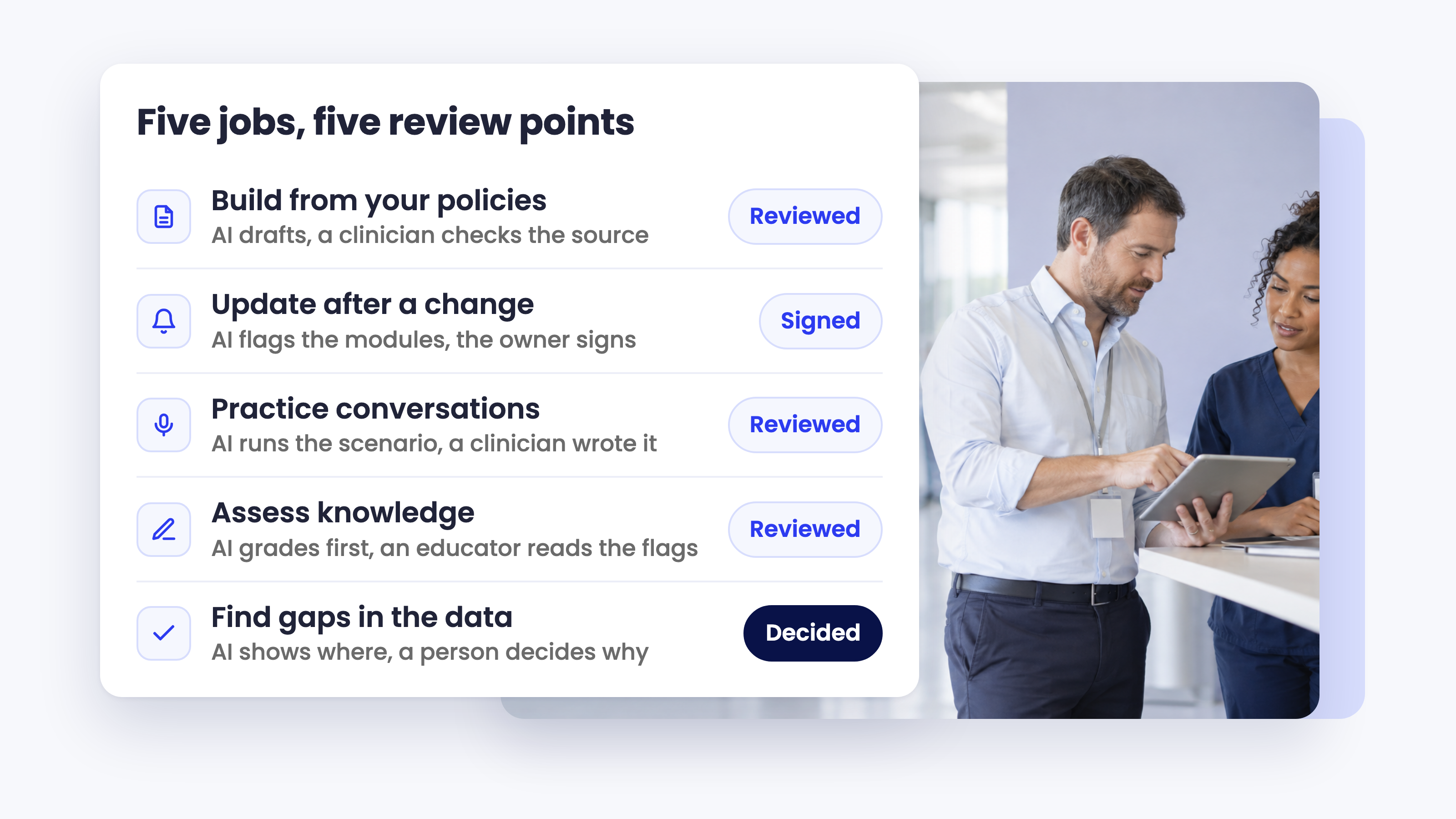
AI in healthcare staff training now does five jobs well: drafting courses from your own protocols, flagging what to update when a policy changes, running practice conversations with rubric feedback, generating and first-pass grading assessments, and finding gaps in completion data. Each job has a review point where a named person checks or signs. AI cannot grant accredited CE, replace clinical judgment, or carry accountability.
The 5 Jobs AI Does in Healthcare Staff Training
The map first, then the detail. AI drafts training from documents you already own. It flags which modules a policy change touches. It runs practice conversations and scores them against a rubric. It writes and grades knowledge checks. It reads completion data for gaps. Five jobs. None of them ends without a person, and the map below shows where that person sits for each one, which is the part vendor demos tend to skip. When I brief a vendor I put the review side first, because the capability side is what they'll show you anyway.
What Changed for AI in Healthcare Staff Training in 2026
Two things moved this year. Regulators wrote the training rule for AI tools, and the models got good enough to read your own documents rather than the open web. Neither change made AI safe to leave unreviewed.
The regulator part came in September 2025, when the Joint Commission and the Coalition for Health AI released guidance on the responsible use of AI in healthcare. It is voluntary today, and a certification is planned for the organizations the Joint Commission accredits. I read that plan as a timeline: voluntary now, a survey item within a few years. Element 7 of the guidance covers education and training, and its wording is plain: "Healthcare organizations should train clinicians and staff who will leverage AI-enabled technology on the proper use of AI tools and any limitations or guidelines for use."
That sentence adds a line to the training lead's list. Training about AI is now your job as well as training built with AI.
The adoption part shows up in the workforce data. The Incredible Health 2026 State of Nursing report, a survey of 2,240 U.S. nurses, found that AI use among nurses nearly tripled in a year, while only 8% of nurses reported a clear AI strategy from their employer. Staff are using the tools. Most organizations haven't told them how.
Can AI Build a Course From Your Own Protocols?
Yes. Give a model your approved policy, SOP or clinical protocol and it will draft learning objectives, a module sequence and a quiz in minutes. What it can't do is know whether that document is current, or whether the draft matches how your unit works. So a named clinician reviews every draft before anything is assigned.
The source material matters more than the model. A course drafted from your infection-control policy is worth reviewing. A course drafted from a web summary of "infection control" is not, because nobody can trace a sentence back to a document your organization approved. Version the source, and link the module to that version. I'd ask any vendor to build from a document you supplied, because the whole value is in your own protocols.
The loop is short: draft, review, approve, assign. Most of the time saved is in the first step. The review step should take as long as it takes.
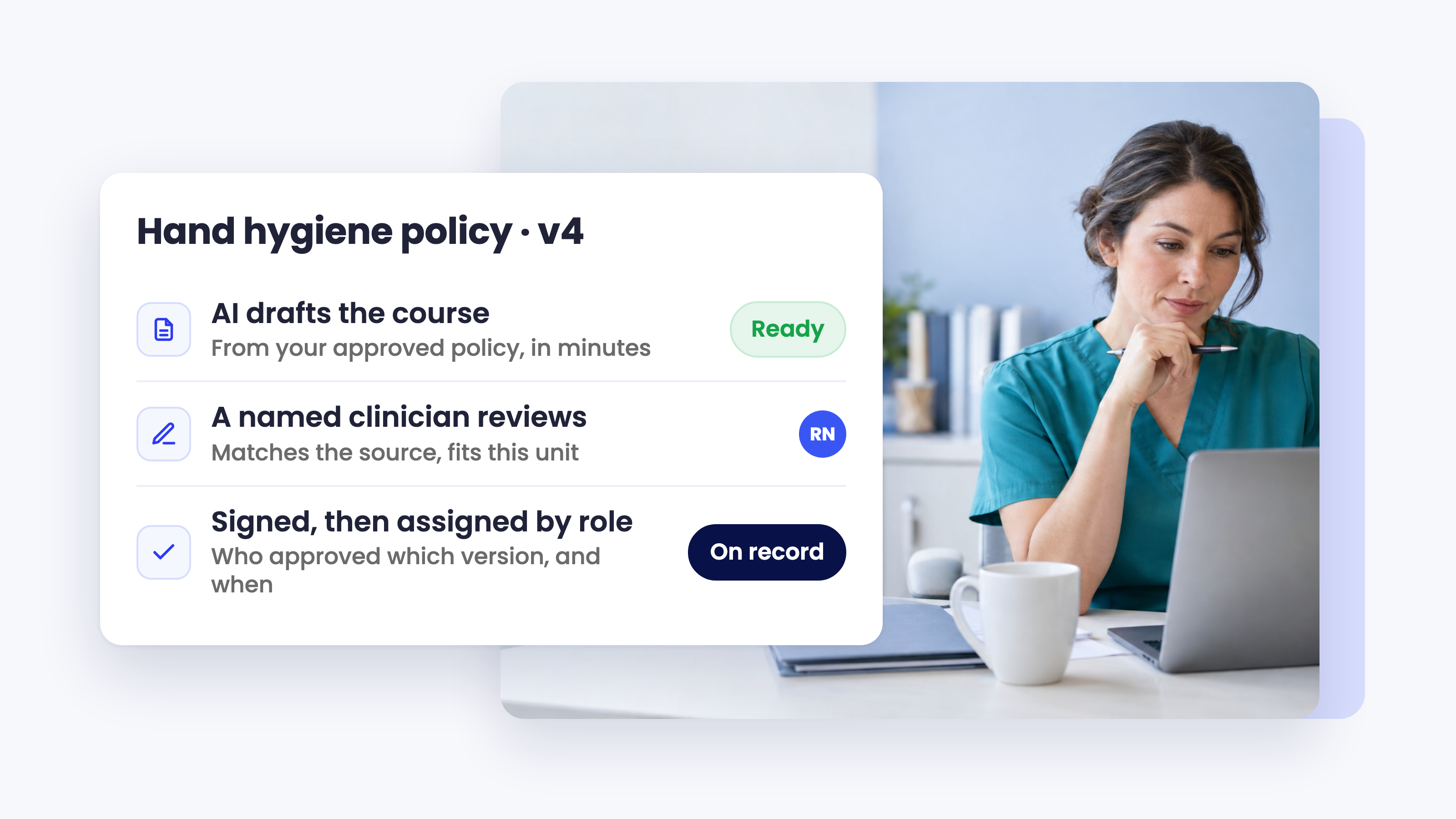
Platforms like EducateMe generate a first draft from an uploaded policy through AI course creation; the review is still yours, and EducateMe ships no accredited CE library, so continuing education stays with your accredited provider. If you want the mechanics of the drafting step, start with how to build a training module from your own material.
Who reviews AI-written compliance content
The reviewer is the policy owner or a clinical educator, and the record names them. They check three things: does the draft match the source document, does it describe the steps this unit takes, and are the dates and references current. Budget an hour of a clinician's time per module. The day it used to take to write the thing is what AI saved; the hour is the part you keep.
Dr. Bethany Robertson, a clinical executive at Wolters Kluwer Health, wrote in January 2026 that "Health systems implementing these new offerings need their nursing workforce involved in the roll out and subsequent evaluation of these tools." The reviewer is a clinician. Not a training coordinator with a checklist.
Keeping Training Current When a Protocol Changes
The retraining rule is older than AI. Under HIPAA, a covered entity must retrain affected staff within a reasonable period after a material change to its policies, and keep the documentation for six years (45 CFR 164.530). The rule never said how you would find every module the change touches.
That is the job AI does here. It compares the new policy with the old one, lists the modules that cite the changed section, drafts the update, and queues the affected staff for re-assignment. A person still decides what counts as material. A person signs the new version. And the record of who was retrained, on which version, and when, is what a surveyor asks for.
Two practices make this work. Keep one source document per policy, with every module linked to it, so the diff has something to compare. And keep the change log in the LMS, not in a spreadsheet somebody maintains on Fridays. A healthcare LMS that can't show a module's source version can't do this job. The measure I'd hold a platform to is how fast a policy change reaches every affected module, not how fast it builds the first course.
Practice With Feedback: AI Roleplay for Patient-Facing Conversations
Practice is the job AI changed most. A front-desk hire can rehearse a billing dispute, a scheduler can practice a call with an anxious parent, a nurse can run a family update, all against a simulated patient, and get feedback against a rubric without a trainer in the room. Until recently, that practice happened when a role-play day could be scheduled.
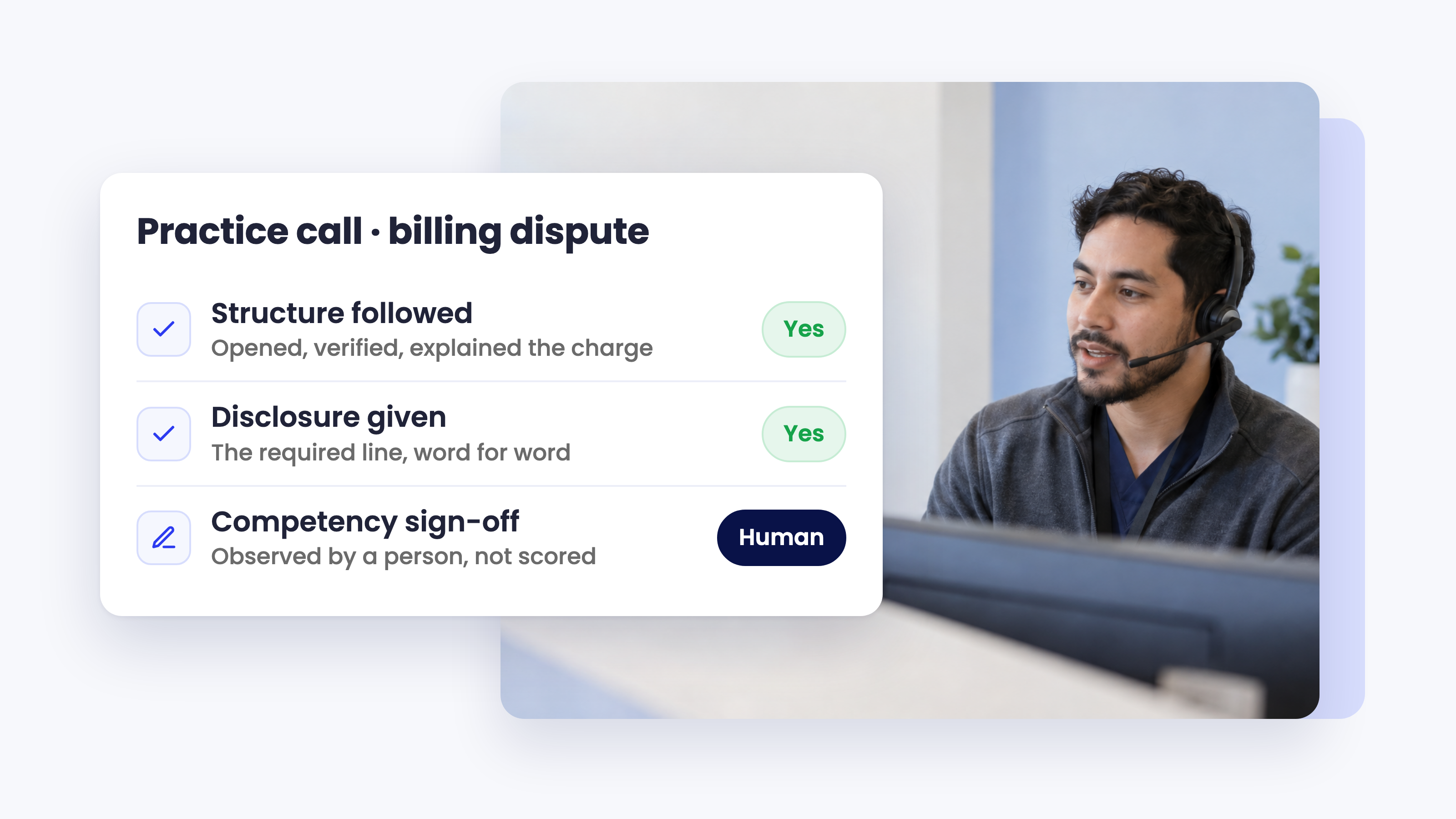
The rubric scores what a rubric can score: did the staff member follow the structure, use the required disclosure, avoid the phrases the organization has decided against, stay calm. What it cannot judge is whether the clinical content of the conversation was appropriate. So the scenarios are written and approved by a clinician, and the feedback is coaching input. It is not a competency sign-off. I'd start with the three conversations your complaints log shows most often, not with a library of fifty scenarios.
The practice layer for healthcare, scenario libraries, de-escalation and AIDET included, lives on the practice side rather than in the LMS. For that detail, see AI roleplay training for healthcare teams on trainio.ai.
Assessment: What AI Can Grade and What a Person Signs
AI generates knowledge checks well and grades them perfectly, because the answers are fixed. It grades short written answers acceptably, and it is good at flagging the answer that contradicts the other nine. Competency, meaning whether this person can do the task safely, is observed and signed by a qualified person. No regulator accepts a model's signature.
Keep the two apart in your records. A knowledge check proves someone read the module. A competency validation proves they can perform the skill, and it carries an observer's name. AI's honest place is item generation, first-pass grading, and a flag on inconsistent answers for an educator to read. The sign-off field, in my view, holds a person's name: not a score, not a model version, but the educator who watched the task and is prepared to say so in front of a surveyor.
Finding the Gaps in Your Training Data
The least dramatic job is the most useful one. The data an LMS already holds can show which roles are overdue, which module every new hire fails, which site's completions stall in the month before a survey, and how long a module takes compared with how long you planned. AI makes those questions cheap to ask.
What the data can't show is why. A high failure rate on one item means the item is bad or the training is, and a person has to look. Personalized paths belong here too, in one sentence: assigning modules by role and by what someone already passed is useful, and it is also where most vendors stop explaining.
I'd read the item-level failures before the completion chart: the chart tells you who finished, the failures tell you what to fix. And one rule for this job: analytics run on data the LMS holds, and no patient data belongs in it. That sets up the questions in the last section.
What AI Cannot Do in Healthcare Staff Training
Three things, without hedging. AI cannot grant accredited CE or CME; only an accredited provider can, and a draft generated by a model is not accredited until that provider says so. AI cannot replace clinical judgment about what staff should be taught or whether they're competent. AI cannot hold a license, sign a record, or carry accountability. A person does.
The CE point catches people. An AI course on hand hygiene can be accurate, current and well built, and still count for nothing toward a nurse's continuing education. Accreditation belongs to the provider and the process, not to the content.
The judgment point is the one clinicians raise first. Ali Morin, the chief nursing informatics officer at symplr, said in an August 2026 interview that "ambient tools and virtual nursing can't replace a clinician's judgment. The technology simply removes tasks that are quietly competing with it." She was speaking about clinical AI. The same line holds for training AI: it removes the drafting and the grading, and leaves the judgment where it was. I'd write those three limits into the training policy before any tool arrives, so nobody discovers them during a survey.
Questions to Ask Any Vendor About Training Data
Five questions decide whether an AI training tool is safe to run in a healthcare organization. Where are training content and learner records stored? Does the vendor train its models on your content? Can protected health information enter the system, and does the contract say it must not? Who sees AI-generated drafts before approval? How is AI-generated content versioned and logged?
- Where do our content and learner records live, and who can access them?
- Do you train models on our content? The answer should be one sentence.
- Can PHI enter the system? Training data should never include it, and the contract should say so.
- Who can see an AI-generated draft before a reviewer approves it?
- How is each AI-generated version logged, and can we export that log for a survey?
I'd expect the second answer in one sentence, and I'd be strict about the third. A training system needs role, site, completion and assessment data. It does not need a single patient record, and a vendor who suggests otherwise has a different product in mind. When you're ready to compare platforms on these answers, this comparison of healthcare LMS platforms asks them of ten vendors.
Where to Start
The map is short. Five jobs, five review points, three things that stay human. Pick one job, name the reviewer, and run it with a real policy for a quarter before you touch the other four. Most teams start with drafting from their own protocols, because the time saved is visible in the first week and the review habit forms early. That is where I'd start.
That is AI in healthcare staff training in 2026: less drafting, less grading, the same judgment.
Frequently asked questions
Either can be safe. A surveyor audits the record, not the authoring tool: who was assigned what, which version, who reviewed it and when, and whether retraining followed a policy change. Ask the same five data questions of both kinds of vendor. EducateMe, an AI-native LMS, keeps a named reviewer and a version log on AI-drafted content; an established LMS should show you the same.
There is no single best tool, so use criteria. The onboarding AI should draft role-specific modules from your own policies, assign by role and site, trigger retraining when a policy changes, keep a signed record for each completion, and keep protected health information out of the system entirely. EducateMe meets those criteria for clinical and front-office onboarding; compare it against the others on the same list, not on demo polish.
Yes. The Joint Commission and Coalition for Health AI guidance (September 2025) says organizations should train clinicians and staff on each AI tool's proper use and its limits. The Incredible Health 2026 State of Nursing report found that among nurses with AI training from their employer, 24% saved over an hour a day, against 16% without it, and only 8% reported a clear employer AI strategy.
No, not on its own. Accreditation belongs to an accredited provider and its review process, not to the content. A course drafted by AI can be accurate and current and still earn nothing toward continuing education unless it is delivered and approved through that provider. EducateMe has no accredited CE library, so CE stays with your accredited provider while everything else runs in the LMS.