
Healthcare LMS Pricing in 2026: What Vendors Charge

By Sofia KondratSofia KondratCorporate Training Expert & Content EditorHey there! I’m Sofi Kondrat, your go-to corporate training advisor here at EducateMe. I’ve been navigating the highs…Read more
Corporate Training Expert & Content Editor
12 min read
You need a number for next year's training budget, and 6 of the 14 vendors in this guide won't give you one without a demo. Where prices are public, healthcare LMS pricing runs about $2 to $10 per user per month, and every vendor uses one of five models that make a quote easier to read. This guide covers how vendors price, what 14 of them charge, and how to get a quote you can compare and negotiate.
Healthcare LMS pricing comes in two forms: published plans and custom quotes. MedTrainer, HealthStream, Relias, Absorb, Docebo and Cornerstone sell by quote; a May 2025 county order put Relias at $8.29 per user a month for 35 users, libraries included. Published plans run from ProProfs at $1.99 per active learner to MedBridge at $329 per seat a year with CE. EducateMe starts from $239 a month for 80 users. Compare any two on cost per user per month.
How Much Does a Healthcare LMS Cost in 2026?
On public figures, a healthcare LMS costs about $2 to $10 per user per month for the software, and more when a continuing-education library is bundled in. MedTrainer, HealthStream, Relias and three general platforms publish no organizational price at all. The table lists what each vendor shows, and the per-user column is our own division of that figure.
| Vendor | Published price | Per user per month (our math) | Pricing model |
|---|---|---|---|
| MedTrainer | None; Select, Premier and Signature tiers by quote | Not calculable | Bundled quote |
| HealthStream | None on its learning center pages | Not calculable | Bundled quote |
| Relias (organizations) | None; a county record shows $3,483.81 a year for 35 users | $8.29, two libraries included | Bundled quote, per learner per year |
| Relias Academy (individuals) | $249 a year for All Access | $20.75 for one clinician | Individual subscription |
| Absorb LMS | None | Not calculable | Enterprise quote |
| Docebo | None on its site; AWS listing shows $35,900 a year for 500 active users | $5.98 on a 36-month term | Per active user, by quote |
| Cornerstone | None; Vendr's median buyer pays $29,705 a year | Not calculable, no user count | Enterprise quote, modular |
| MedBridge | Essentials at $329 per seat a year for 2 to 49 seats | $27.42, CE included | Per seat, quote at 50+ |
| CareAcademy | Essentials at $239 a month for 25 seats, 1-year minimum | $9.56, 250+ trainings included | Per seat tier |
| SAP Litmos | Foundation from $8,000 a year | Not calculable, no user count | Platform floor plus tiers |
| Tovuti | $7,500 a year for the first 100 learners | $6.25 | Platform floor plus tiers |
| TalentLMS | Core at $119 a month billed yearly, up to 40 users | $2.98 at 40 users | Plan with a user cap |
| ProProfs | $1.99 per active learner a month, up to 100 | $1.99 | Per active learner |
| 360Learning | Team plan at $8 per user a month, up to 100 users | $8.00 | Per user, then custom |
| EducateMe | From $239 a month for 80 users, plus $3 per extra user | $2.99 | Plan plus per seat |
Prices were checked on each vendor's site or the public record named in the row in November 2026; the Relias Academy price was last confirmed in September 2026. I'd read the third column before the second. A $35,900 contract and a $239 plan only become comparable once both are divided by the people who'll use them, because one bills a 500-person organization for three years and the other bills a clinic month to month.
The 5 Ways Healthcare LMS Vendors Price
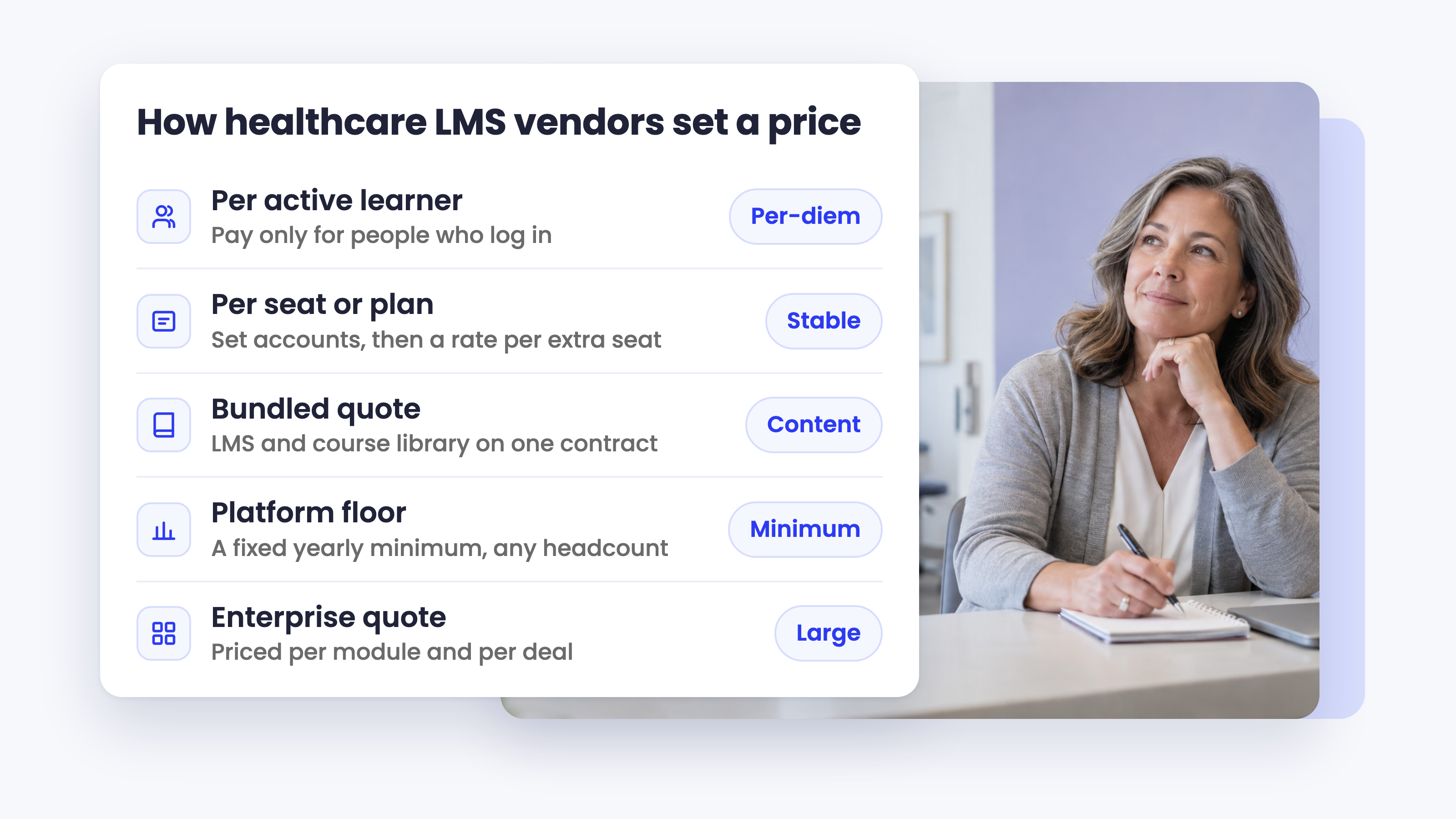
Healthcare LMS vendors use five pricing models, and the model matters as much as the number. It decides what happens to your bill when headcount moves, when you add a clinic, or when you want to leave, so I'd settle on the model before comparing prices.
- Per active learner — you pay only for people who log in during the period. ProProfs bills this way, and Docebo's marketplace listing prices yearly active users. It suits teams with per-diem, seasonal or agency staff.
- Per seat or plan with a user cap — a fixed price for a set number of accounts, then a rate per extra seat. TalentLMS, 360Learning, CareAcademy and MedBridge publish prices like this. It suits a stable headcount you can forecast.
- Annual quote bundled with content — the LMS and a library of compliance and CE courses on one per-learner contract. Relias, MedTrainer and HealthStream sell this way. It suits teams that need accredited courses in the same bill.
- Platform floor plus tiers — a fixed yearly minimum whatever your headcount. Litmos starts at $8,000 and Tovuti at $7,500.
- Enterprise quote — priced per module and per deal, as Cornerstone and Absorb do. It's built for organizations with hundreds or thousands of learners.
Why Do Healthcare LMS Prices Vary So Much?
Four things set a healthcare LMS price: how the vendor counts users, whether a content library comes with the software, the contract term, and the setup fee. The library usually matters most. A vendor that ships CE and compliance courses charges for that content, and the LMS itself is often the smaller part of the bill.
- Who counts as a user — active learners, yearly active users or every account in the workspace. A clinic with per-diem staff pays very differently under each.
- Content library — MedTrainer, HealthStream, Relias, MedBridge and CareAcademy sell training content alongside the LMS. For many healthcare buyers, that content is the real purchase, so I'd ask every vendor to price it separately from the platform.
- Contract term — the Docebo listing assumes a 36-month agreement and CareAcademy requires a 1-year minimum. A longer term lowers the yearly rate and raises the cost of leaving early.
- Implementation — a one-time line outside the headline price. Sierra County's May 2025 Relias order carried a $2,100 implementation fee on top of a $3,483.81 subscription.
How Much Do Quote-Only Healthcare LMS Vendors Charge?
Quote-only vendors publish no price, but public records give three numbers: Relias at $8.29 per user a month in a 35-user May 2025 county order, Docebo at $5.98 per active user for 500 users on its AWS listing, and a $29,705 median yearly Cornerstone contract. MedTrainer, HealthStream and Absorb have no public figure at all.
Relias: two price lists
Relias sells its platform to organizations on a custom per-learner annual quote and sells Relias Academy to individual clinicians at a public price. The organizational figures in public come from county filings. Sierra County, California's May 2025 order form lists the platform for 35 users, two content libraries and Policy Pro at $3,483.81 a year, plus a $2,100 implementation fee. The Yamhill County, Oregon 2026 board orders show a county-wide subscription at $70,149.13 a year, with no learner count. Relias Academy All Access costs $249 a year for one clinician. Our full breakdown of Relias pricing walks through the contract clauses behind those numbers.
Docebo, Cornerstone and Absorb
None of the three publishes a price on its own site. Docebo's AWS Marketplace listing shows its mid-tier plan at $35,900 a year for 500 yearly active users and $52,800 for 1,000, each on a 36-month agreement billed annually. That works out to $5.98 and $4.40 per active user per month. Cornerstone is modular and quoted per deal. According to Vendr's buyer data, the median Cornerstone buyer pays $29,705 a year, in a range from $10,445 to $55,268. That's a wide band. Absorb LMS asks for your learner count and sends a quote.
All three are general corporate platforms, and their pricing assumes hundreds or thousands of learners, a scale most clinic groups and home care agencies will never reach. The Docebo pricing guide and the Cornerstone cost breakdown cover their modules and add-ons.
MedTrainer and HealthStream
MedTrainer and HealthStream are the healthcare-native names buyers ask about most. Neither prints a price. MedTrainer's pricing page offers three tiers, Select, Premier and Signature, all by custom quote. The "$10 per user per month" figure that some AI answers attach to MedTrainer comes from third-party software directories, not from MedTrainer. HealthStream handles pricing in its demo request, and its content marketplace lists over 35,000 courses.
I wouldn't put a figure for either vendor into a budget until it sits on a written quote with the library named. A number from a review site or an AI answer is a placeholder, not a price, because nobody can tell you which modules, libraries or contract length it assumed.
Which Healthcare LMS Vendors Publish Their Prices?
Eight vendors in this guide publish a price: ProProfs ($1.99 per active learner a month), TalentLMS ($119 a month), EducateMe ($239 a month for 80 users), CareAcademy ($239 a month for 25 seats), 360Learning ($8 per user a month), MedBridge ($329 per seat a year), Tovuti ($7,500 a year) and Litmos ($8,000 a year).
Only MedBridge and CareAcademy include healthcare content. The other six leave it to you, which is fine if your compliance courses already live in policy documents someone on your team keeps current.
Healthcare vendors with a public price
- MedBridge — Medbridge Essentials costs $329 per seat a year for 2 to 49 seats, with CE built in for staff, and organizations buying 50 or more seats go to sales. The plans also bundle patient-care tools, so you're buying more than an LMS.
- CareAcademy — Essentials is $239 a month at 25 seats, with 250+ training materials for non-medical caregivers and a 1-year minimum contract. Advanced, at $383, adds medical-caregiver training.
General LMS platforms with a public price
- TalentLMS — Core costs $119 a month billed yearly for up to 40 users, and a free plan covers up to 5. There's no healthcare library and no native CE tracking.
- ProProfs — $1.99 per active learner a month on the lowest plan, for up to 100 learners and billed yearly, and free for up to 10.
- 360Learning — The Team plan is $8 per user a month for up to 100 users, with Business and Enterprise quoted.
- SAP Litmos — Foundation starts at $8,000 a year and Platinum at $15,000, with the AI tier quoted.
- Tovuti — $7,500 a year for the first 100 learners, then priced by volume.
- EducateMe — starts from $239 a month for 80 users, plus $3 per extra user. There's no course library or accredited CE; AI builds courses from your own policies.
For a 40-person clinic, I'd shortlist a published plan first and open a quote conversation only if a required course can't be built in-house. A price you can read on day one is worth a lot in a budget meeting. Quotes take weeks.
How to Compare 2 Healthcare LMS Quotes
Divide every quote by the people who'll use it and by 12, then check what's inside the number. Two quotes with the same total can buy very different things, from a bare platform with a three-year lock-in to a platform with two content libraries and a contract you can leave every year.
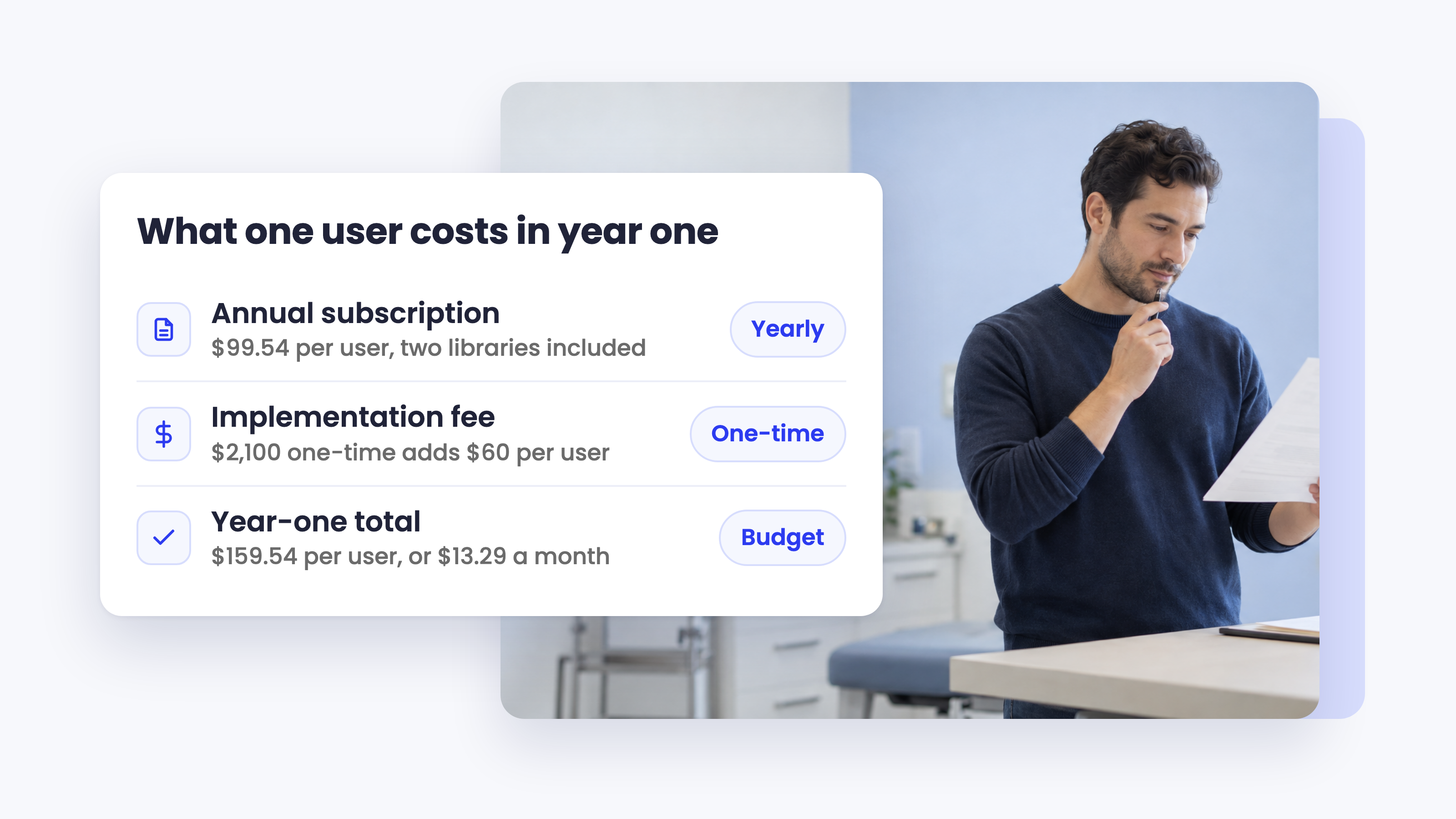
The one public Relias order shows how much the details move the result. Sierra County's May 2025 subscription of $3,483.81 across 35 users is $99.54 per user per year, or $8.29 a month. The $2,100 implementation fee adds $60 per user. That makes the first-year figure $159.54 per user, or $13.29 a month. A 60% jump.
Ask every vendor the same 3 questions in writing, so the answers line up:
- Which libraries are in the price, and which are separate lines?
- Does the user count mean every account or only active learners?
- Is the implementation fee one-time, and what does it cover?
The per-user number I'd put in front of a finance lead is the year-one figure with implementation included. That's the amount that actually leaves the budget.
How to Negotiate a Healthcare LMS Quote
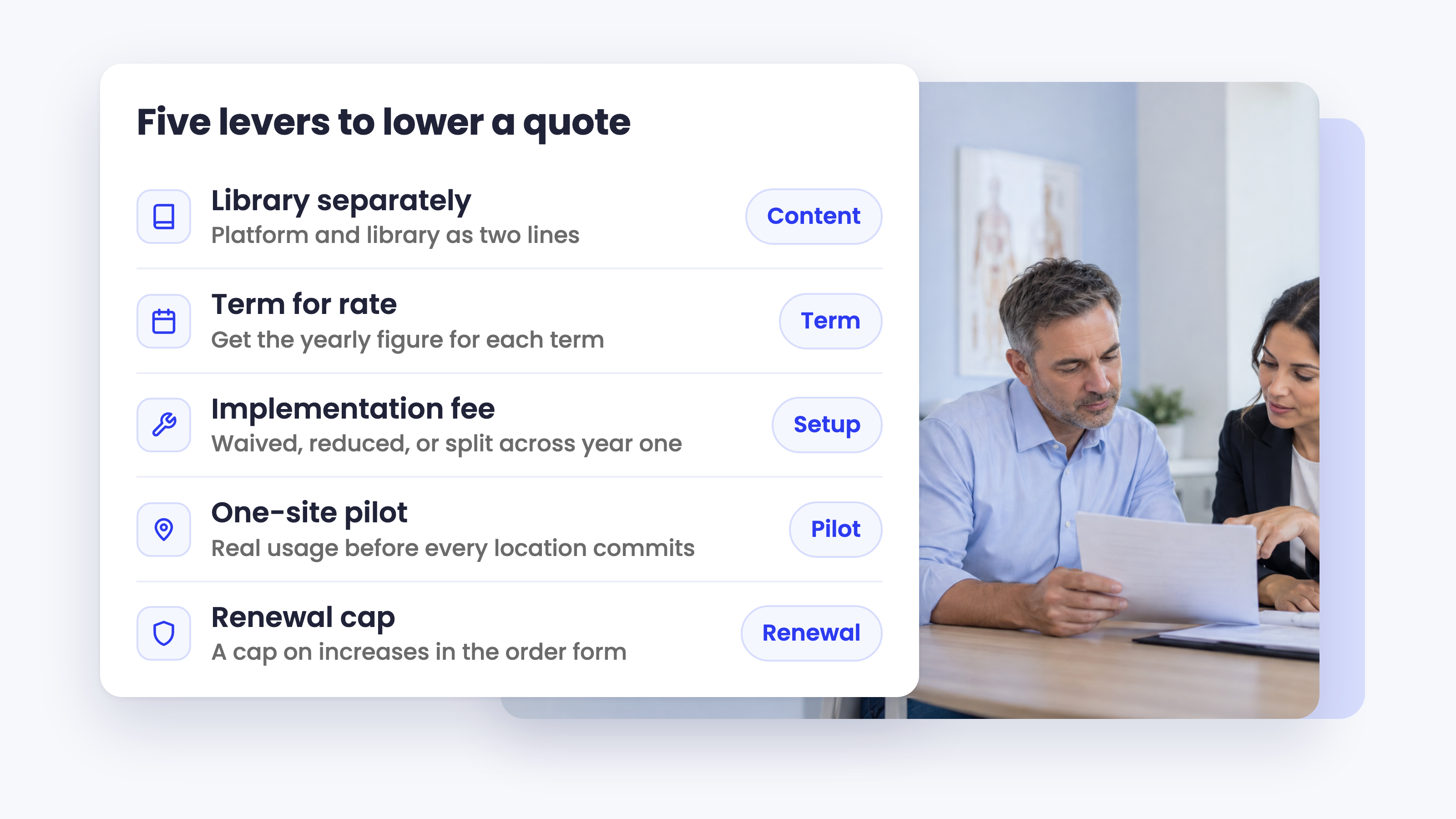
A healthcare LMS quote is assembled from separate lines, so it has more room than the total suggests. These are the levers I'd pull, in order.
- Price the library separately — ask for a platform-only line and a platform-plus-library line. If you already write your own policies, you may need only one library, or none.
- Trade term for rate, in writing — a three-year term should buy a lower annual rate. Get the yearly figure for each term length before you choose.
- Cut or spread the implementation fee — ask for it waived, reduced, or split across the first year's invoices.
- Pilot one site first — a paid pilot at one clinic shows real usage before you commit every location.
- Cap the renewal increase — Relias' 2023 Master Subscription Agreement lets it change fees after the first 12 months on 60 days' notice, so write a cap on renewal increases into the order form.
Contract Terms to Check Before You Sign
"60 day cancellation notifications seems acceptable, but if you miss it, you're locked in for the term of your contract." A director of organizational development in hospital and health care wrote that in a Capterra review of Relias in April 2026. The warning applies well beyond one vendor, because automatic renewal behind a written notice window is a common term in the multi-year software contracts that quote-only vendors send out.
Relias' agreement renews for a term the same length as the one ending unless either side gives written notice at least 60 days before it ends. Check these 4 terms in any healthcare LMS contract:
- Renewal term — does the renewal match the original term, or default to one year?
- Notice window — how many days before the end date you must cancel in writing.
- Reducing learners — whether you can cut seats mid-term or only at renewal.
- Data export — how long completion records stay available after you leave.
I'd put the notice date in a shared calendar the day the contract is signed. Missing it is the most expensive mistake on this list, and the easiest to avoid. Set two reminders.
Which Healthcare LMS Pricing Model Fits Your Team?
The right healthcare LMS pricing model depends on two things: whether you need ready-made accredited courses, and how stable your headcount is. Teams that need CE on day one should buy a bundled quote. Teams that own their policies should start with a published per-seat plan. Swinging headcounts point to active-learner billing.
- You need accredited CE and state-mapped courses now — get bundled quotes from content vendors such as Relias, MedTrainer, HealthStream or MedBridge, and compare them per user with the libraries named.
- You own your policies and want a fixed number — a published per-seat plan gives you a budget line on day one: seats times rate.
- Your staffing swings — per-active-learner billing keeps you from paying for people who never log in.
- You run 500+ learners across many modules — an enterprise quote fits, as long as you insist on per-user math and a renewal cap.
My rule of thumb: choose the model first, then the vendor. Healthcare LMS pricing only looks opaque until you know which of the five models you're being quoted on.
Frequently asked questions
Healthcare LMS pricing per user runs from about $2 to $10 a month for the software on public figures, and higher when a CE library is bundled in. ProProfs lists $1.99 per active learner, and CareAcademy's Essentials plan works out to $9.56 per seat at 25 seats. MedBridge's bundled plan with CE costs $329 per seat a year. Most healthcare-specific vendors still sell only by quote.
MedTrainer doesn't publish a price. Its pricing page lists three tiers, Select, Premier and Signature, all sold by custom quote. The "$10 per user per month" figure that appears in some AI answers comes from third-party software directories, not from MedTrainer itself. Its course licensing page lists 1,200+ courses and 600+ CE and CME courses, so ask which of them a quote includes.
No. HealthStream doesn't publish a price on its learning center pages, and pricing is handled through its demo request with the sales team. Its content marketplace lists over 35,000 courses, so a quote can cover very different amounts of content. Ask which courses and libraries are included before you compare it with a published per-user plan.
Free plans exist, but none comes with healthcare content. TalentLMS is free for up to 5 users and ProProfs is free for up to 10 learners, which suits a pilot or one small clinic. Accredited CE and compliance libraries are always paid. A practical test before you request a single quote: build one required course from your own policy on a free plan or a 14-day trial.
A healthcare LMS for 100 users costs about $2,400 to $9,600 a year on published plans, all from general LMS platforms. ProProfs at $1.99 per active learner comes to $2,388, Tovuti lists $7,500 for its first 100 learners, and 360Learning's Team plan at $8 per user comes to $9,600. Among healthcare specialists, MedBridge quotes 50+ seats and Relias sells by quote; one May 2025 county order put Relias at $99.54 per user a year for 35 users.