
Cornerstone LMS Pricing: Costs, Plans, and Hidden Fees Explained

By Sofia KondratSofia KondratCorporate Training Expert & Content EditorHey there! I’m Sofi Kondrat, your go-to corporate training advisor here at EducateMe. I’ve been navigating the highs…Read more
Corporate Training Expert & Content Editor
8 min read
Cornerstone LMS pricing is not public, and that’s intentional. The platform is sold through a sales-led, enterprise procurement model, where final pricing is shaped by deployment complexity rather than headcount alone. Factors like governance requirements, compliance scope, and rollout footprint carry more weight than a simple per-user rate.
For most buyers, however, this creates two common challenges. It’s hard to see costs upfront, and the true total cost of ownership often only becomes clear once the contract is in place.
To help teams budget accurately, this guide breaks down how Cornerstone pricing works in practice. It reveals where the total cost typically expands beyond the initial quote and how to plan for the full investment before it becomes a surprise.
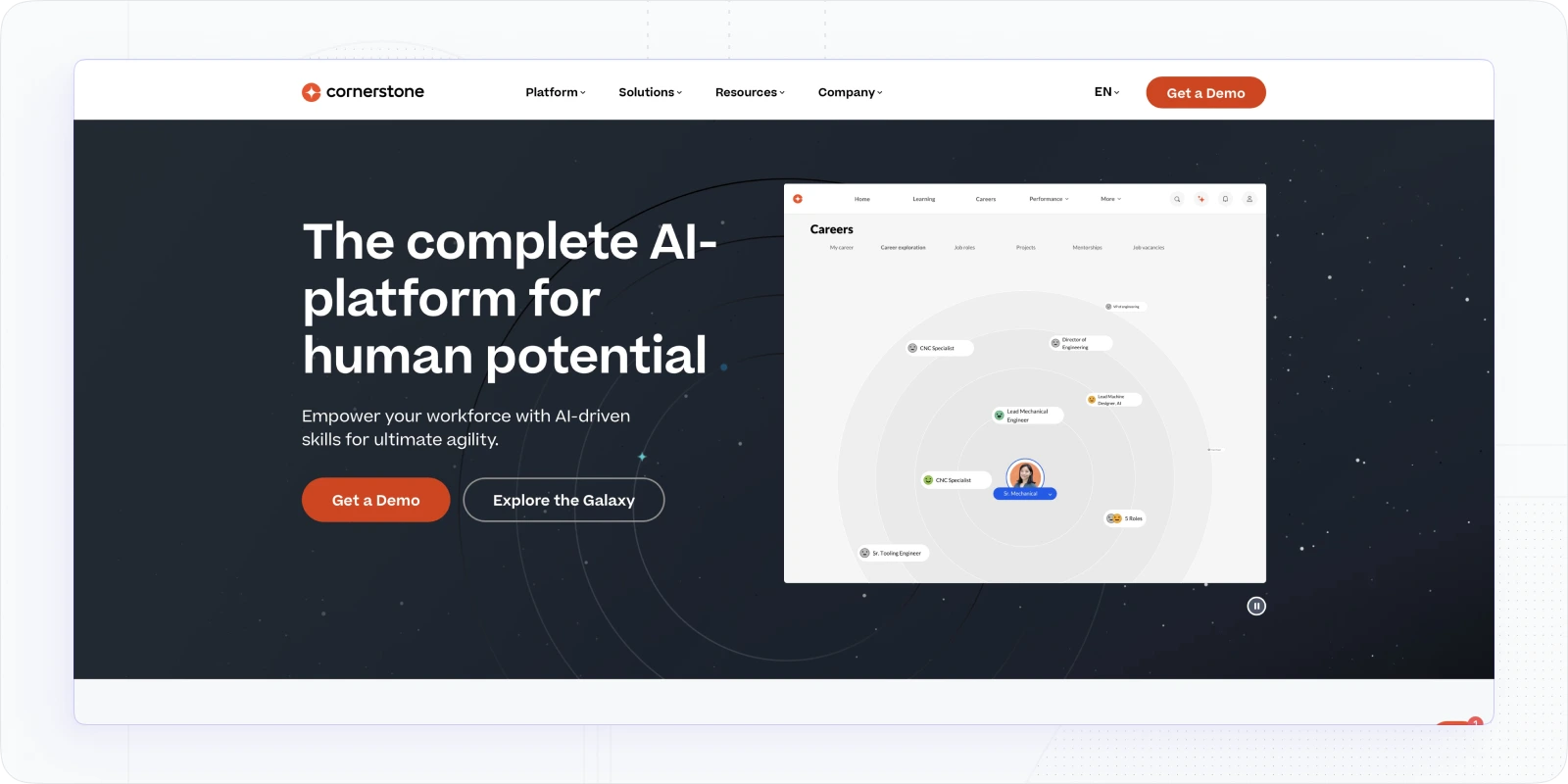
How Cornerstone LMS Pricing Works
The Cornerstone pricing model is quote-based and modular, with no public rate card or fixed tiers. This is why platforms like G2, which aggregate verified enterprise buyer feedback, list Cornerstone’s pricing as “Custom - please request a quote.” The final cost is defined during the sales process.
The four factors that shape a Cornerstone quote
In practice, the Cornerstone OnDemand pricing structure is driven by the following levers:
- The user metric. Pricing may be based on registered users, active users, or a contracted population minimum. However, the metrics that apply depend on the deal structure, and this alone can materially change the effective “per-user” cost, especially for organizations with seasonal usage or large inactive populations.
- The modules selected. Learning is the base, but it’s rarely the full purchase. Talent management, performance reviews, content libraries, analytics, and skills features are priced separately. As more modules are added, costs scale accordingly, often over multiple contract years.
- Enterprise complexity. Geographic footprint, data and security requirements, approval workflows, reporting needs, and integrations all influence pricing. Two organizations with the same headcount can receive very different quotes if one operates in a single region and the other runs a multi-country deployment with strict compliance controls.
- Contract term and minimums. Cornerstone contracts are typically multi-year and include minimum user commitments, with renewal pricing often increasing unless capped during negotiation. These minimums can significantly affect the apparent per-user price, particularly if headcount fluctuates or adoption ramps up slowly.
Cornerstone Pricing Per User
Because Cornerstone doesn't publish list prices, most buyers encounter benchmark ranges from advisors and pricing guides instead.
Some sources cite figures in the range of $6–$10 per employee per month in certain contexts. These numbers can be useful for early back-of-the-envelope planning, but they are not a reliable way to budget for a full deployment.
The reason is simple: Cornerstone is rarely priced as a clean monthly subscription. Implementation costs, module selection, support tiers, and minimum commitments all sit outside that per-user figure.
For enterprise buyers, the more accurate way to think about cost is annual contract value, not monthly seat price.
A reality check on total cost
To understand what Cornerstone really costs, procurement datasets are a useful starting point. For example, according to Vendr procurement data aggregated from enterprise software contracts, the average annual Cornerstone contract value is around $69,000, with higher-end deals reaching approximately $185,000 depending on scope and scale.
These figures show a practical pricing range that helps guide early budgeting and internal planning. However, they are best read as reference ranges, not price guarantees. Actual spend varies widely based on learner population, module selection, and rollout footprint.
The practical takeaway is this: when evaluating Cornerstone LMS pricing, it’s better to model the Cornerstone LMS total cost of ownership (licenses, modules, implementation, integrations, and services) than to anchor decisions on a single per-user number.
Cornerstone Pricing Table [Breakdown]
The following Cornerstone pricing table reflects how this LMS is typically purchased in real deployments. It draws on market benchmarks and public procurement datasets used in large enterprise and public-sector buying decisions.
| Package (typical pattern) | What’s usually included | Typical price range (benchmarks) | Best fit |
|---|---|---|---|
| Cornerstone Learning (Core LMS) | Learning assignments, curricula, compliance tracking, reporting, and mobile learning | Custom quote; many mid-enterprise deployments land in the tens of thousands per year | Organizations with 1,000+ learners and strong compliance or governance requirements |
| Learning + Content Subscription | Core LMS combined with a curated content library | Content has appeared in public-sector listings at approximately £5 per user per year, with wider ranges depending on content scope | Teams seeking faster access to ready-made learning content without sourcing multiple libraries |
| Learning + Talent / Performance Modules | Core LMS plus performance reviews, goal management, and skills frameworks | Adds meaningful cost; typically priced modularly across the covered population | HR organizations standardizing performance management and employee development processes |
| Enterprise Suite (multi-module) | Learning, talent management, content, analytics, and enterprise integrations | Can reach six figures annually at scale; procurement datasets show high-end deals in this range | Global enterprises with multi-region rollouts and complex HR technology stacks |
The key point: Cornerstone learning pricing reflects how much you deploy, not which “plan” you choose.
Additional Costs to Expect
Beyond licensing, Cornerstone deployments carry a second layer of costs that often shape the final budget. These Cornerstone hidden fees are usually not separate line items at first: they surface as planning turns into implementation, integrations are scoped, and operating requirements become real.
Implementation and onboarding
Based on user-reported timelines from enterprise HR teams and procurement reviews, Cornerstone deployments take about seven months on average. This duration directly affects total cost, as configuration work, system integrations, and phased rollouts extend both vendor services and internal effort.
In practice, the Cornerstone LMS implementation costs can reach tens of thousands (commonly 20–50% of the first-year license), and internal time can match or exceed external spend.
The internal time and resources used can match or exceed what is paid to external partners. This is typically the first point at which the total cost exceeds the original estimate.
Integrations
Cornerstone is typically connected to other HR and IT systems, such as Workday, SAP SuccessFactors, Oracle HCM, and identity providers like Azure AD or Okta. While technical connectors exist, the work involved goes beyond setup.
Costs come from security reviews, HRIS data mapping, role and permission design, testing, and ongoing maintenance, especially when HR systems change. These efforts add time and cost, even if they don’t appear as a single line item.
Content, support, and reporting
Learning content is rarely included by default. But when added, it becomes a recurring cost that grows with the number of users. Support follows a similar pattern. Based on patterns seen in enterprise LMS renewals, many organizations later upgrade to premium support or dedicated services once issues surface during rollout or expansion.
Reporting is another area where costs grow over time. While Cornerstone provides reporting tools, enterprise teams often need custom reports, regional dashboards, or BI exports. The main cost here is ongoing effort: building, adjusting, and maintaining reports as requirements change.
What Makes Cornerstone Expensive (or Affordable) in Practice
Cornerstone OnDemand pricing is driven less by size and more by how complex the deployment is. The biggest cost drivers tend to be:
- Global rollout: multiple regions, languages, and compliance requirements.
- Audience type: employees only vs. extended audiences (partners, contractors).
- Governance: strict role permissions, approval chains, and audit needs.
- Integrations: HRIS, identity providers, content libraries, and BI tools.
- Contract structure: minimum user or contract value commitments (often several hundred users), term length, and renewal clauses.
Why Buyers Still Choose Cornerstone
Cornerstone is typically shortlisted when learning is treated as enterprise infrastructure, not a lightweight tool. Common reasons include:
- Compliance-heavy training environments with audit pressure.
- Large learner populations and complex org structures.
- Global rollouts that require standardization and control.
- A need to align learning closely with talent and performance systems.
In regulated industries, pricing is often justified against risk. Cornerstone itself cites an average $490,000 cost per employment lawsuit when discussing compliance economics. Whether or not that exact figure applies, the underlying logic is familiar: for many enterprises, the cost of non-compliance far outweighs the cost of the platform.
Where Cornerstone Can Be a Wrong Fit
Cornerstone is not always the right fit, especially when its structure outweighs immediate needs. It can be overbuilt for organizations that are:
- Under 1,000 learners and still experimenting with enablement programs
- Prioritizing speed of rollout over governance and standardization
- Lacking HRIS maturity, which makes integrations harder
- Trying to avoid multi-year commitments and minimum seat requirements
The hidden cost here is not just money. It’s time to value. A multi-month implementation can be reasonable for global enterprises, but it can slow momentum significantly for fast-moving teams.
Final Verdict: Is Cornerstone LMS Worth it in 2026?
For organizations with global compliance requirements, complex structures, and a mature HR technology stack, Cornerstone can be a solid long-term choice. Once the scope is defined, Cornerstone software pricing becomes more predictable, and the level of control the platform offers can justify the investment.
For teams that need to move quickly, keep implementation light, or tightly align costs to short-term needs, Cornerstone may be harder to justify. Longer rollout timelines, minimum commitments, and added complexity can slow time to value.
The real question isn’t simply whether Cornerstone is expensive. It’s whether your organization truly needs (and is prepared to manage) the level of structure, process, and governance that Cornerstone is built to support.
That’s why many teams exploring enterprise LMS solutions also spend time reviewing Cornerstone alternatives. When speed of deployment, pricing transparency, and operational flexibility become higher priorities than deep enterprise governance, lighter-weight platforms often enter the evaluation process.
In these scenarios, solutions like EducateMe frequently appear on the shortlist, particularly for organizations that value rapid rollout, simpler administration, and clearer pricing models over extensive multi-module ecosystems. For growing teams or modern training programs, balancing capability with agility can make all the difference.
Why EducateMe?
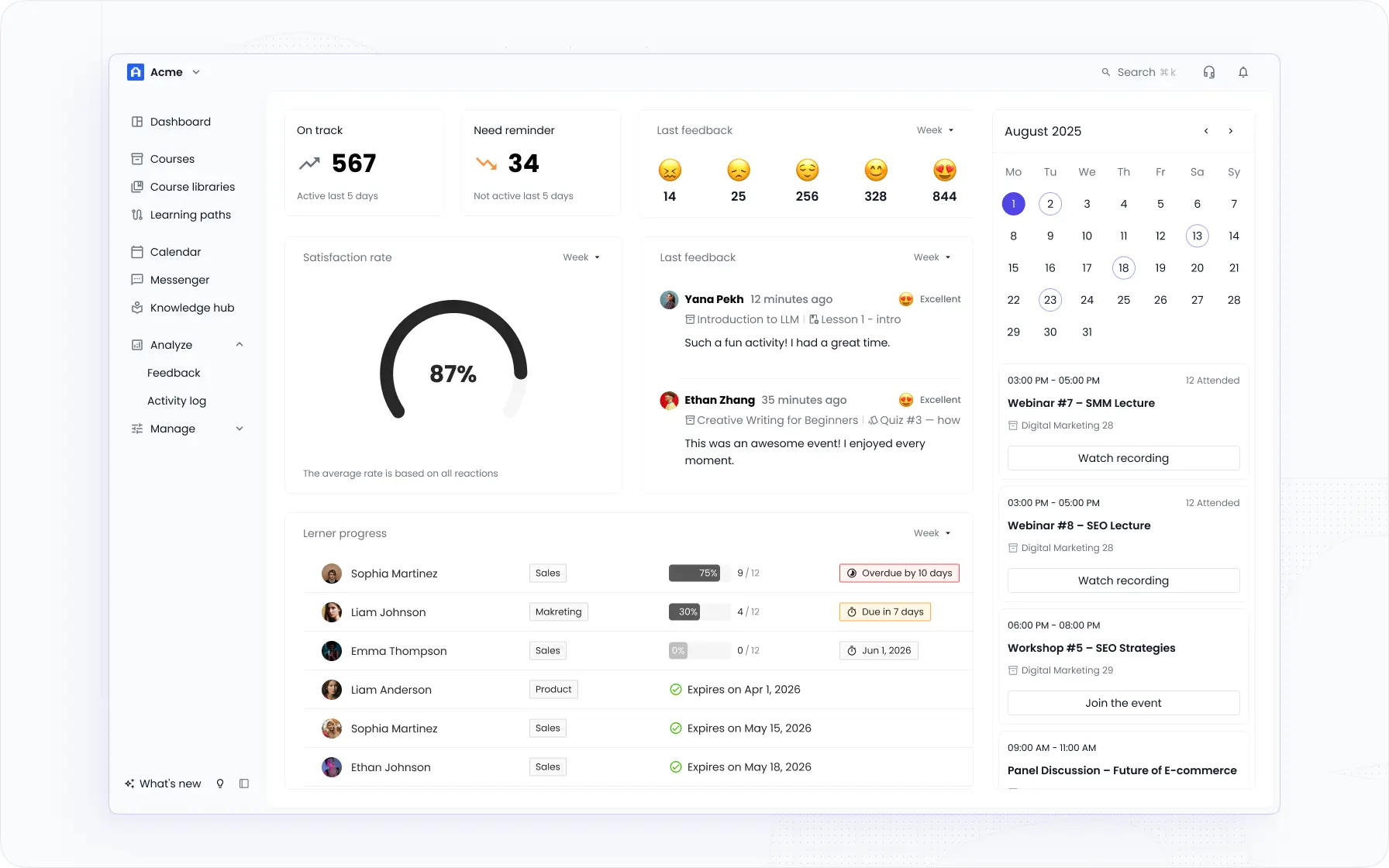
For teams evaluating Cornerstone, the conversation often centers on scale, governance, and long-term standardization. But not every organization needs a highly layered enterprise LMS to deliver effective training, especially when speed, clarity, and adaptability matter more than deep HR system complexity.
EducateMe is designed for organizations that want meaningful learning outcomes without navigating multi-module contracts, lengthy implementations, or rigid user models.
Rather than anchoring pricing and setup to enterprise-wide structures, EducateMe emphasizes flexibility and practical usability. Organizations choosing EducateMe typically benefit from:
- Straightforward pricing that aligns more closely with actual training needs, not broad organizational headcount
- Fast deployment, enabling teams to launch fully branded learning environments in a short timeframe
- AI-supported content creation and automation, reducing reliance on manual administration
- Native multi-tenant architecture, ideal for training departments, customers, partners, or multiple business units
- Advanced white-labeling, allowing full control over branding and learner experience
- Built-in live sessions, analytics, integrations, and progress tracking, all within a clean, intuitive platform
- A complete free trial, giving teams real product access before making a purchasing decision
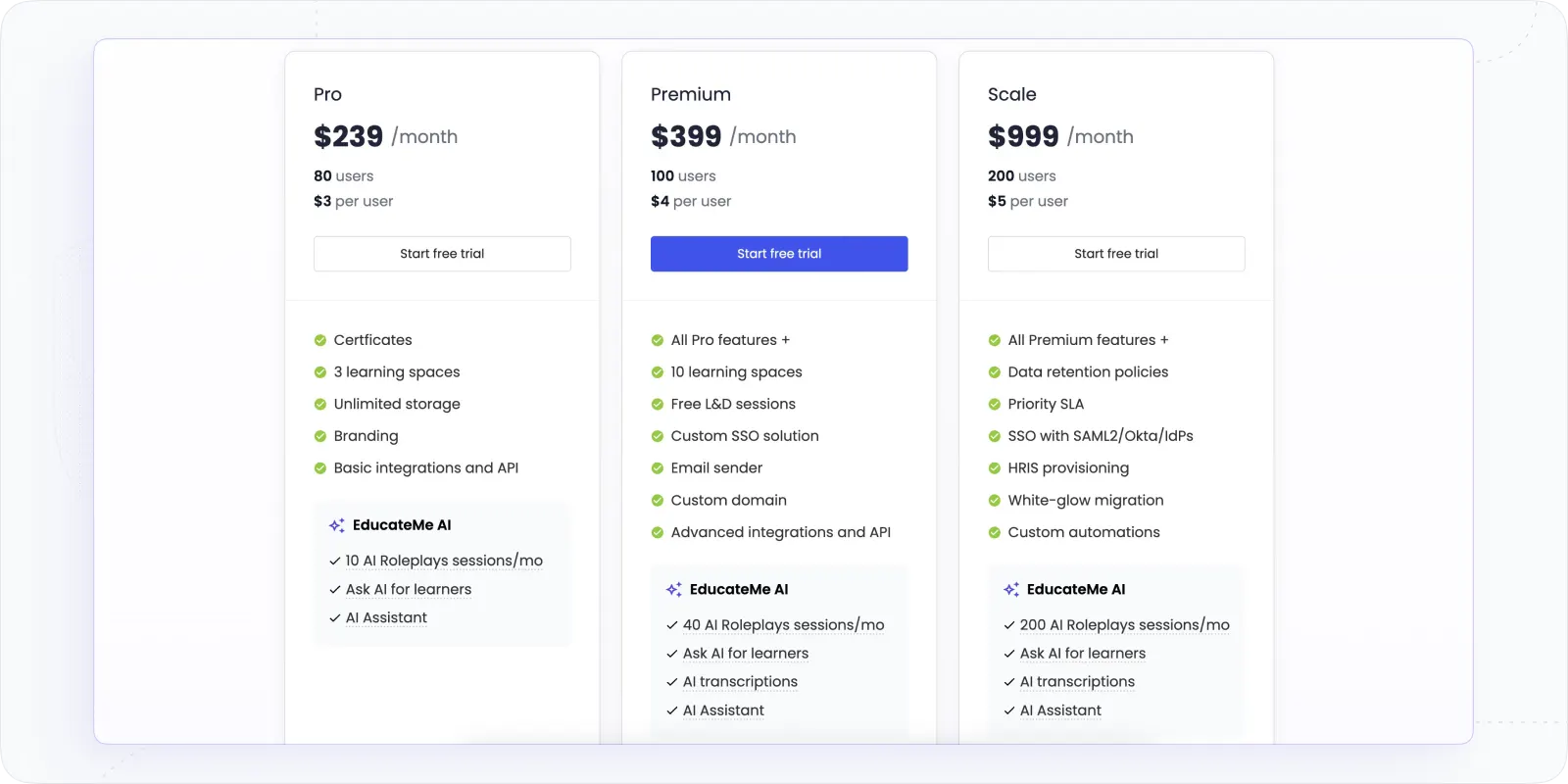
If Cornerstone feels too complex, too long-term in its commitment, or too tightly coupled to enterprise HR processes, EducateMe offers a more agile alternative. It delivers the tools needed for professional training programs while remaining accessible for teams that value momentum, transparency, and ease of ownership.
See how EducateMe fits your training strategy — schedule a demo and get pricing aligned with your real needs.
Frequently asked questions
No. Cornerstone doesn't publish a self-serve free trial or a free tier, since it sells through a sales-led enterprise process with guided demos instead. You'll typically see the product through a scoped demo tied to your use case, not a hands-on sandbox. If trying the platform before committing matters to you, that's worth flagging early — some lighter LMS platforms, EducateMe included, offer full free trials with real product access
Focus on the levers that actually move the number: cap renewal increases in the contract, negotiate the user metric (active vs. registered), and trim modules you won't use in year one. Ask for phased pricing tied to adoption ramp rather than paying for full seats on day one. Bundling multi-year terms can cut the rate, but only commit to minimums you're confident you'll fill.
Cornerstone sits at the higher, more complex end — quote-based, modular, and multi-year, with pricing driven by deployment scope rather than a clean per-seat rate. Competitors like SAP SuccessFactors and Workday Learning follow similar enterprise procurement models. Mid-market platforms differ sharply: EducateMe, for example, uses transparent published pricing tied to training needs rather than organizational headcount, which makes budgeting far more predictable for smaller teams.
Not easily. Cornerstone contracts are typically multi-year with minimum user or contract-value commitments, so early exit usually means paying out the remaining term. Downgrading mid-contract is often limited by those same minimums. Read the renewal and termination clauses carefully before signing, and negotiate an off-ramp or adoption-based flexibility upfront — it's much harder to add once the contract is in place. Book a demo with a more flexible platform if long commitments concern you.