
5 Best Uplimit Alternatives After the Handshake Deal (2026)

By Roman ShaukRoman ShaukCorporate Training & AI Expert, FounderRoman Shauk is the Founder of EducateMe.Read more
Corporate Training & AI Expert, Founder
16 min read
Most teams searching for Uplimit alternatives this week aren't unhappy with the product. They're reacting to a headline: on June 30, 2026, Handshake — the early-career network — acquired Uplimit, and the announcements say a lot about job seekers and nothing about existing corporate customers.
Full disclosure before we go further: I'm the founder of EducateMe, one of the platforms on this list. I run an LMS company, so I read acquisition announcements the way you probably read them right now — asking "what happens to the people already on the platform?" This guide answers that question first, then walks through 5 genuine Uplimit alternatives matched to what teams actually ran on it. It's also honest about who shouldn't switch at all.
What the Handshake Acquisition Means for Uplimit Customers
Handshake acquired Uplimit on June 30, 2026, for an undisclosed amount. Handshake's stated plan is a free, consumer-facing "skills studio" — AI learning experiences tied to career paths and job profiles for its network of 25+ million job seekers. As of early July 2026, no announcement addresses what happens to Uplimit's existing corporate customers or their contracts.
Here's what the announcements actually say:
- The buyer. Handshake is the career network for students and early-career workers: 25+ million job seekers, 1,600+ colleges, and around a million employers. It also runs Handshake AI, a data-labeling business for frontier AI labs.
- The plan. A "skills studio" offering free AI-skills curriculum by career path (sales, marketing, business analysis), where learners build projects and earn credentials that show up on their Handshake profiles. Julia Stiglitz, Uplimit's CEO, framed the ambition as building "the job and skilling network for the AI age."
- The gap. Nothing published so far — not on Uplimit's site, not in Handshake's materials — states a roadmap for the enterprise product. Josh Bersin, who's tracked Uplimit since its launch, wrote that his first reaction was that the company "simply sold too early in their goal to win over the corporate learning market" before warming to the consumer opportunity. That analyst read matches mine: the center of gravity just moved away from corporate L&D.
There's a pattern here worth naming. Uplimit is the second AI-native learning platform absorbed by a bigger network in under a year — Workday announced its $1.1 billion acquisition of Sana in September 2025, and we covered what that meant in our guide to Sana Labs alternatives. I'd call it the consolidation wave: standalone AI learning platforms keep becoming features inside larger networks, and after the deal closes, the acquirer's roadmap — not yours — decides the product's future. The practical buying rule that follows: pick a platform whose entire business is corporate training, because that's the roadmap you can actually rely on.
What should you do this quarter? Nothing dramatic. Check your renewal date, export a content inventory while everything works normally, and shortlist a successor so a migration is a plan rather than an emergency. Our LMS migration playbook covers the sequence step by step.
Uplimit Overview: Is It Still a Good Platform?
Let me say this plainly: the product itself is good, and nothing about the acquisition changes that overnight. Uplimit (formerly CoRise) is an AI-native learning platform built around personalized practice and feedback — its AI Skills Instructor turns learning objectives and existing content into adaptive programs, learners rehearse real scenarios through voice and visual simulations, and cohort automation handles the nudges, reminders, and announcements that normally eat an L&D coordinator's week.
The pedigree is real too. Julia Stiglitz was an early Coursera employee who built its enterprise business past 1,000 customers; her co-founders came from Google ML and Coursera product. Greylock, GSV Ventures, Cowboy Ventures, and Salesforce Ventures backed the company. Customers include Databricks, Gusto, Procore, Kraft Heinz, and GE HealthCare. Uplimit reports 12× higher completion rates than traditional e-learning and 93% less admin time on program management — company-reported figures, but directionally consistent with the 75–80% course completion Salesforce Ventures cited when it invested in 2024.
Two things were always harder to pin down. Pricing is custom and enterprise-shaped — there's no public price list. And the public review base is thin: unlike most established platforms in this category, Uplimit has almost no verified reviews on G2 or Capterra, so third-party validation mostly rests on its customer logos.
Uplimit's product remains one of the strongest AI-first learning experiences on the market. What changed on June 30, 2026 is who sets its direction: an early-career job network, not its corporate customers.
Why look for Uplimit alternatives now?
None of the reasons below are product complaints. They're ownership math, and they're worth taking seriously precisely because the product is good.
- The roadmap points at consumers. Handshake's stated plan is a free skills studio for job seekers — energy flows to the 25-million-user network, not the enterprise backlog.
- No continuity statement. As of July 2026, neither company has published what happens to existing corporate contracts, support SLAs, or the enterprise feature roadmap.
- Renewals are now a bet. Uplimit runs on custom annual contracts. Signing one today means betting a year of your training program on a roadmap nobody has stated.
- The consolidation pattern. Second standalone AI learning platform acquired in a year. Teams that migrated off Sana after the Workday deal will recognize this fork in the road.
Best Uplimit Alternatives for Corporate Training Teams
I picked these 5 for Uplimit's actual customer base — teams running AI-built programs with real practice, live cohorts, and mastery tracking — not as a generic LMS roundup. Every pick is a company whose core business is corporate training, which is the whole lesson of the consolidation wave.
One honesty note on pricing before the list: most vendors in this category quote custom enterprise contracts, so treat "custom" as "expect a sales call." EducateMe and Disco are the exceptions with published pricing — and I'll be equally clear about everyone else's model.
- EducateMe — closest like-for-like replacement: AI-built courses, voice roleplay practice, cohort + self-paced programs.
- 360Learning — collaborative course creation at mid-market and enterprise scale, built on internal experts.
- Disco — AI-native cohort programs, academies, and community-driven learning.
- Docebo — enterprise-grade governance, integrations, and global rollouts.
- LearnUpon — multi-portal delivery for customer and partner education.
| Platform | Best for | Content creation | AI capabilities | Cohort / live | Practice / roleplay | Pricing | G2 |
|---|---|---|---|---|---|---|---|
| EducateMe | Like-for-like Uplimit replacement | AI Assistant builds from docs, URLs, SOPs | AI-native: creation, assessment, roleplay, analytics | Cohort + self-paced in one | Voice AI roleplay, rubric-scored | From $239/mo, published | 4.8 |
| 360Learning | Collaborative, SME-driven programs | Collaborative authoring + AI | AI Companion, AI-assisted authoring, skills-based learning | Strong cohort/social DNA | Not advertised | From $8/user/mo (≤100 users), then custom | 4.6 |
| Disco | Cohort academies and communities | AI-assisted curriculum design | AI agents for program ops | Built for cohorts/community | No | From $399/mo (annual) | See G2 |
| Docebo | Enterprise scale and governance | AI authoring (Content Creator) | Harmony AI: authoring, roleplay, knowledge search, agents | ILT/vILT support | AI Roleplay (virtual coaching) | Custom, annual | 4.3 |
| LearnUpon | Customer and partner education | Create+ AI authoring | AI-assisted learning suite | Live sessions supported | No | Custom, seat-banded | 4.5 |
#1. EducateMe: Best Like-for-Like Replacement for Uplimit's AI-First Core
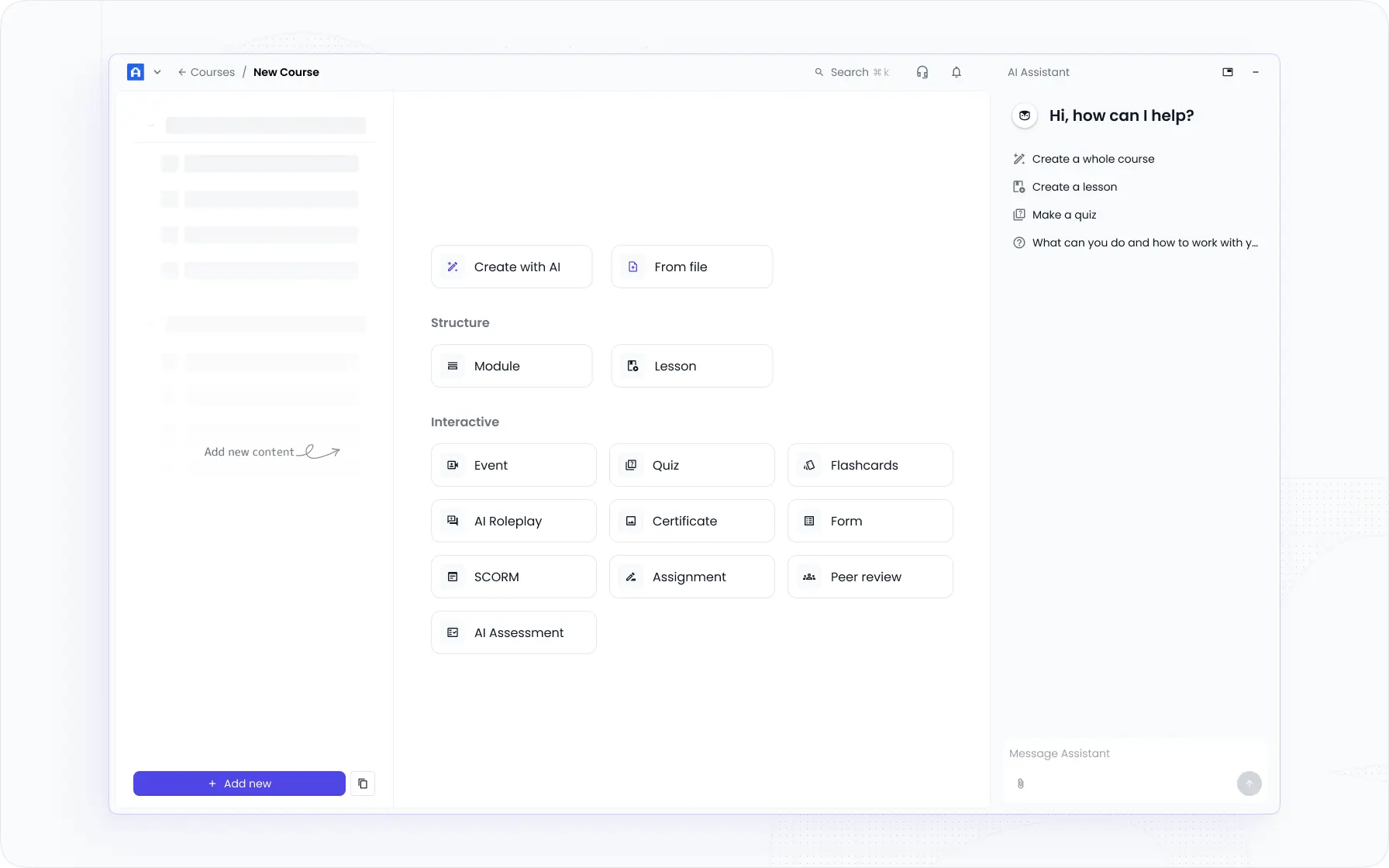
EducateMe is an AI-native LMS for modern training teams that want to launch AI-built, practice-heavy programs in hours instead of weeks. I'm biased — it's my company — so here's the un-spun version: we're first on this list because the overlap with what Uplimit did well is unusually direct, and you can verify every claim in a free trial rather than taking my word for it.
The core workflow will feel familiar to an Uplimit team. The AI Assistant builds a first-pass course from the docs, URLs, and SOPs you already have — customer data shows course creation running about 3× faster than manual builds. Practice is native, not bolted on: the AI Roleplay Coach runs voice conversations with AI personas and scores learners 0–100 against your rubric — the same practice model Uplimit ran. (Docebo ships roleplay too, at enterprise weight; here you can test it this afternoon.) Delivery covers both of Uplimit's modes — live cohort programs and structured self-paced paths that release steps in order — and completion runs at 83% across customer programs (customer data). You can see how EducateMe customers run their programs for the receipts.
Where Uplimit optimized for enterprise contracts, EducateMe publishes its pricing and includes support on every plan — the switching-risk math is different when you can test the whole product for 14 days without a procurement cycle.
EducateMe offers a free trial with full access to every feature — including its AI assistant — so you can test it before committing.
Key features of EducateMe
- AI course creation. Turn existing docs, URLs, or SOPs into a full course in minutes — with generated images, video, and quizzes.
- AI Roleplay Coach. Learners practice real conversations with voice AI personas, scored 0–100 against your rubric — Uplimit-style simulation practice.
- Cohort + self-paced paths. Run live cohort programs and sequential learning paths in one place; required steps can't be skipped.
- Analyze with AI. Skill gaps and performance patterns surfaced across quizzes, roleplays, and assessments — mastery visibility, not just completions.
- Multi-audience portals. Train employees, customers, and partners in separate branded spaces.
Pros
- AI built into every step: creation, delivery, assessment, practice, analytics
- Published pricing and a 14-day full-feature trial — no procurement cycle to evaluate
- Support included on all plans, not reserved for enterprise tiers
- Cohort and self-paced delivery in the same platform
Cons
- No native mobile app — learners use the mobile-responsive web version
G2 Rating: 4.8 out of 5
Best for: teams replacing Uplimit's core — AI-built courses, voice practice, and cohort programs — without inheriting another enterprise sales cycle.
#2. 360Learning: Best for Collaborative, SME-Driven Programs at Scale
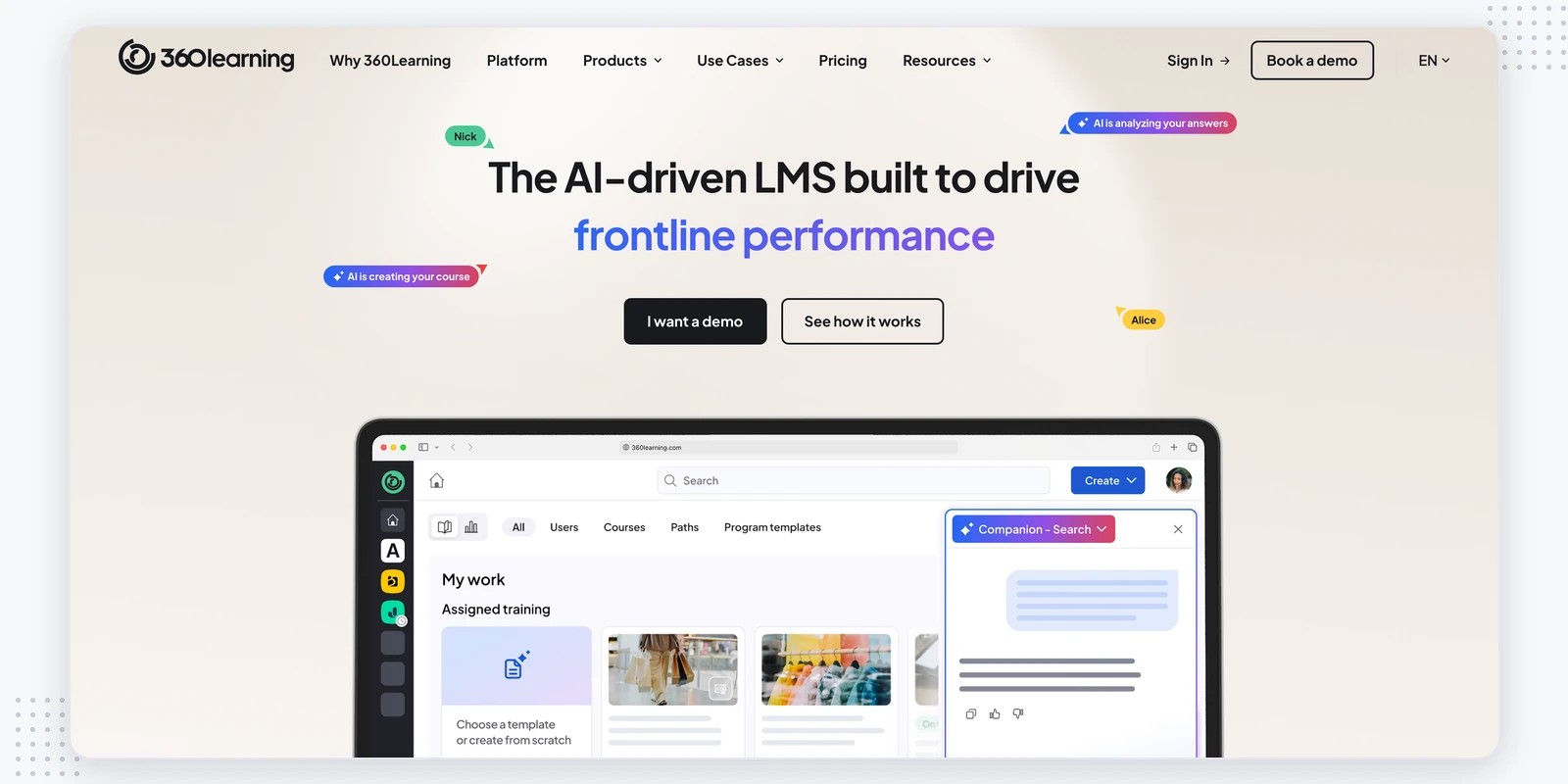
360Learning is a collaborative learning platform where courses are built by your internal experts rather than a central L&D team. If what you valued in Uplimit was the peer momentum — cohorts moving together, discussion threaded into the course — 360Learning is the most established platform with that DNA. Its authoring tool is genuinely fast for SME contributions, AI helps draft courses and recommendations (AI Companion, AI-assisted authoring), and reactions and comments keep programs social by default.
I'd shortlist 360Learning when the bottleneck is subject-matter experts, not program design: it's built to pull knowledge out of your senior people's heads and into courses without making them instructional designers.
The trade-offs are the mirror image of its strengths. The collaborative model needs internal champions to keep content flowing, admin structure gets heavy as you scale across departments, and conversation practice isn't part of the advertised toolkit — there's no Uplimit-style roleplay simulation.
Key features of 360Learning
- Collaborative authoring. SMEs draft courses in minutes with templates and AI assistance; peers react and improve them.
- Champion workflows. Identify internal experts and route course requests to them.
- Cohort-based delivery. Sessions, discussions, and group progress built into the learning flow.
- Skills-based learning. AI maps courses to skills and tracks coverage across teams.
Pros
- The strongest collaborative/SME model in the category
- Fast authoring with built-in AI assistance
- Social features (reactions, comments, forums) keep cohorts engaged
Cons
- Needs sustained internal champions to deliver on the collaborative promise
- Admin complexity grows quickly at enterprise scale
- No conversation-practice/roleplay feature
G2 Rating: 4.6 out of 5
Pricing: Team plan $8/user/month (up to 100 users); custom pricing above that
Best for: mid-market and enterprise teams whose training content should come from internal experts, with cohort and social learning built in.
#3. Disco: Best for Cohort Academies and Community Programs
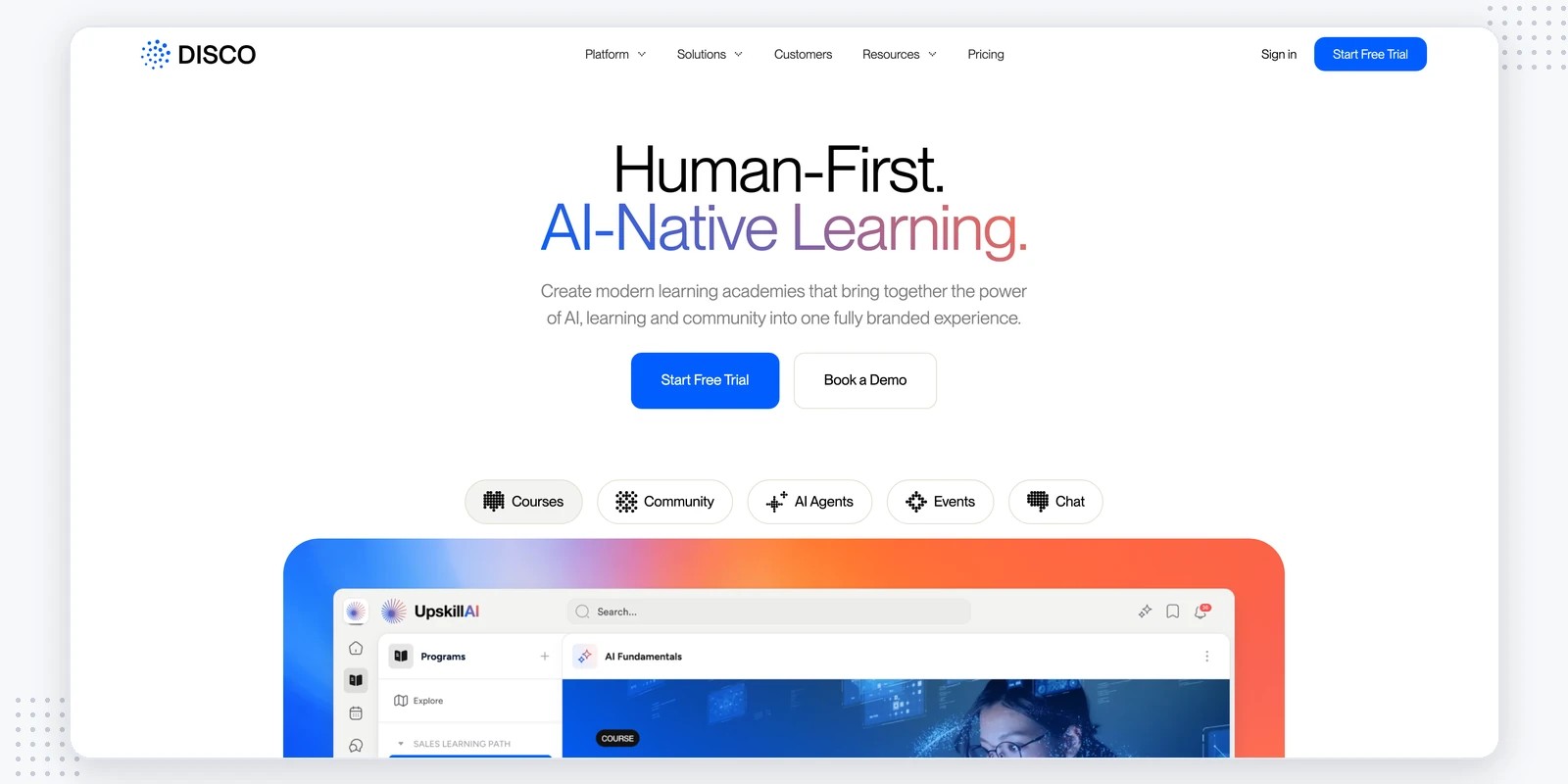
Disco is an AI-native platform for cohort-based programs, academies, and learning communities. Of everything on this list, it's the closest match to Uplimit's live-cohort experience: programs run as cohorts with events, discussion, and community threaded through, and its AI handles curriculum drafts, quizzes, and learner support (Ask AI). Training businesses, bootcamps, accelerators, and customer-education teams are its natural users.
What I like about Disco is that it treats community as the delivery mechanism rather than a tab nobody opens. If your Uplimit programs leaned on peer energy — capstone projects, live sessions, cohort channels — Disco preserves that feeling better than a classic corporate LMS will. It also publishes pricing and offers a 14-day trial, which puts it in the test-before-you-buy camp with EducateMe.
Apply the same lens this article started with, though: Disco is a younger venture-backed vendor in a consolidating category. It's built external-programs-first — internal-employee depth (compliance-style tracking, HRIS-driven automation) isn't the pitch — and there's no voice-roleplay practice.
Key features of Disco
- Cohort program design. Curriculum, live events, and community in one program structure.
- AI program operations. AI agents and Ask AI draft curriculum, generate quizzes, and answer learner questions.
- Community spaces. Channels, discussions, subgroups, and leaderboards native to the learning experience.
- Branded academies. Run your academy on a custom domain with unlimited learning products.
Pros
- Closest live-cohort and community experience to Uplimit's
- AI-assisted program creation and operations
- Published pricing and a 14-day free trial
Cons
- Younger vendor — the same category-consolidation risk this article is about applies
- External-programs-first; thinner internal-training depth (compliance tracking, HRIS automation)
- No voice roleplay practice
G2 Rating: See reviews on G2
Pricing: Organization plan $399/month billed annually ($499 monthly); Enterprise custom
Best for: cohort academies, accelerators, and community-driven programs where peer interaction is the product.
#4. Docebo: Best for Enterprise-Scale Rollouts and Governance
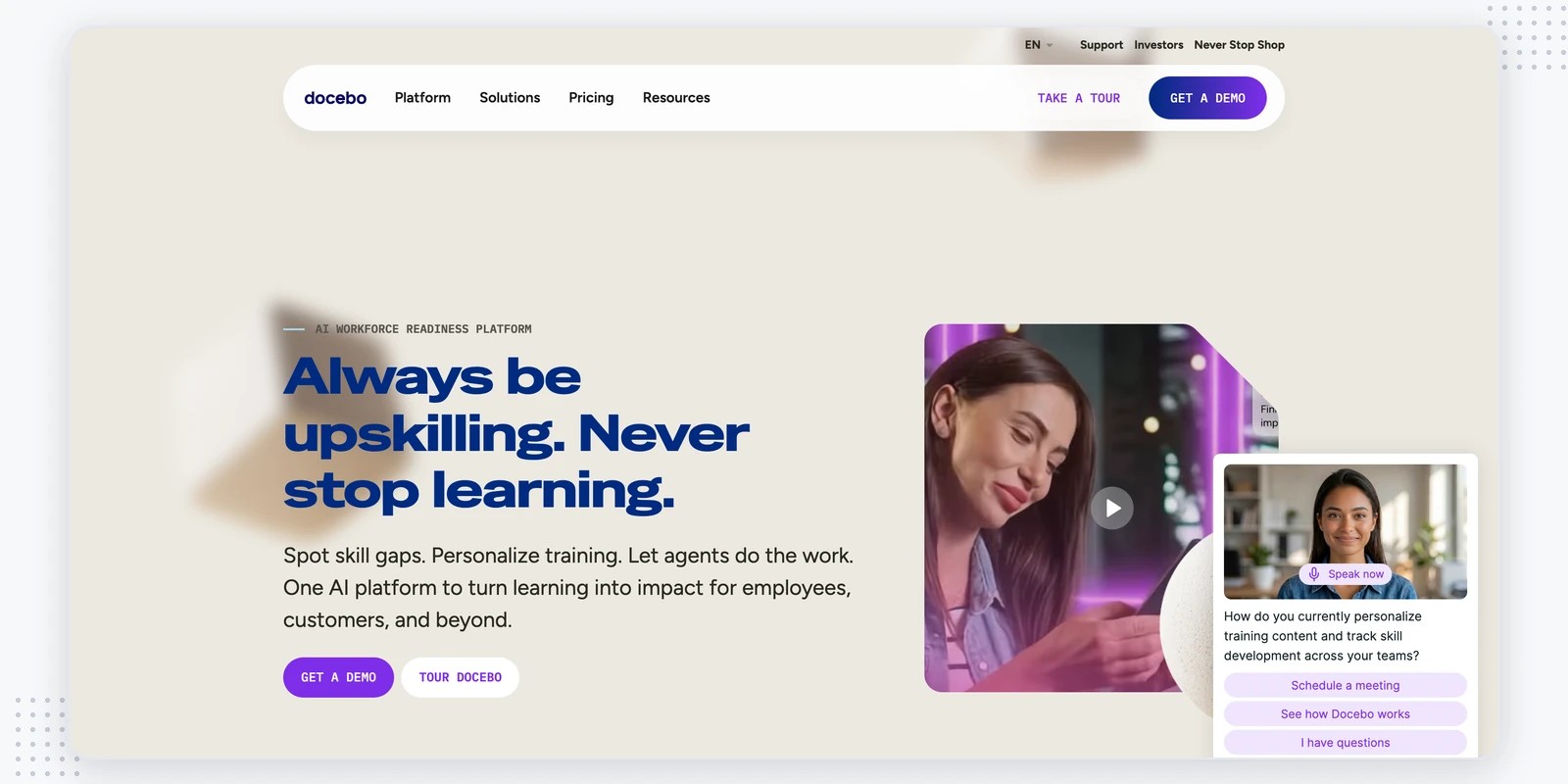
Docebo is the stability pick, and after June 30 that word carries weight. It's a public company whose entire business is corporate learning — the opposite of a platform that just became a feature inside a job network. For Uplimit's largest customers (the Kraft Heinz and GE HealthCare end of the spectrum), Docebo offers what an acquisition-nervous enterprise wants: multi-brand delivery, deep integration coverage, formal governance, and a roadmap that answers to L&D buyers.
Docebo's AI has grown into a full suite it calls Harmony AI: Content Creator for AI authoring, AI Roleplay for virtual coaching, enterprise knowledge search, and AgentHub for AI agents. That makes it the one enterprise platform here that also covers Uplimit-style conversation practice. I ranked it fourth anyway, for a simple reason: for most Uplimit-sized programs it's more platform than you need. Implementations run months, pricing is custom and annual, and the suite is built for enterprise procurement rather than a team that wants a practice program live this quarter.
Key features of Docebo
- Extended enterprise. Separate branded audiences (employees, partners, customers) from one platform.
- Harmony AI suite. AI authoring, AI Roleplay virtual coaching, knowledge search, and AI agents.
- Integration depth. Native connectors across HRIS, CRM, and content sources.
- Governance and reporting. Enterprise roles, audit trails, and custom dashboards.
Pros
- Public company with corporate learning as its whole business — the stability pick
- Handles global, multi-brand, multi-audience rollouts
- AI suite now includes roleplay-based virtual coaching
Cons
- Implementation and admin weight — plan for months, not days
- Custom annual pricing; total cost climbs as modules stack
- More platform than most sub-500-learner programs need
G2 Rating: 4.3 out of 5
Pricing: custom, annual contracts; quote-based
Best for: enterprises that want a public, training-only vendor with governance, integrations, and AI coaching at global scale.
#5. LearnUpon: Best for Customer and Partner Education Programs
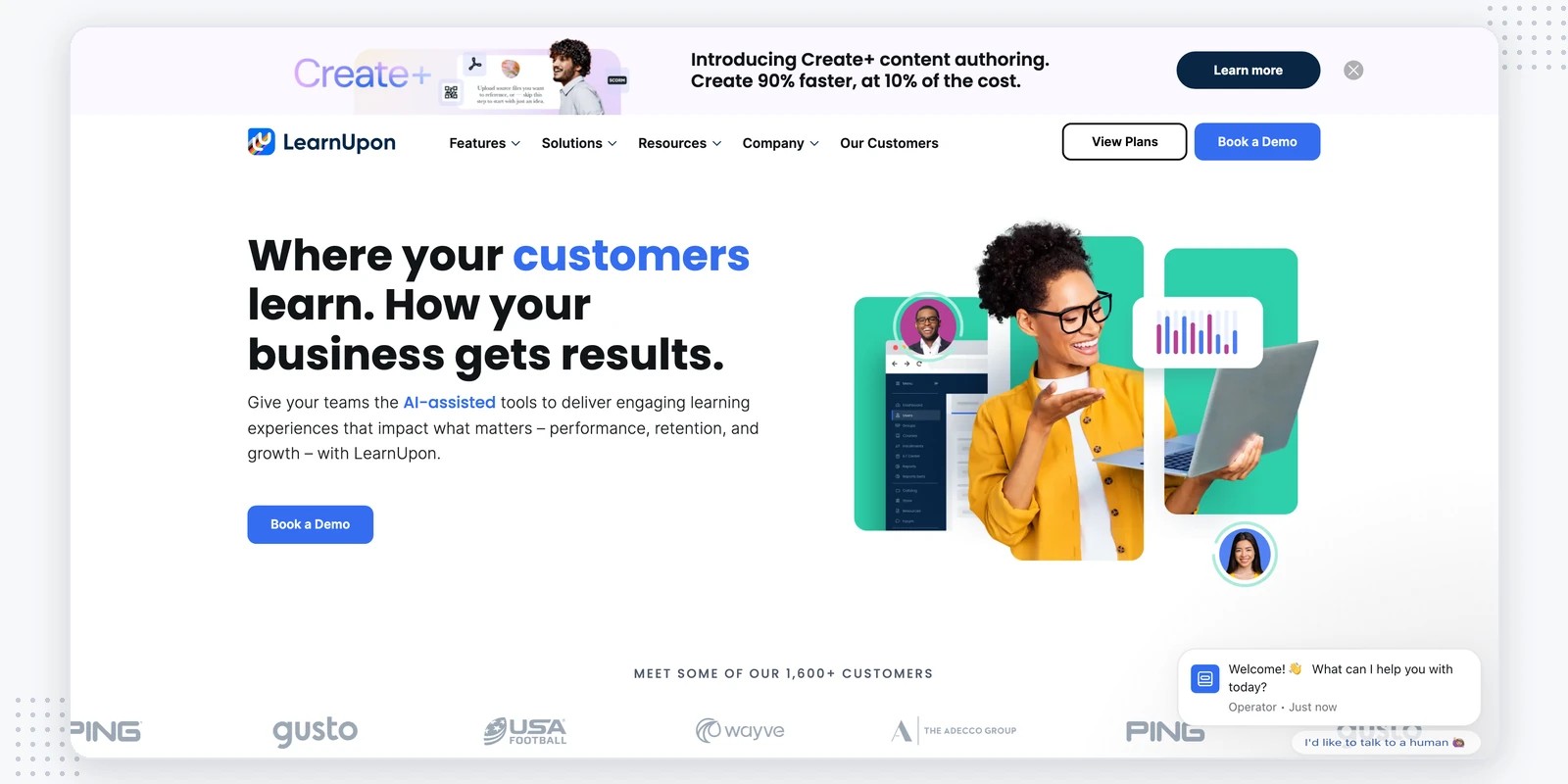
LearnUpon is a multi-portal LMS built for training several audiences at once — employees, customers, partners — each in its own branded environment with separate reporting. Uplimit marketed a customer-education use case, and for teams whose main program is external, LearnUpon is the specialist: 1,600+ customers run their training through it, and its customer-experience team stays involved from implementation on — that hands-on support is central to how it sells.
I've watched customer-education teams choose LearnUpon for a mundane but decisive reason: the admin experience stays manageable when you're running six portals with different branding, catalogs, and completion rules. That's the job it's engineered for.
The honest gap is practice. LearnUpon's AI centers on authoring — Create+ claims courses built 90% faster at 10% of the cost — but there's no simulation or roleplay layer. If your Uplimit programs mixed customer education with practice-heavy internal training, pair this entry's job with the AI-first way to cover training external audiences and employees from one platform — that's what EducateMe's multi-audience portals are for.
Key features of LearnUpon
- Multi-portal architecture. Separate branded portals per audience with independent catalogs and reporting.
- Create+ AI authoring. Build courses dramatically faster with AI content authoring (LearnUpon claims 90% faster).
- Automation and integrations. Training tasks automated; data flows to your CRM and other systems.
- AI-assisted learning suite. AI features across course delivery and learner support.
Pros
- Purpose-built multi-audience delivery
- Hands-on implementation and support experience
- Straightforward admin at multi-portal scale
Cons
- No practice/roleplay layer
- AI capabilities center on authoring, not delivery-wide intelligence
- Custom pricing, seat-banded
G2 Rating: 4.5 out of 5
Pricing: custom, seat-banded annual plans
Best for: customer and partner education programs where multi-portal delivery and dependable support matter more than AI depth.
Who Should Stay on Uplimit (For Now)
Not everyone should migrate, and I'd rather lose you to that conclusion than push a pointless switch. Stay put — for now — if you're mid-contract with deep program investment and no renewal before mid-2027: your programs keep running, and panic-migrating a working stack burns goodwill and budget for a risk that hasn't materialized yet.
Staying also makes sense if Handshake's direction is your direction. A team whose training goal is early-career AI skills — with credentials that surface in a hiring network — may end up better served by the combined company than by any platform on this list.
Picture the realistic middle case: a 2,000-person company, nine months left on the contract, three flagship programs live. The right move there isn't a migration project this quarter. It's a decision date — put "evaluate Uplimit continuity" on the calendar for 90 days before renewal, export your content inventory now, and judge Handshake's enterprise signals then. If the roadmap statement never comes, that silence is your answer.
Conclusion: Which Uplimit Alternative Is Best?
The trade-off runs on two axes: how much of Uplimit's AI-first, practice-heavy experience you need to preserve, and whether your programs serve employees, external audiences, or an enterprise org chart.
For most teams leaving Uplimit, EducateMe is the closest like-for-like home: AI-built courses, voice roleplay practice, and cohort programs on one platform — from a company whose entire business is corporate training, with published pricing you can check today.
- Choose EducateMe if you're replacing Uplimit's core — AI course creation, real practice, cohorts — and want to verify it in a trial, not a sales cycle.
- Choose 360Learning if your content should come from internal experts and social, collaborative learning is the point.
- Choose Disco if your programs are cohort academies or communities where peer energy drives outcomes.
- Choose Docebo if you're an enterprise buying stability, governance, and AI coaching at global scale.
- Choose LearnUpon if customer and partner education is the main job and multi-portal admin is your daily reality.
The acquisition took the decision out of your hands once. The way to take it back is a shortlist of Uplimit alternatives you've actually tested. Start a free trial with full feature access, or book a demo and we'll map your Uplimit programs to EducateMe together.
Frequently asked questions
No shutdown has been announced. Handshake's stated plan is a free, consumer-facing AI skills studio, and as of July 2026 neither company has published what happens to existing corporate contracts or the enterprise roadmap. Watch your renewal date: many teams are shortlisting Uplimit alternatives now so a migration, if it comes, is a plan rather than an emergency.
The closest like-for-like option is EducateMe — AI-built courses, voice roleplay practice, and cohort programs, with published pricing from $239/month. Docebo fits enterprises that want governance at global scale, and LearnUpon fits customer and partner education. Match the platform to the programs you actually ran on Uplimit rather than to a generic feature checklist.
Start with an inventory: export course content, learner records, and completion data while everything works normally. Map each live program to the new platform's formats, then pilot one cohort end-to-end before a full cutover. AI course creation shortens the rebuild — EducateMe's AI Assistant, for example, regenerates courses from the source docs you already have, so re-authoring takes hours instead of weeks.
Yes, though it's rarer than AI course authoring. EducateMe's AI Roleplay Coach runs voice conversations with AI personas and scores learners 0-100 against your rubric — the same practice model Uplimit used. Docebo also offers AI Roleplay inside its Harmony AI suite at enterprise scale. If practice is your core use case, test it directly: EducateMe's 14-day free trial includes roleplay.