
Best Learner Engagement Strategies in Corporate Training

By Sofia KondratSofia KondratCorporate Training Expert & Content EditorHey there! I’m Sofi Kondrat, your go-to corporate training advisor here at EducateMe. I’ve been navigating the highs…Read more
Corporate Training Expert & Content Editor
9 min read
We've stopped trusting completion rates as a proxy for training quality. After working across enough L&D programmes to see the pattern, what we keep finding is this: the organisations with the highest completion rates aren't always the ones where learning is actually happening. Often, they're the ones that have made it easiest to click through.
Learner engagement is a harder metric to chase, but it's the one that actually predicts whether training transfers to behaviour.
There are four consistent reasons employees disengage from corporate training:
- Training is too theoretical. A third of employees say their workplace training doesn't connect to the tasks they actually do. Reading slides about handling a difficult customer conversation is not the same as practising one.
- It's passive by design. Clicking through a 45-minute module and answering a multiple-choice quiz at the end does not produce retention. According to Gallup's ongoing meta-analysis of workplace performance, organisations with strong learning cultures consistently outperform those without — but most LMS-delivered training is built around reading and listening, not doing.
- There's no momentum mechanism. Without reminders, progress nudges, or social accountability, most learners simply forget a course exists. Life moves on. The training doesn't.
- The content doesn't feel relevant. Generic off-the-shelf courses covering generic scenarios don't produce the 'this applies to me' moment that drives engagement.
Most corporate training doesn't have an engagement problem. It has a relevance problem. Learners aren't disengaged because they don't want to grow. They're disengaged because the training has nothing to do with their actual work or their actual day — Oleksandra Berezina, L&D specialist at EducateMe
Fix the structure, and engagement follows. Here's how to do it in practice.
What Is the Difference Between Learner Engagement and Completion Rate?
These two metrics are often confused, and conflating them produces bad training decisions. Completion rate tells you whether someone finished a course. Learner engagement tells you whether they actually did anything meaningful while they were in it.
A compliance training module with 100% completion and a 95% first-attempt pass rate on a 5-question quiz may have zero real engagement. Employees clicked through, guessed the answers, and moved on. That's a completion. It's not learning.
I'd argue completion rate is a hygiene metric — it tells you something went wrong if it's low. Engagement metrics tell you whether the programme is actually working. Track both, but build your programme around engagement first.
If you're choosing a platform, engagement features are one of the core evaluation criteria of the best LMS platforms for corporate training.
How to Make Corporate Training More Engaging: 7 Strategies That Work
1. Build learning around practice, not content delivery
The most direct fix for low engagement is the simplest one: replace passive content consumption with active practice. Assessments that require application, not just recall. Scenarios that mirror real workplace situations. Tasks that produce something tangible — a plan, a response, a decision — rather than a quiz score.
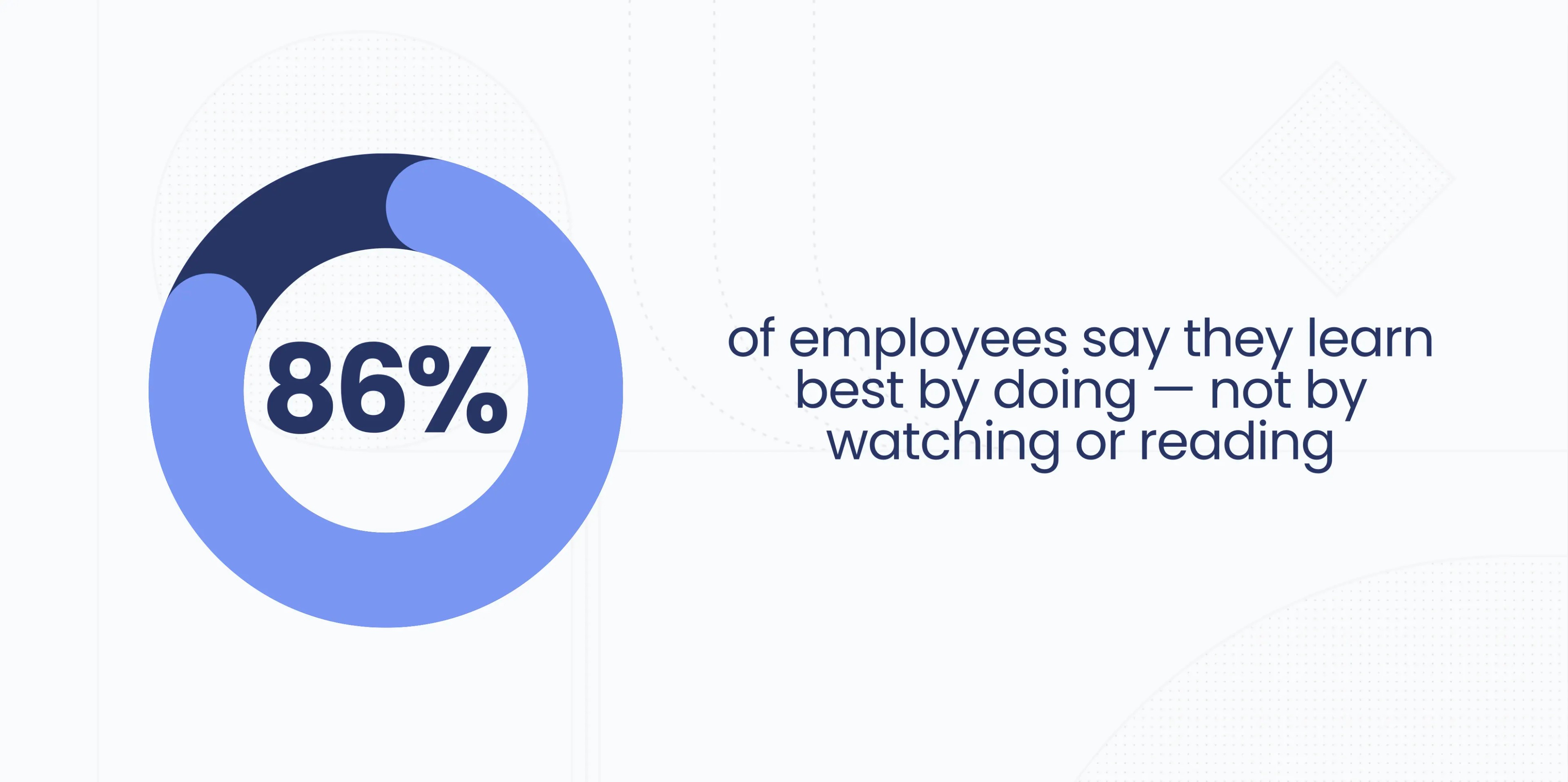
⚡ Third of employees say their training is too theoretical, and 86% want training that maps directly to their job role. Less reading and listening. More doing. Every course I evaluate gets tested against that standard.
Practically, this means designing learning activities where the employee has to produce something, respond to something, or decide something — not just read it and acknowledge it.
When a sales rep sees a scenario that sounds like last Tuesday's call, they pay attention. When a new manager recognizes their own team in a case study, they lean in. That's relevance doing its job. Building relevance means getting closer to the business. Talking to managers before you build anything, not after. Updating content when roles or processes change, not once a year when someone remembers to flag it — said Oleksandra
2. Use AI roleplay coaching for skill practice at scale
Sales conversations. Difficult HR discussions. Customer escalations. Onboarding scenarios. These are all skills that can only be developed through practice — but in most companies, practice opportunities are scarce, inconsistent, and socially risky.
AI roleplay coaching solves all three problems. Employees can practise the same conversation 10 times, get rubric-based feedback each time, and do it without the social risk of getting it wrong in front of a manager or peer. EducateMe's AI Roleplay Coach runs contextualised practice scenarios and gives structured feedback that improves with repetition.
The engagement case is strong: employees who can practise without stakes engage more with difficult skills training. Completion is a side effect. Confidence is the actual output.
You can see how this plays out in our full breakdown of how AI is being used across corporate training programmes.
3. Use AI assistance to help learners move forward, not get stuck
One of the quieter engagement killers in corporate training is learner friction. An employee hits a concept they don't understand, there's no one to ask, and they abandon the module. They don't fail. They just stop.
AI search and assistant tools embedded in the LMS remove that friction point. This is particularly valuable in onboarding, where new hires are moving through large volumes of new information quickly and the margin for 'I'll come back to this later' is very high.
4. Automate reminders and engagement nudges
The average employee has limited weekly time for formal learning — the LinkedIn Workplace Learning Report documents consistently that L&D teams cite insufficient time as the top barrier to engagement. That window disappears fast without a prompt.
Automated engagement sequences — reminder emails, in-platform nudges, manager notifications when an employee falls behind — turn passive learner access into active learner habits. This isn't about pestering people. It's about removing the friction between intention and action.
The key is personalisation. A reminder that says "You're 2 modules away from completing your Q1 compliance certification — here's where you left off" is far more likely to produce a click than a generic training reminder blast. Most modern platforms handle this automatically; it's a baseline expectation, not a premium feature.
5. Add collaborative assignments with direct mentor sharing
Learners engage more when their work is seen. This is one of the most underused engagement levers in corporate training: structured assignments that require the employee to produce something — a written response, a plan, a case analysis — and submit it for review by a manager or mentor.
EducateMe handles this through collaborative assignments, where learners submit work directly to a named reviewer and receive structured feedback. It creates two things passive training can't: accountability and real-world relevance. The employee knows someone will read their output, so the output gets taken seriously.
For onboarding programmes in particular, I recommend at least one assignment per learning path that requires a manager to respond. It forces the two-way relationship that turns training into a conversation rather than a formality. Our data from the corporate eLearning solutions shows consistently higher satisfaction scores in programmes that include peer or manager review components.
6. Mix formats — and match format to learning goal
Not every learning goal is best served by the same format. A compliance requirement might need a structured module with attestation. A sales skill needs a practice scenario. A process update might just need a short video and a knowledge check.
Mixing formats isn't variety for its own sake — it's precision. Use each format where it's strongest:
- Short videos and microlearning — for concept introductions and quick updates
- Interactive scenarios — for decision-making and judgment calls
- Live or cohort sessions — for anything requiring discussion, nuance, or peer challenge
- AI roleplay — for practising conversations and client-facing skills
- Assignments — for applying knowledge to a real work context
- SCORM content — for content you already have and need to deliver consistently
Platforms that support all of these within a single programme produce meaningfully better engagement than single-format deployments. If you're evaluating platforms on this basis, our tested review of employee training software covers format flexibility as a core criterion.
7. Make managers part of the programme design
The biggest engagement lever in corporate training isn't a platform feature. It's the line manager. When managers bring up training in one-on-ones, connect it to a real project, or ask about it afterwards, learners take it more seriously — highlighted Oleksandra
L&D can't control this alone. But it can design with it in mind. Short manager briefings before a programme launches. Simple talking points. Team-level data that gives managers something useful to act on. The platforms that surface per-manager dashboards — showing who's behind, who's completed, where scores are low — make this significantly easier.
How to Measure Learner Engagement in Corporate Training
You can't improve what you're not measuring. Completion rate is the floor. Here are the engagement metrics I actually track in a well-instrumented programme:
- Time on task per module — are learners spending meaningful time or rushing through?
- Quiz retake rates — learners who voluntarily retake quizzes are engaged; ones who accept a first-pass fail and move on are not
- Assignment submission quality — are responses substantive or minimal-effort?
- AI roleplay scores across repetitions — are scores improving? That's engagement.
- Course re-entry rate — did the learner come back after their first session, or complete it in one forced sitting?
- Manager review completion — in programmes with collaborative assignments, are managers actually reviewing and responding?
Engagement is a signal, not a design challenge. When learners engage, it means the training is worth their time. When they don't, something is off, whether that's the content, the timing, the format, or the relevance. Fix what's causing the signal. Not just how it looks on the surface — Oleksandra Berezina
For the broader statistical picture, our 2026 employee training statistics roundup covers benchmarks across completion, engagement, and retention. The ATD 2025 State of the Industry report also provides solid benchmarks for training hours per employee and spend per participant — useful when making the internal business case for investing in engagement infrastructure.
What Corporate Training Best Practices Actually Look Like in Practice
Theory is easy. Here is what a high-engagement corporate training programme looks like when it's running well:
- Onboarding — new hires are auto-enrolled into role and seniority-specific paths. Each module ends with either a practice scenario or a short assignment. A manager receives a notification when the hire completes their first week's modules and reviews their first assignment within 48 hours. Completion rate on this path runs at 83% on average in EducateMe's customer data.
- Sales training — reps complete product knowledge modules, then move directly to AI roleplay scenarios that simulate common objections. Scores are tracked by manager. Reps who score below threshold on roleplay are flagged for coaching — not punished, but supported. Knowledge sticks because it was practised.
- Compliance training — automated re-enrolment at the required interval. Reminder sequences trigger 30 days, 14 days, and 3 days before deadline. Attestation captured automatically. Audit reports available in real time.
The programmes that perform consistently across all three use cases share one characteristic: the platform does the operational work — enrolment, reminders, tracking, reporting — so the L&D team can focus on content quality and learner experience.
Frequently asked questions
The most common reasons are passive content design, lack of relevance to daily work, and absence of any momentum mechanism to keep learners returning. Employees don't disengage from learning — they disengage from training that doesn't require them to do anything, doesn't connect to a real task they perform, and doesn't remind them it exists. Fixing even one of these three usually produces a measurable engagement increase.
Completion rate measures whether an employee finished a course. Learner engagement measures whether they actively participated — retook quizzes, practised scenarios, submitted quality assignments, and improved over repetitions. You can have 100% completion and zero meaningful engagement; compliance training passes this test routinely. Build your programme around engagement metrics, and completion usually follows.
AI contributes at three points: practice (AI roleplay coaching lets employees rehearse real scenarios with feedback, at any time, without social risk), assistance (AI search removes the friction that stops learners progressing), and automation (AI-triggered reminders and enrolment sequences keep learners on track without manual L&D intervention). EducateMe builds all three into the platform natively.
Track time on task, quiz retake rates, assignment submission quality, AI roleplay score progression, and course re-entry rates. These tell you whether learners are actively participating or passively passing through. Completion rate is a baseline check, not an engagement signal. A good LMS will surface most of these through its analytics dashboard — if yours only reports completion, that's a capability gap worth addressing when you next evaluate platforms.