
Best Employee Training Methods & Techniques [2026]

By Alexa BerezinaAlexa BerezinaL&D Specialist & CSM LeadMy name is Oleksandra (Alexa), and I’m a certified Learning & Development specialist focused on turning complex knowledge…Read more
L&D Specialist & CSM Lead
11 min read
L&D as a field has been around for over 80 years — the ATD was founded in 1943. In that time it's accumulated hundreds of named methodologies, frameworks, and delivery formats. The real problem for most training managers isn't lack of options. It's knowing which ones are actually worth using for your specific team, goal, and context.
We've worked with dozens of L&D teams building and rebuilding training programmes. The pattern I see most often: companies default to the types of employee training methods that's easiest to deploy, not the one that matches the learning objective. The result is training that gets completed but doesn't change behaviour.
Why Training Method Matters More Than Training Content
The L&D industry spent years focused on content quality — better videos, more interactive modules, slicker decks. That focus was largely misplaced. Research consistently shows that how people learn matters more than what they're taught.
According to ATD's 2025 State of the Industry report, organisations are spending more per learning hour than ever — yet formal training hours per employee have fallen sharply, from 17.4 hours in 2023 to just 13.7 in 2024. The implication is clear: every hour of training needs to work harder. And that starts with method selection, not content volume.
A 2025 active learning study by Engageli found that learners in active learning environments scored 54% higher on retention tests than those in passive, lecture-based sessions — 70% average versus 45%. The conclusion is direct: the most common corporate training format (watching and reading) is also the weakest at building lasting capability.
| Learning method | Average retention rate |
|---|---|
| Reading / watching (passive) | 10–20% |
| Discussion and group learning | 50% |
| Practice by doing | 75% |
| Teaching others | 90% |
That doesn't mean video or written content is useless types of employee training methods. It means they're best used for awareness and knowledge transfer, not skill development. Knowing the difference is the foundation of any effective training strategy.
The 8 Effective Employee Training Methods in 2026
These are the methods with the strongest evidence base and the widest applicability across corporate training contexts. Each one suits different objectives — I've included practical guidance on when to use each and when to skip it.
1. On-the-Job Training (OJT)
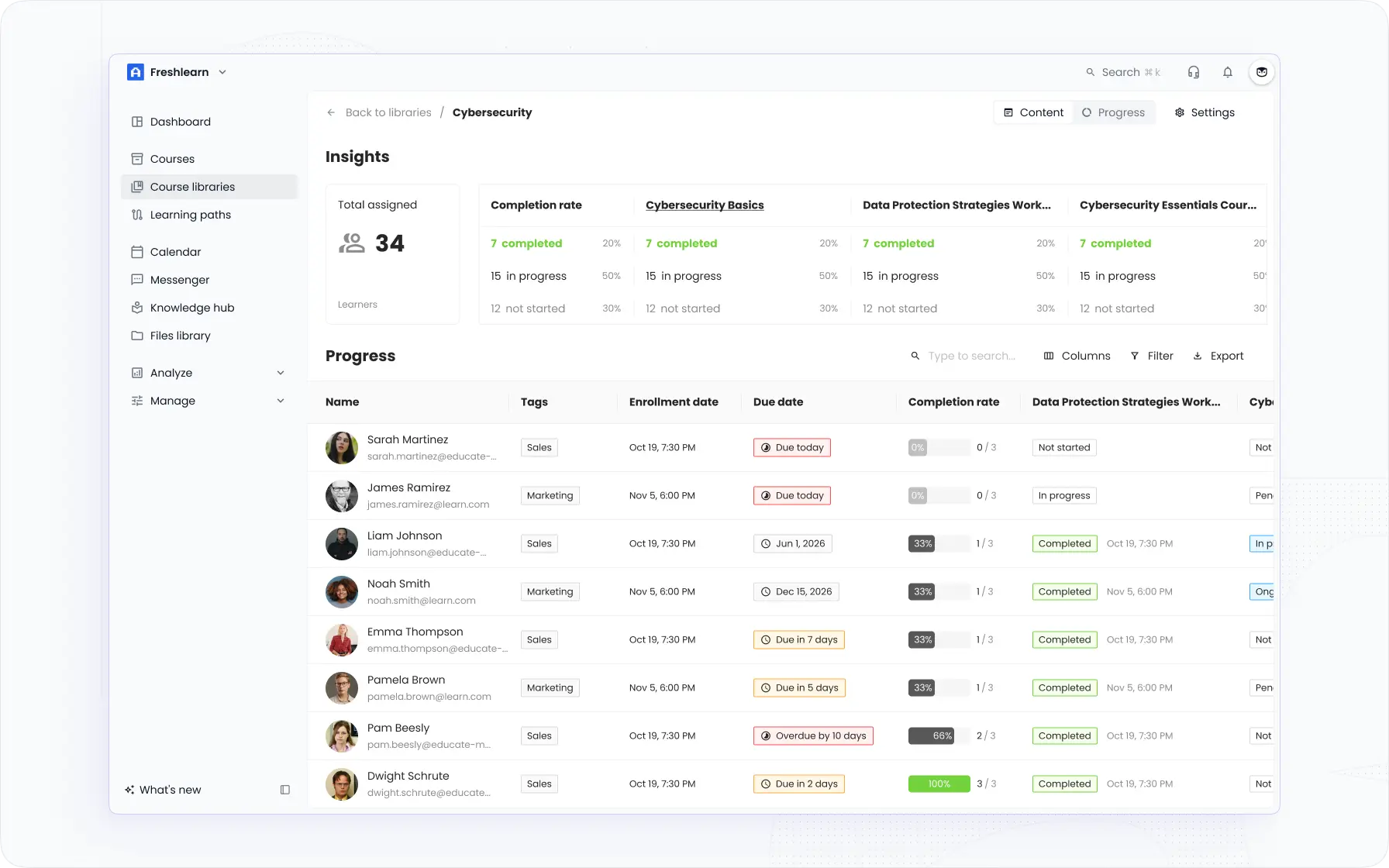
On-the-job training places learning directly inside the work itself. New hires or upskilling employees learn by doing real tasks, with support from a manager, mentor, or structured guide.
OJT is the most widely used training method in corporate environments — and for good reason. It's immediately relevant, contextually grounded, and requires no classroom time. The challenge is consistency: without a defined structure, OJT becomes "watch what I do and figure the rest out", which transfers tacit knowledge poorly.
Best for: Role-specific skills, procedural tasks, and new hire onboarding.
Watch out for: Inconsistent delivery across managers. If two new hires in the same role get different OJT experiences, your onboarding programme has a structural problem, not a content problem.
2. Instructor-Led Training (ILT)
Instructor-led training (whether in-person or virtual) remains one of the most effective methods for complex, high-stakes content. The presence of an expert who can answer questions, read the room, and adjust in real time is still hard to replicate digitally.
ILT is expensive to run at scale, which is why many companies have moved away from it. That's often a mistake. For topics that require nuance — compliance interpretation, leadership development, complex product knowledge — a facilitated session with real discussion will outperform any self-paced module.
Best for: Complex or sensitive topics, senior-level development, new programme launches.
Watch out for: Scaling. ILT doesn't grow cheaply. Consider blending it with asynchronous pre-work to maximise the time learners spend with the facilitator on content that actually needs discussion.
3. E-Learning and Self-Paced Online Courses
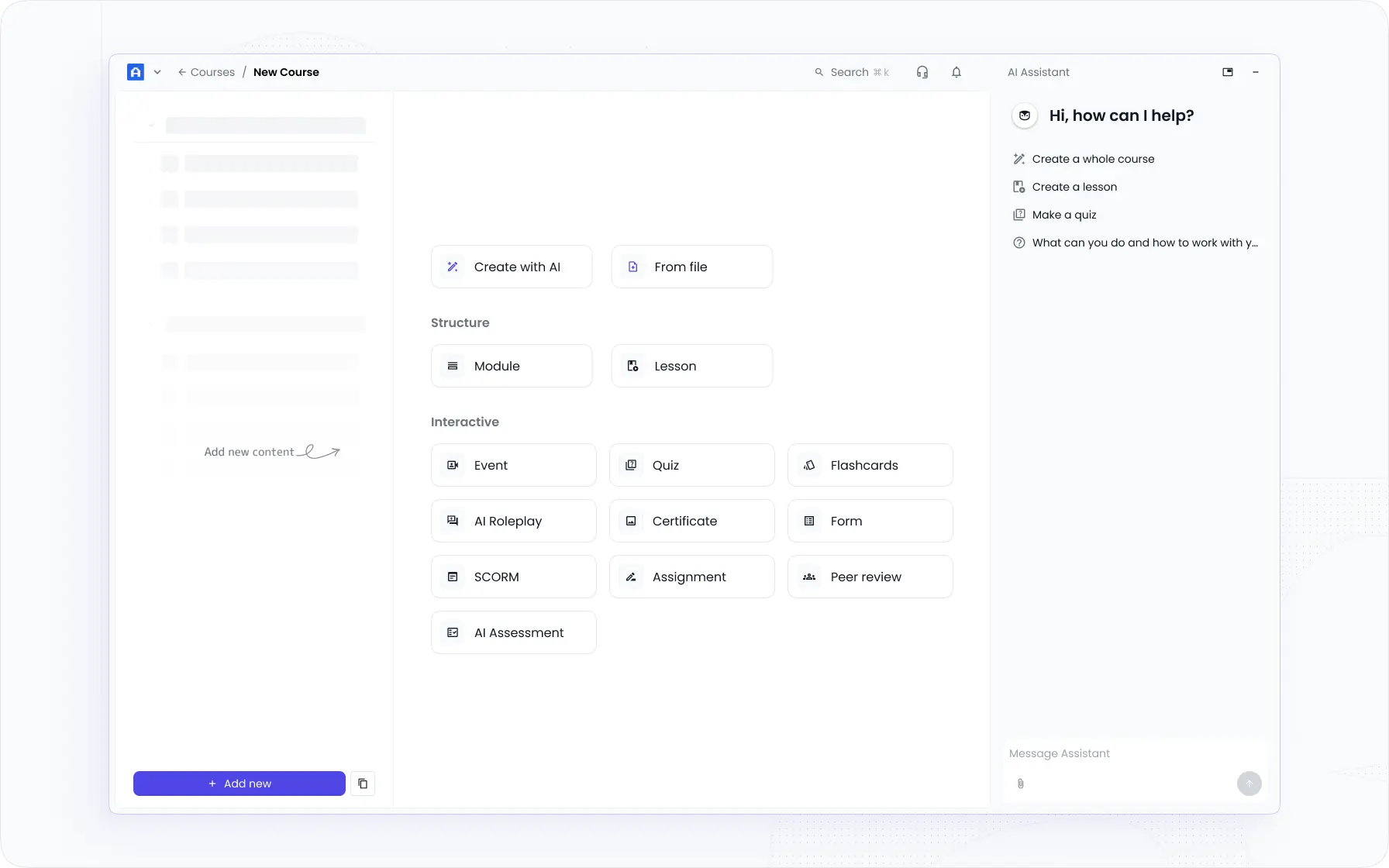
Self-paced e-learning is the backbone of most corporate LMS deployments. Done well, it's flexible, scalable, and measurable. Done badly — which is most of the time — it's click-through compliance theatre.
The most common failure mode: e-learning is used for everything, including content that doesn't suit the format. Platforms like EducateMe let you build self-paced courses that include interactive activities, assignments, and assessments — which closes some of that gap.
Best for: Compliance training, product knowledge, onboarding foundations, knowledge reinforcement.
Watch out for: Completion rate as the only metric. A 95% completion rate on a compliance module tells you learners clicked through. It tells you nothing about whether they understood or will apply the content.
4. Blended Learning
Blended learning combines online and offline elements — typically self-paced content followed by live sessions, or the reverse. The logic is sound: use async delivery for content that doesn't need a facilitator, save live time for discussion, practice, and application. The biggest mistake in corporate learning is designing for completion, not for behaviour change.
This quote captures why blended learning, when done properly, outperforms either pure format. The async component builds a shared knowledge base. The live component activates it.
Best for: Onboarding programmes, leadership development, any topic with both knowledge and application components.
Watch out for: Additive rather than integrated design. Blended learning fails when the online module and the live session are designed separately with no intentional connection between them.
5. Microlearning
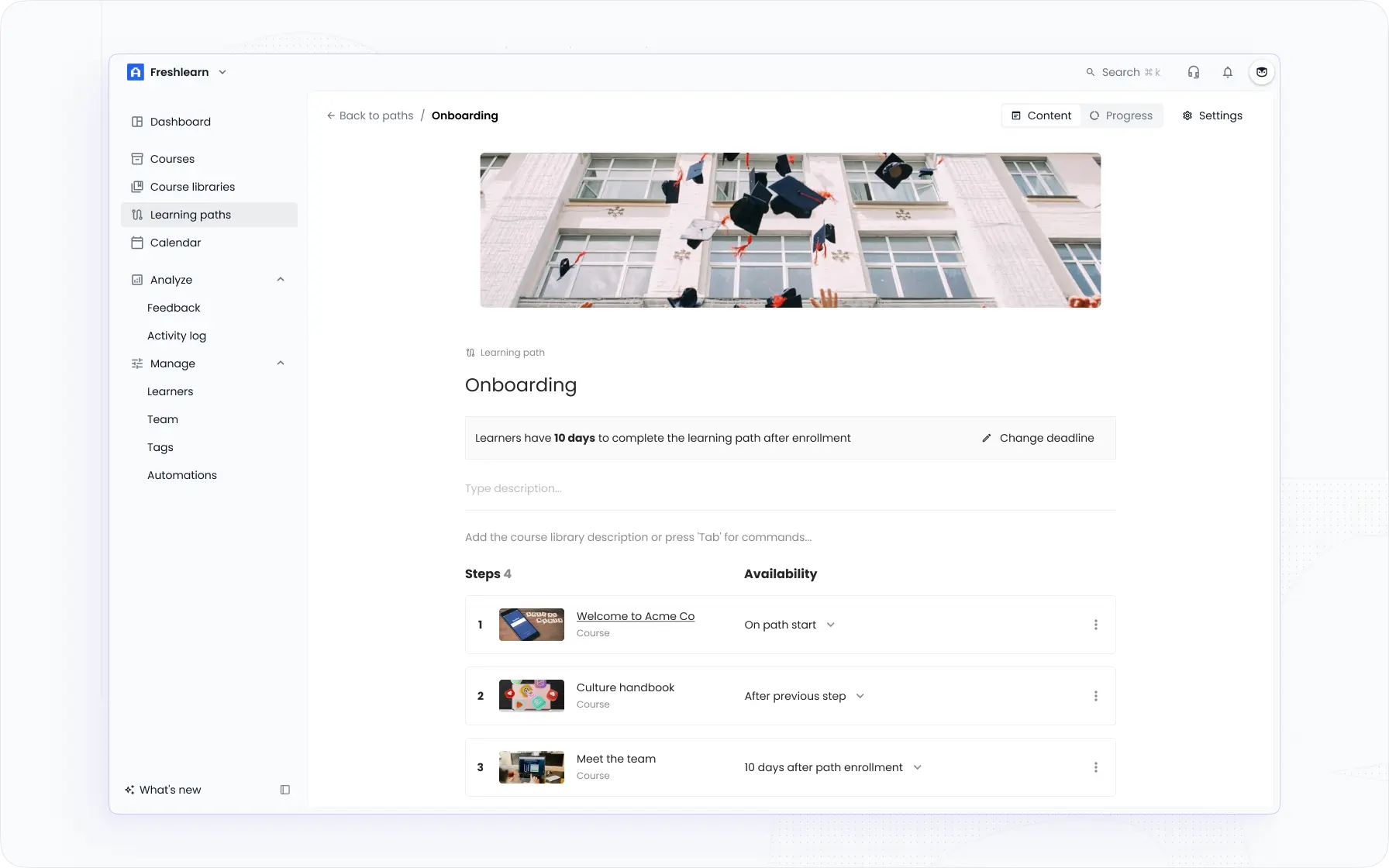
Microlearning delivers content in short, focused bursts — typically 3 to 7 minutes per module, built around a single concept. Its strength is reinforcement and just-in-time support, not initial skill development.
The microlearning hype cycle peaked a few years ago, and the reality has caught up: excellent as a supplement, poor as a replacement for structured training. A 5-minute video won't teach someone how to handle a difficult performance conversation. But a 5-minute refresher the morning of that conversation? Genuinely useful.
Best for: Reinforcing existing knowledge, performance support, spaced repetition programmes.
Watch out for: Using microlearning to replace training. Shorter modules are not automatically more effective — they're just easier to produce. The depth must match the objective.
6. Mentoring and Coaching
Mentoring pairs a less experienced employee with a more experienced one for ongoing guidance. Employee coaching typically involves a structured relationship focused on a specific development goal. Both are highly effective for leadership and professional development — and difficult to scale without structure.
In my experience, the biggest barrier to formal mentoring programmes isn't interest — it's design. Companies set up the pairs but don't define what good looks like. Without structured check-ins, conversation guides, and goals, most mentoring relationships fade after 60 days.
Best for: Leadership development, high-potential programmes, career progression support.
Watch out for: Programme administration. Manual matching, tracking, and follow-up is where mentoring programmes go to die. The more you can systematise the logistics, the more the human relationship can do its job.
7. Simulation and Role-Play
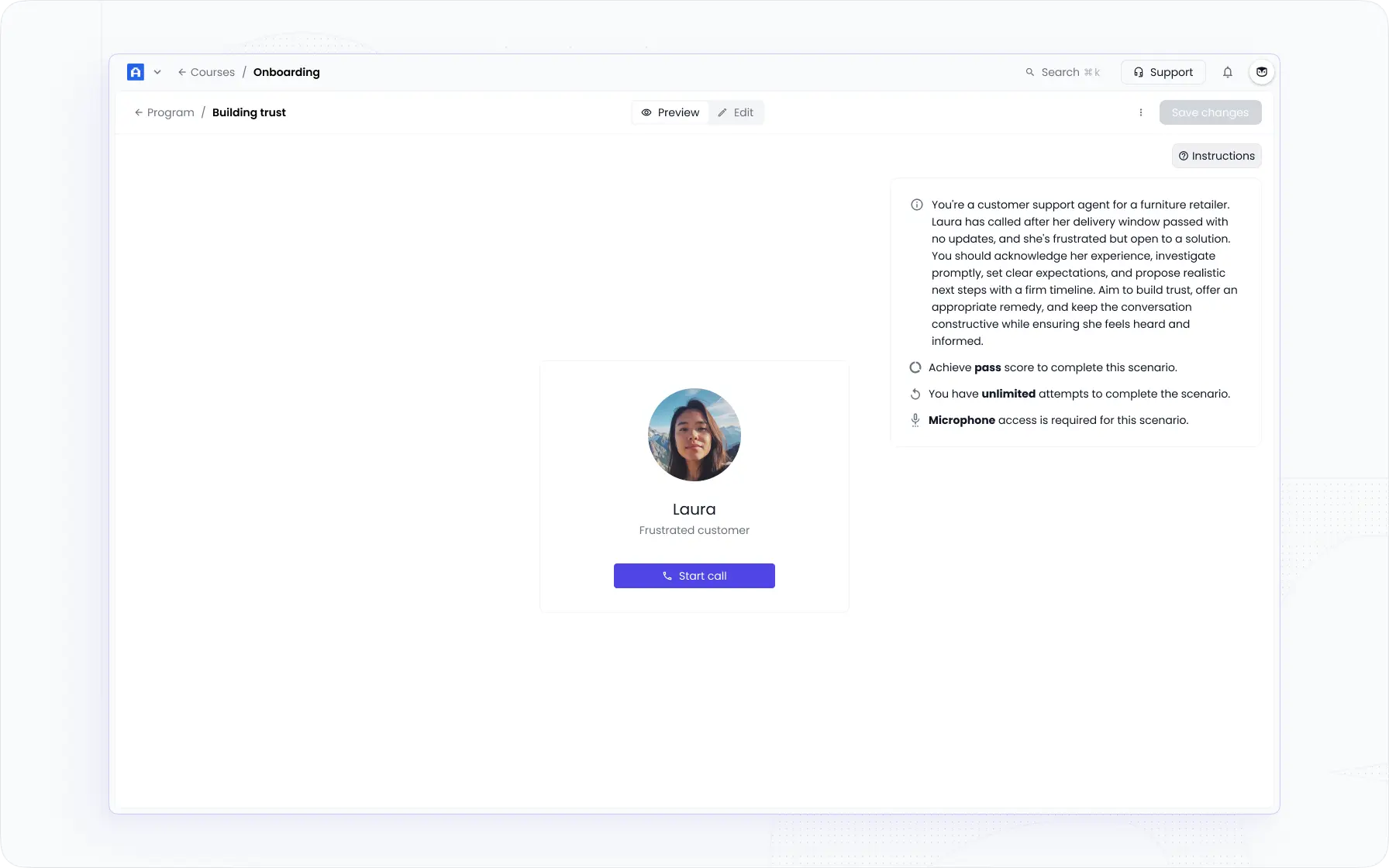
Simulation-based training puts learners in realistic scenarios where they must apply knowledge and make decisions — without real-world consequences for getting it wrong. This is among the most effective training formats for skill development, and historically one of the hardest to deliver at scale.
That's changed significantly with AI-powered role play software. Where traditional role-play required a trained facilitator, a scheduled session, and a degree of social risk for the learner, AI-driven roleplay scenarios are available on demand, scale to any team size, and deliver consistent rubric-based feedback regardless of how many people are practicing simultaneously.
Best for: Sales training, customer service, difficult conversations — any context where "practice" is the learning objective.
Watch out for: Scenario realism. Simulations only transfer to real performance if the scenarios are genuinely close to real-world conditions. Generic or oversimplified scenarios produce generic, oversimplified practice.
8. Social and Collaborative Learning
Social learning happens when employees learn from each other — through shared resources, peer feedback, discussion forums, or simply watching how colleagues handle situations. It's always been one of the most powerful learning mechanisms. It's also the hardest to formalise without making it feel forced.
The companies that do it well don't try to manage social learning — they create conditions for it. Internal knowledge hubs, structured peer review processes, and a culture that treats sharing as a professional value all support social learning more effectively than a mandatory discussion board.
Best for: Knowledge sharing, culture development, team onboarding, communities of practice.
Watch out for: Forced participation. Mandatory peer discussion forums are almost universally disliked. Build participation incentives into the culture, not the compliance requirements.
| Method | Description | Best for |
|---|---|---|
| On-the-Job Training (OJT) | Learning by doing real tasks inside the actual role, with support from a manager or mentor | Role-specific skills, new hire onboarding, procedural tasks |
| Instructor-Led Training (ILT) | Live sessions led by a subject-matter expert, in-person or virtual, with real-time interaction | Complex or sensitive topics, leadership development, new programme launches |
| E-Learning and Self-Paced Courses | Structured online modules completed at the learner's own pace inside an LMS | Compliance training, product knowledge, onboarding foundations |
| Blended Learning | A mix of async online content and live sessions, designed to work together intentionally | Onboarding programmes, leadership development, topics with both knowledge and application components |
| Microlearning | Short focused modules of 3–7 minutes built around a single concept or skill | Knowledge reinforcement, performance support, spaced repetition |
| Mentoring and Coaching | Structured one-to-one relationships focused on longer-term growth or a specific development goal | Leadership development, high-potential programmes, career progression |
| Simulation and Role-Play | Realistic practice scenarios where learners make decisions without real-world consequences | Sales training, customer service, difficult conversations, any skill that requires practice |
| Social and Collaborative Learning | Learning through peer interaction, shared resources, discussion, and observation of colleagues | Knowledge sharing, culture development, communities of practice |
How to Choose the Right Employee Training Methods and Techniques
There's no universal answer. The employee training techniques methods that works best depends on three variables: what outcome you need, who you're training, and what resources you have.
Step 1: Define the outcome, not the topic
Before choosing a method, be precise about what success looks like after the training. Three distinct outcome types — and they need different methods:
- Knowledge transfer — learners need to know something
- Skill development — learners need to be able to do something
- Behaviour change — learners need to consistently act differently
Step 2: Consider the learner context
Delivery format should match how your learners actually work. Key questions to ask before committing to a format: Are learners in the same time zone? Do they have dedicated learning time? Are they tech-comfortable? Is this training mandatory or voluntary?
Step 3: Prioritise practice for anything skills-based
This is the principle most programmes skip. If the outcome is a skill, the programme needs a practice component — on-the-job tasks with feedback, simulation, role-play, or worked examples with guided reflection.
Watching a video about how to handle a difficult customer conversation is not practice. Practice is doing the thing — or doing something as close to the thing as possible — and getting feedback on it.
Key Takeaways
- Match the method to the outcome — knowledge, skill, and behaviour change need different approaches
- E-learning scales well but transfers skills poorly without a practice layer
- Blended learning outperforms either pure format when the components are intentionally connected
- Simulation is the most underused method in corporate training — AI is making it accessible at scale
- Completion rates measure access, not learning — build feedback and assessment into every programme
- The learner context matters as much as the content — async teams need async-first design
The method is only half the decision. The platform matters too. See how the top 15 employee training tools compare in 2026
Frequently asked questions
There's no single most effective method — it depends on what you're trying to achieve. For knowledge transfer, self-paced e-learning works well. For skill development, simulation and practice-based methods consistently outperform content-only formats. Research shows that active learners retain significantly more than passive ones, which is why any training objective involving a skill should include a deliberate practice component — not just content delivery.
Start with the outcome, not the format. Define what success looks like after training — is it knowing something, being able to do something, or consistently doing it differently? Then match the method to that goal. E-learning suits compliance and knowledge-based topics. Role-play and simulation suit skills like sales, customer service, and difficult conversations. EducateMe's AI Assistant can help you map learning objectives to the right content format during course creation.
Training is typically focused on building specific skills for a current role — onboarding, compliance, product knowledge, sales technique. Development is longer-term and often role-agnostic — leadership capability, critical thinking, career progression. Training is often best delivered via structured programmes with clear objectives. Development benefits more from mentoring, coaching, stretch assignments, and collaborative learning over time.
Completion rates are the most common metric and the least useful. The Kirkpatrick four-level model (kirkpatrickpartners.com) is still the most practical framework: measure reaction, learning, behaviour, and results. Most organisations only measure level one. EducateMe's analytics track completion, engagement, and assessment scores — a solid starting point for levels one and two.