
How to Turn Online Sales Training into Real Skill Practice (2026 Guide)

By Alexa BerezinaAlexa BerezinaL&D Specialist & CSM LeadMy name is Oleksandra (Alexa), and I’m a certified Learning & Development specialist focused on turning complex knowledge…Read more
L&D Specialist & CSM Lead
7 min read
I've reviewed a lot of online sales training programmes, and most of them have the same core problem: they're built around consuming content, not developing skill. Slides, videos, a multiple-choice quiz at the end, a completion certificate, and somehow that counts as trained.
It doesn't. And sales teams pay the price first.
A rep who finished a 40-minute onboarding course still freezes when a prospect pushes back on pricing. Someone who clicked through a negotiation module still stumbles in the room. Knowing content and being able to perform under pressure are two completely different things. The gap between them isn't a knowledge problem — it's a practice problem.
Why Online Training Alone Doesn't Build Skills
The research on this is pretty consistent. The Ebbinghaus Forgetting Curveresearch shows that learners lose up to 70% of new information within 24 hours, and up to 90% within a week, if there's no reinforcement or application after the learning event.
Reading a module on how to handle objections is not the same as handling one. Watching a video on discovery questioning doesn't give you the muscle memory to ask good questions under pressure. The brain needs repetition, feedback, and variation to convert knowledge into usable skill.
Sales environments make this worse. Products change. Competitor positions shift. Buyers raise objections that weren't in the onboarding deck. A rep who learned six months ago and hasn't practised since is already behind. This is especially true during rapid onboarding cycles, where there's rarely enough time to give every new hire meaningful coaching before they're on live calls.
The Practice Problem in Sales Training
The biggest structural failure in most sales training programmes isn't the content. It's that there's no safe place to practise.
Roleplay with a manager is valuable but rare — managers have pipelines to run. Peer practice is inconsistent. Live calls are high-stakes by definition; you can't afford to experiment in front of a real prospect. So most reps go from "finished the course" to "on the phone with a customer" with nothing in between.
That gap is where skill development dies.
The answer isn't more content. It's structured, repeatable, low-stakes practice with feedback built in. This is where the conversation about AI roleplay and modern assessment tools becomes genuinely relevant, not as a tech trend, but as a solution to a specific problem that traditional online training can't solve.
How AI Roleplay Fills the Gap
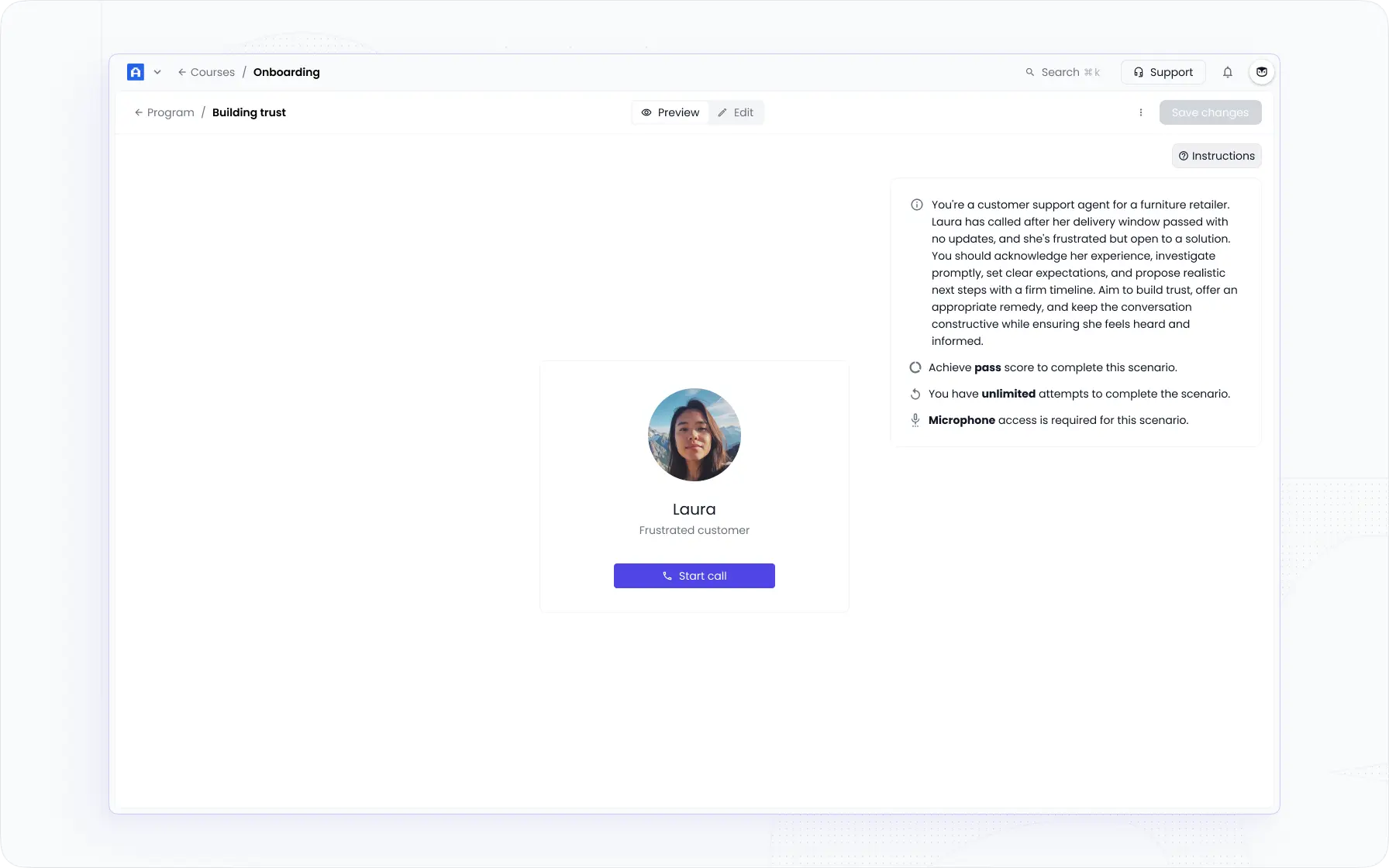
AI roleplay works exactly the way the name suggests: a learner practises a real conversation scenario with an AI that responds dynamically to what they say. Not a scripted branch-logic simulation where option A leads to outcome B. An actual back-and-forth conversation that adapts in real time.
For sales teams, the use cases are immediate. A new rep practises an objection-handling scenario twenty times before their first live call, trying different approaches, seeing what lands, and getting feedback without any reputational risk. A team preparing for a product launch can run through updated positioning before it goes live. A rep on a performance plan can work on discovery questioning without a manager needing to be in the room.
The safety element here matters more than most L&D conversations acknowledge. Practising badly in front of a manager or peer has a social cost. Practising with an AI doesn't. That removes the hesitation to try, fail, and try again, which is exactly the repetition cycle that actually builds skill.
EducateMe's AI Roleplay Coach runs both voice call and text chat formats, so it works for sales teams practising phone calls or written outreach. Scenarios can be built from a single prompt — describe the use case, the learner's goal, the AI persona, and the system handles the rest. Instructors can review session recordings, transcripts, and per-attempt feedback. Learners can see how their approach evolved across multiple attempts.
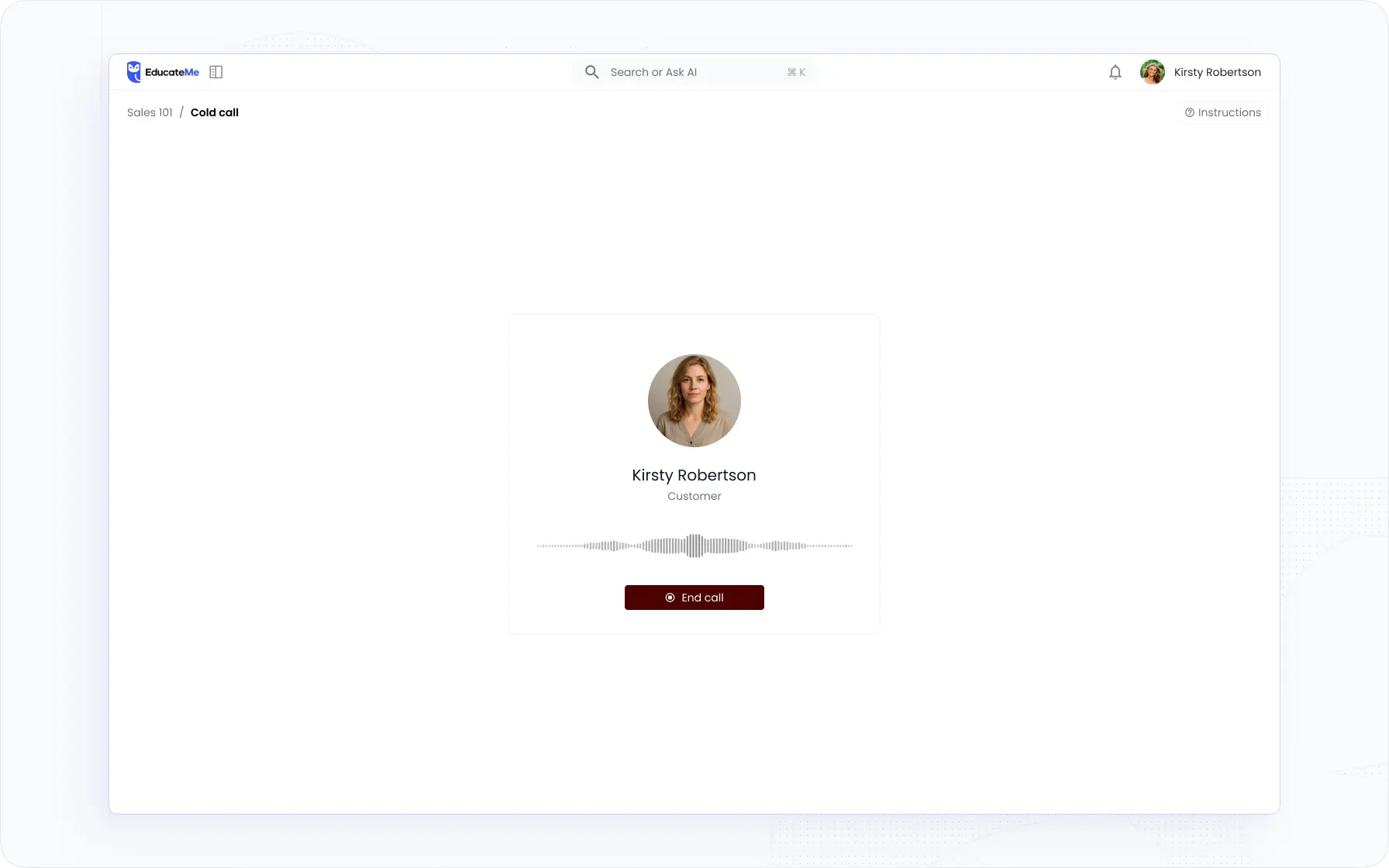
💡I'd recommend that any sales training programme using this tool builds the scenario around real situations the team actually faces, not generic "difficult customer" prompts. The more specific the scenario, the more transfer you get to real performance. A prompt like "practice handling a pricing objection from a mid-market SaaS buyer who has already evaluated a competitor" produces a much more useful session than "practice objection handling."
What Good Assessment Actually Looks Like
Most online assessments measure one thing: whether you remember what the course just told you. The quiz follows the content, uses the same vocabulary, and confirms recall. That's not skill assessment — it's a retention check.
Actual skill assessment asks harder questions. Can the learner apply this concept in an unfamiliar context? Where does their understanding break down? What's the specific gap between what they know and what they can do?
Adaptive assessment, where questions adjust based on how the learner responds, gets you much closer to this. Instead of everyone completing the same 10-question quiz, the system identifies where understanding becomes uncertain and probes deeper there. A rep who understands the surface-level features of a product but gets confused on edge cases or competitive differentiators will surface that gap through adaptive questioning that a standard quiz would miss.
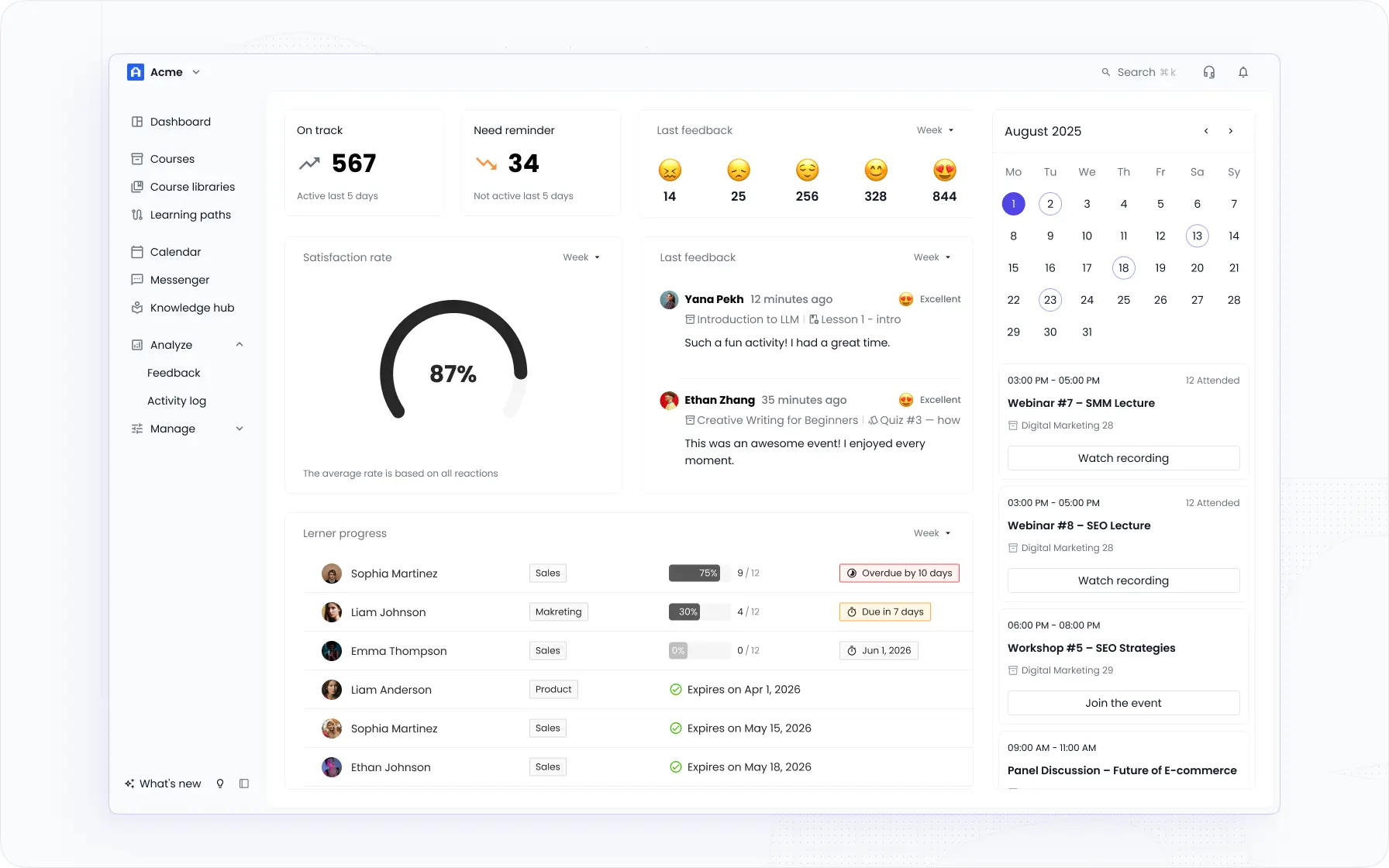
💡The practical outcome for L&D teams: you can see exactly what each person actually understands, not just what they clicked through. That's the data you need to decide whether someone is ready for live calls, what coaching to prioritise, and where the training content itself needs updating.
EducateMe's assessment tools are built into the same platform as the learning content, which means you're not running training in one system and trying to interpret assessment data from another. For sales managers tracking a team of 15 new hires through onboarding, that consolidation alone saves meaningful time.
4 Ways to Build Practice into Your Online Training
These are the approaches I'd actually implement — not a generic checklist.
| Strategy | What to do | Why it works | Tool to use |
|---|---|---|---|
| Replace the end-of-module quiz with a scenario | Instead of asking "which of the following is correct," have the learner handle the actual situation in an AI roleplay | Assessment is embedded in practice — one step instead of two | AI Roleplay Coach |
| Build repetition into the programme structure | Design key skills — discovery, objection handling, closing — to appear in multiple scenarios across the programme, not just once | Repetition with variation is how skill consolidates; a single pass doesn't cut it | Multiple roleplay scenarios per topic |
| Use assessment data to direct coaching | If adaptive assessment shows six reps have a gap in competitive positioning, that's your coaching agenda for the next team call | Data should drive manager conversations, not just populate a completion dashboard | Adaptive assessment + manager reporting |
| Close the loop between practice and real work | After a session, have reps apply one specific thing to their next real interaction — then come back to practice again | Online environment and real-world performance feed each other instead of running in separate silos | Roleplay + live call debrief cycle |
For more on structuring this kind of programme, the EducateMe blog on sales training approaches covers how different LMS features map to different training goals.
How This Works in Sales Environment
The timeline pressure in sales training is real. A new rep might have a week of onboarding before they're on calls. A product launch might give the team two days' notice before updated positioning needs to be in market.
Static course content can't respond to that speed. A well-designed AI roleplay scenario can be built in under an hour and deployed to an entire team immediately. When product messaging changes, you update the scenario prompt — you don't rebuild the course.
That's particularly valuable for teams where product knowledge moves faster than traditional training cycles. The ability to spin up a targeted roleplay or a short adaptive assessment on a specific topic, without a full content development cycle, changes what's possible.
EducateMe supports this with an AI course builder that creates structured learning content from a prompt, a URL, or a file upload. If your product team just published a new one-pager, that can be training material within the same day. Combined with AI roleplay for immediate skill practice, the gap between "new information" and "practised skill" can shrink from weeks to days.
Summary
Online training is a delivery mechanism, not a development method. Content without practice builds familiarity, not competence. To close the gap between knowing and doing:
- Add AI roleplay scenarios that let reps practise real situations repeatedly, safely, and with feedback
- Replace recall-based quizzes with adaptive assessments that surface genuine skill gaps
- Use assessment data actively — as a coaching input, not just a reporting metric
- Design for repetition and real-world application, not course completion
Frequently asked questions
Online training delivers information — videos, slides, written modules — that learners consume at their own pace. Skill practice involves applying that information in context, with feedback, until performance actually improves. Most online training stops at delivery. Adding AI roleplay and scenario-based assessment is how you bridge the gap between finishing a course and being able to use what it covered.
AI roleplay puts learners in a simulated conversation with an AI that responds dynamically to what they say. For sales teams, that means practising objection handling, discovery calls, or negotiation scenarios repeatedly and safely — without needing a manager or a live prospect. EducateMe's AI Roleplay Coach supports both voice call and text chat formats, and instructors can review session transcripts and per-attempt feedback to track progress over time.
A standard quiz checks whether someone remembers what a course just covered. Adaptive assessment adjusts the questions based on how the learner responds, which means it can identify exactly where understanding breaks down — not just whether they passed or failed. For sales managers, that difference matters: knowing that a rep has a specific gap in competitive positioning is more useful than knowing they scored 78%.
The most practical approach is to separate content types: use a structured course for foundational knowledge, and use AI roleplay scenarios for anything that changes frequently. Scenarios can be updated or rebuilt from a new prompt in under an hour. EducateMe's AI Assistant also creates training content from a URL, file, or prompt, which means new product documentation can become a practice scenario the same day it's published — without a full content development cycle.