
Best Microlearning LMS for Sales Teams in 2026

By Sofia KondratSofia KondratCorporate Training Expert & Content EditorHey there! I’m Sofi Kondrat, your go-to corporate training advisor here at EducateMe. I’ve been navigating the highs…Read more
Corporate Training Expert & Content Editor
8 min read
Sales reps don't have 90 minutes to sit through a training session on a Tuesday afternoon. They have a call in 20 minutes, a demo in an hour, and a deal they're trying to close before the end of the quarter. We've worked with enough sales teams to know that the moment training competes with pipeline, training loses.
That's why microlearning for sales isn't just a nice format option — it's practically the only training strategy that actually sticks in a fast-moving sales environment. And choosing the right LMS to deliver it makes the difference between a training programme people use and one that collects dust.
This guide covers what to look for, why it matters, and which platforms I'd actually recommend.
What Makes Microlearning Work for Sales Teams?
Microlearning delivers content in bite-sized chunks (typically 3 to 10 minutes per module) targeting one skill or concept at a time. That format maps directly to how sales reps actually learn: in gaps between calls, during commutes, right before a product demo.
I'd argue what makes microlearning particularly effective for sales isn't just the length. It's the specificity. A microlearning course on handling a specific objection is infinitely more useful than a 45-minute general course on "objection handling." The more precise the content, the more a learner can actually apply it.
Research from the Journal of Applied Psychology shows that breaking lessons into bite-sized pieces increases learning efficiency by 17%. For sales teams juggling high volumes of information (pricing updates, competitive positioning, product knowledge), that efficiency gap matters every week.
Why Traditional LMS Platforms Fall Short for Sales
Here's something we've seen repeatedly: companies invest in a solid LMS for sales training, load it with training materials, and six months later, completion rates are sitting at 30%. The platform isn't bad. The format is.
Most legacy learning management system platforms were built for compliance training — mandatory, tracked, checkbox-ticking. Sales training needs are different. Sales reps need just-in-time learning they can access whenever and wherever a need arises. They need content that's updated in real-time when a product changes. They need training that fits into their workflow, not one that pulls them out of it.
According to ATD research, knowledge retention is significantly higher when content is delivered in small chunks at spaced intervals — exactly the model microlearning is built on. The best microlearning LMS platforms today are designed around that principle.
Key Features to Look For in a Sales Microlearning LMS
What role should AI play?
The platforms worth your attention use AI to do three things: create content faster, personalise learning paths, and give learners real-time feedback.
For sales teams specifically, AI-powered roleplay coaching is the capability I'd prioritise. Instead of a manager sitting through 40 practice pitches, an AI Roleplay Coach can run unlimited practice scenarios, score against a rubric, and give real-time feedback on objection handling, tone, and messaging. That scales in a way human coaching tools never can.
How should analytics work?
Data-driven sales training requires more than a completion percentage. I want to see which specific modules are driving performance improvement, where learners are dropping off, and which sales reps are flagging knowledge gaps before those gaps show up in lost deals.
Reporting and analytics in a sales-focused LMS should surface those patterns at the manager level — not buried in an admin dashboard that nobody opens. Look for per-rep progress tracking, skill gap detection, and metric visibility that maps back to business goals.
Does it integrate with your CRM?
This is non-negotiable for modern sales teams. The best platforms offer LMS integrations with CRM tools (Salesforce included) so that training activity can be correlated with sales performance data. If you can see that reps who completed a specific microlearning course on discovery questions are closing deals at a higher rate than those who didn't, that's the evidence that justifies the training budget.
Salesforce integration, in particular, gives sales enablement teams a direct line between learning outcomes and revenue metrics.
Best Microlearning LMS Platforms for Sales in 2026
1. EducateMe — Best for AI-Native Sales Training
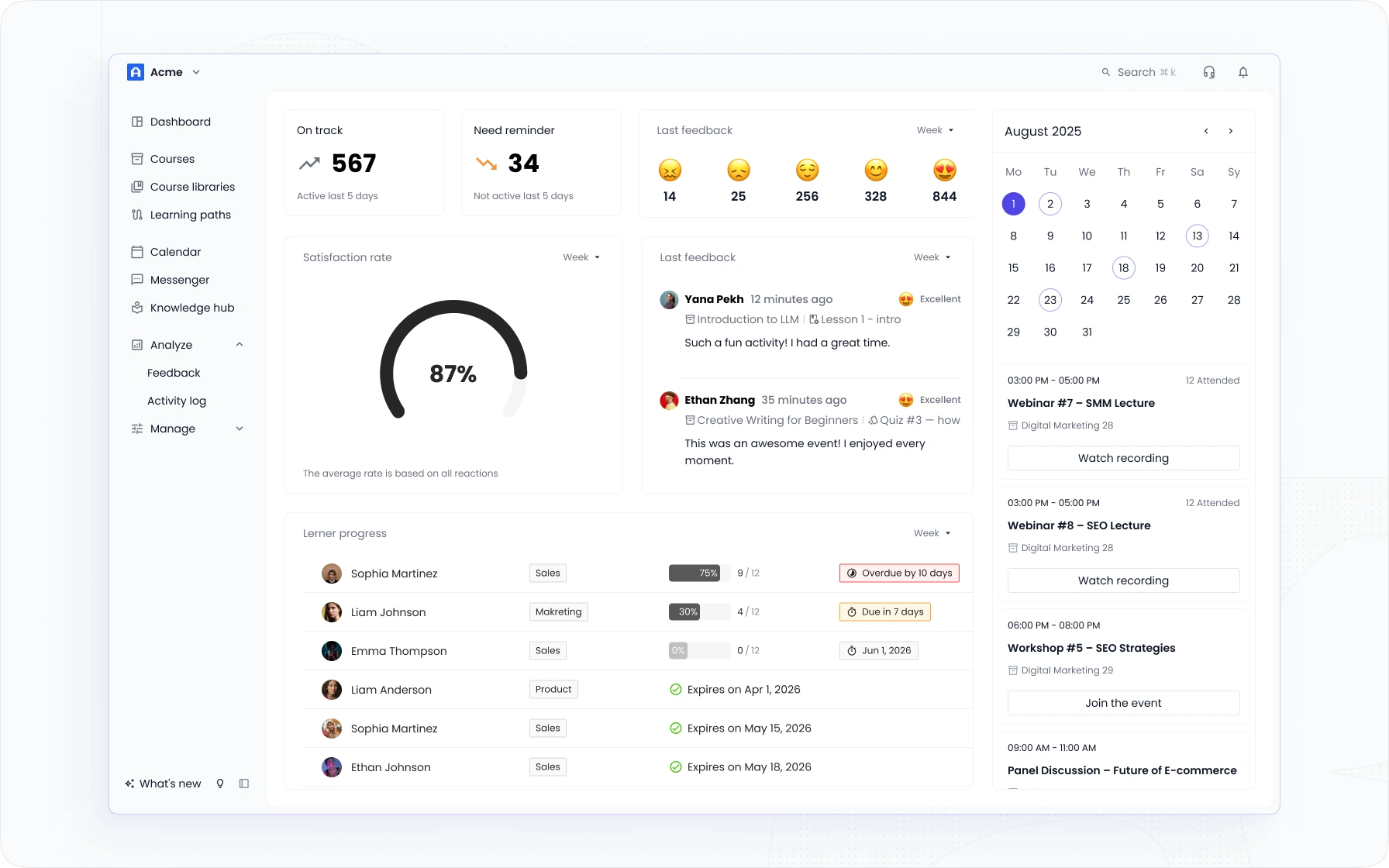
EducateMe is an AI-powered corporate LMS built for teams that need to launch training fast and keep it current without constant manual rework. For sales teams, the combination of microlearning content delivery, AI Roleplay Coach, and real-time analytics makes it a strong fit.
What I'd highlight for sales teams:
- AI Roleplay Coach — practice scenarios with rubric-based real-time feedback; designed specifically for pitching, objection handling, and product demos
- AI course creation — build a microlearning course from a URL, file, or prompt in hours, not weeks; useful when product updates require fast content turnaround
- Cohort + self-paced in one platform — run structured onboarding cohorts alongside on-demand training libraries
- Per-manager dashboards — sales managers get visibility into team progress without needing admin access
- 3x faster course creation and 1.8x faster onboarding compared to traditional approaches
Who it's best for: Mid-sized sales teams (20–500 reps) wanting AI-native tools, fast content creation, and coaching at scale. Particularly strong for onboarding, product knowledge updates, and sales skills development.
Honest limitation: No dedicated mobile app — the platform is mobile-responsive but not a native iOS/Android experience. If offline mobile access is a hard requirement, factor that in.
2. Absorb LMS — Best for Enterprise-Scale Delivery
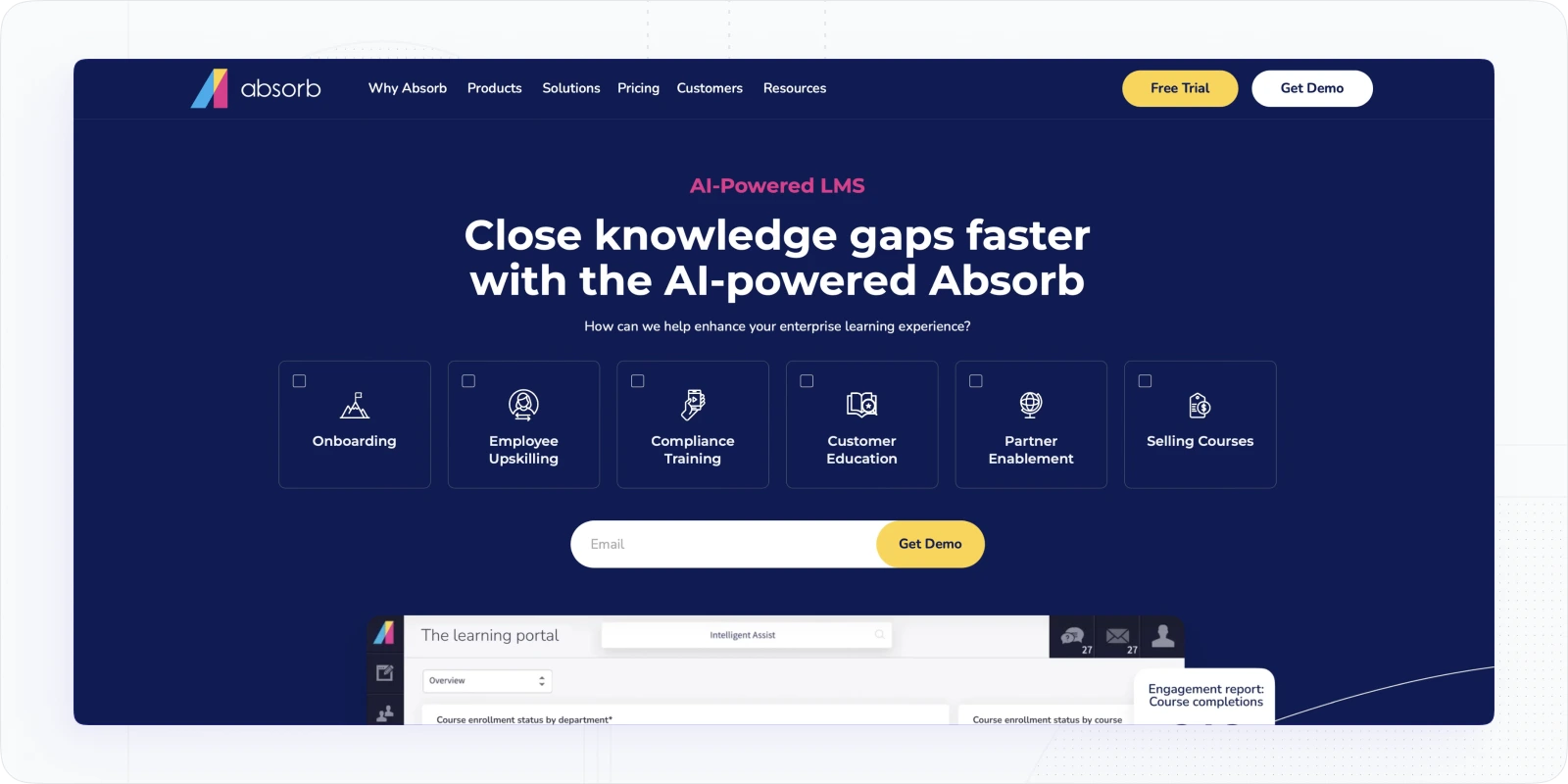
Absorb LMS has been around long enough to earn genuine trust at enterprise scale — and it shows in the depth of its reporting. CRM integrations, including Salesforce, are solid, and the platform handles multi-region rollouts with a level of administrative control that mid-market tools typically can't match. Where it earns its place on this list is analytics: managers get granular visibility into completion, assessment scores, and learning activity across teams.
What I'd highlight for sales teams:
- Salesforce and CRM integrations — training data flows into existing sales systems
- Advanced reporting — per-rep, per-team, and cross-region visibility out of the box
- Gamification features — badges, leaderboards, and contests are included at standard tiers
- Mobile apps — native iOS and Android, which matters for field sales teams
- Smart automation — auto-enroll rules based on department, role, or region
Best for: Large enterprises with complex compliance and sales training needs running across multiple regions. Particularly strong where admin depth and audit-readiness matter.
Honest limitation: The setup and configuration process is more involved than newer AI-native platforms. If speed-to-launch is the priority, that overhead adds up quickly. The admin UI has also been noted by users as feeling dated compared to newer tools.
3. Mindtickle — Best Dedicated Sales Enablement Platform

Mindtickle is purpose-built for sales performance rather than broad corporate training — and that focus shows in every feature decision. Call recording analysis, readiness scorecards, and AI-powered conversation intelligence aren't add-ons here; they're core to how the platform works. If your L&D function sits inside revenue operations and the entire training strategy is sales-specific, this is the closest thing to a native fit.
What I'd highlight for sales teams:
- AI conversation intelligence — analyses real sales calls and feeds insights back into training
- Readiness scorecards — scores reps on knowledge, skills, and behaviour before they're in front of buyers
- Digital sales rooms — buyer engagement tracking linked directly to training outcomes
- Content authoring — purpose-built for sales playbooks, pitch decks, and objection libraries
- CRM integration — connects training data to Salesforce opportunity and pipeline metrics
Best for: Sales-led organisations where the entire training strategy is sales-focused and the L&D function sits inside revenue operations. Less suited to teams running mixed employee training programmes.
Honest limitation: It's not a general-purpose LMS. If you need to run onboarding, compliance, or customer training from the same platform, Mindtickle isn't designed for that overlap.
4. Lessonly (now Seismic Learning) — Best for Sales Playbook Delivery
Seismic Learning (formerly Lessonly) has a specific strength that's hard to match: getting updated sales content into reps' hands fast. When a competitor changes pricing, a product feature ships, or messaging pivots, the platform makes it straightforward to push a revised playbook as a short microlearning module with minimal admin overhead. The content experience is clean, the learning paths are easy to navigate, and completion rates tend to be higher than more complex platforms.
What I'd highlight for sales teams:
- Fast content updates — playbooks and training materials can be revised and re-pushed quickly
- Clean learner experience — minimal friction between login and content; reps actually use it
- Learning paths — structured sequences for onboarding and skills progression
- Coaching features — video practice and manager review built into the workflow
- Salesforce integration — training activity visible inside sales reps' existing workflow
Best for: Teams with high volumes of product updates, shifting competitive positioning, or fast-moving sales environments where content currency is the main challenge.
Honest limitation: Assessment depth and question-bank features are more limited than dedicated LMS platforms. For teams that need complex certification or compliance tracking, the simplicity starts to feel constraining.
5. Docebo — Best for Large-Scale AI Personalisation
Docebo sits at the enterprise end of the market and earns its position there through AI-driven content recommendations and adaptive learning paths that genuinely scale. Where most platforms apply the same learning path to everyone in a role, Docebo's AI engine adjusts content delivery based on individual progress, behaviour, and assessment results. For sales organisations with hundreds of reps across multiple product lines and geographies, that personalisation matters.
What I'd highlight for sales teams:
- AI content recommendations — surfaces relevant microlearning based on each rep's activity and gaps
- Adaptive learning paths — paths adjust in real-time, not just at enrolment
- Virtual coaching — built-in coaching features for manager-led skill development
- Mobile-first design — strong native app for reps who train on the go
- Enterprise integrations — Salesforce, HRIS, and SSO connections are well-developed
Best for: Large sales organisations (500+ reps) running multi-product training across regions, where AI-driven personalisation and enterprise-grade compliance reporting are non-negotiable.
Honest limitation: Docebo pricing starts at $16,000 annually and scales from there — not a realistic option for mid-market teams. Implementation timelines are also longer than faster-to-launch competitors like EducateMe.
| Platform | Key Features | Best For | Pricing |
|---|---|---|---|
| EducateMe | AI Roleplay Coach with rubric-based real-time feedback, AI course creation from URL, file, or prompt, cohort-based + self-paced learning in one platform, per-manager dashboards & real-time analytics, Salesforce & CRM integrations, white-label multi-tenant portals | Mid-sized sales teams (20–500 reps) wanting AI-native tools, fast course creation, and coaching at scale | Start from $239/mo. Free 14-day trial available. |
| Absorb LMS | Salesforce & CRM integrations, advanced multi-region reporting & analytics, gamification (badges, leaderboards, contests), native iOS & Android mobile apps, smart auto-enrollment automation, compliance & certification tracking | Large enterprises with complex compliance and multi-region sales training needs where audit-ready reporting is a priority | Custom pricing. Contact sales for a quote. |
| Mindtickle | AI conversation intelligence on real sales calls, rep readiness scorecards, digital sales rooms with buyer engagement tracking, sales playbook & objection library authoring, Salesforce pipeline integration, call recording analysis | Sales-led organisations where L&D sits inside revenue ops and the entire training strategy is sales-specific | Custom pricing. Enterprise-tier; contact sales. |
| Seismic Learning (formerly Lessonly) | Fast playbook creation & content updates, clean low-friction learner experience, structured onboarding learning paths, video coaching & manager review workflow, Salesforce integration, sales content management | Teams with high volumes of product updates and fast-shifting competitive messaging that needs to reach reps quickly | Custom pricing. Part of the Seismic suite. |
| Docebo | AI-driven personalised content recommendations, adaptive learning paths that adjust in real-time, virtual coaching for manager-led development, mobile-first native app, enterprise HRIS, Salesforce & SSO integrations, advanced compliance reporting | Large sales organisations (500+ reps) running multi-product training across regions where AI personalisation is essential | From ~$16,000/yr. Custom enterprise quotes available. |
Microlearning in Sales: Real-World Use Cases
Onboarding new sales reps
New hire onboarding is where microlearning delivers its clearest ROI. Instead of a week-long classroom induction that reps forget by Thursday, a well-structured microlearning onboarding path delivers content in targeted learning modules aligned to the first 30-60-90 days. Reps get up to speed quickly, and managers can track progress in real-time rather than guessing.
We'd structure the first two weeks as daily 5–10 minute microlearning lessons — product overview, ICP, competitive positioning, CRM workflow — each followed by a short assessment. It keeps the information digestible and creates natural checkpoints.
Handling product updates
Product knowledge degrades fast in sales. A pricing change, a new feature, a shift in competitive positioning, if reps find out about it in the field rather than through training, the consequences show up in deals. Short video updates of 3–5 minutes, pushed through an LMS as a microlearning format, are the most reliable way to distribute product knowledge quickly.
eLearning Industry data shows microlearning completion rates average around 80% — dramatically higher than long-form alternatives.
Pre-call preparation
Just-in-time learning is one of the underused applications of microlearning for sales. A 4-minute module on handling a specific competitor comparison, accessed right before a call, is more valuable than any amount of generic training. The key is having a well-organised content library that reps can actually search.
AI roleplay tools take this further — reps can do a quick practice run of the exact scenario they're about to walk into.
Continuous upskilling
Sales skills atrophy. Collaborative learning — peer challenges, shared scenarios, team assessments — keeps reps engaged beyond onboarding. The best microlearning platforms support features that make upskilling feel less like mandatory training and more like preparation for the next deal.
How to Implement Microlearning in a Sales LMS
Getting this right requires more than picking a platform. Here's the approach I'd actually recommend:
- Map your training needs to specific sales moments — onboarding, pre-call prep, post-loss review, product launch. Each moment needs different content.
- Build content in 75–150 word chunks — every bite-sized lesson should answer exactly one question or teach one skill.
- Use AI to create first drafts fast — platforms like EducateMe can generate a microlearning course from a product page or PDF. That gives you a working draft in hours, not weeks.
- Set completion triggers, not just availability — relevant training pushed to reps at the right moment performs better than a library they have to navigate themselves.
- Measure learning outcomes against sales metrics — if a microlearning isn't improving specific sales performance metrics, it needs to be rebuilt, not just re-assigned.
Microlearning isn't a silver bullet. It works when the content is specific, the delivery is timely, and the platform gives you the analytics to know what's actually working.
Summary
The best microlearning LMS for sales teams combines short-form content delivery with AI coaching, real-time feedback, and analytics that connect training to performance. For most mid-sized sales teams, EducateMe offers the most complete combination of those capabilities in a platform that's fast to set up and genuinely built for modern sales training.
If you're running a large enterprise with complex legacy integrations, Absorb LMS is worth the evaluation process. If your function sits entirely inside a revenue ops team, Mindtickle's sales-specific toolset makes sense.
Setting up your first microlearning course takes less than a day on EducateMe. If you want to test it against your current setup, the 14-day free trial is the fastest way to find out.
Frequently asked questions
For smaller sales teams, the priority is speed and ease of use over enterprise feature depth. Platforms like EducateMe let you launch a microlearning course in hours without a dedicated LMS administrator — useful when you're a team of 15 with no L&D headcount. Look for AI course creation, built-in coaching tools, and clean analytics. Avoid platforms that require months of onboarding before they're usable.
Microlearning improves sales performance by delivering specific, targeted learning at the moments reps actually need it — before a call, after a lost deal, or when a product changes. Research consistently shows bite-sized learning improves retention compared to long-form training. EducateMe's platform data shows 1.8x faster onboarding and 83% average course completion among sales-focused customers, which is well above industry averages.
Traditional sales training typically means long sessions — a day, a week, or a quarterly kick-off. Microlearning breaks that into short bursts of 3–10 minutes, each focused on one skill or concept. The practical difference is that reps can use microlearning in their workflow rather than stepping away from it. It's also far easier to keep current — a 5-minute module on a new product feature is updated in an hour; a full training programme takes weeks to revise.
Not every team needs Salesforce integration, but it's a significant advantage if you're already using it. When your LMS connects to your CRM, you can correlate training completion with deal data — which helps justify the training budget and identify which specific sales skills are driving outcomes. EducateMe supports CRM integrations as part of its broader analytics setup. If your sales team runs on Salesforce, it's worth confirming integration support before you commit to any platform.