
What Is Sales Training? Definition, Types & How to Run It

By Sofia KondratSofia KondratCorporate Training Expert & Content EditorHey there! I’m Sofi Kondrat, your go-to corporate training advisor here at EducateMe. I’ve been navigating the highs…Read more
Corporate Training Expert & Content Editor
8 min read
Most sales managers I've spoken to describe their onboarding programme the same way: a few days of product demos, a Confluence page nobody reads, and a Slack message that says "shadow a senior rep for a week." Then they're surprised when their new hire's first three months look nothing like the quota target.
Sales training is supposed to fix that. But the sales training definition most companies operate from is too narrow — it gets treated as a one-time event rather than an ongoing system. This article covers what sales training actually is, the different types worth knowing about, and what it takes to run a programme that produces results beyond month one.
What Is Sales Training? A Working Definition
Sales training is the structured process of developing the knowledge, skills, and behaviours a salesperson needs to find, engage, and close customers effectively. That's the sales training definition you'll see in most L&D literature — and it's accurate, as far as it goes.
What it leaves out is the practice side. Knowing how to handle an objection and being able to handle it under pressure in a live call are two different things. Effective sales training closes that gap — it doesn't just transfer information, it builds the muscle memory that makes behaviour change stick.
The sales training meaning has also evolved over the past decade. It used to refer almost exclusively to product knowledge and scripted pitch delivery. Today it covers discovery questioning, consultative selling frameworks, negotiation, post-sale expansion, and increasingly, how to sell in environments where buyers have already done their research before the first call.
Why Sales Training Fails (And Why That's Not the Reps' Fault)
A study by Gartner found that sales reps forget up to 70% of training content within a week of delivery if it isn't reinforced. I've seen this play out in practice — a company runs a two-day sales training workshop, reps come back energised, and six weeks later the pipeline looks exactly the same.
The problem is usually structural, not motivational. Single-event training doesn't build lasting behaviour change. It builds temporary enthusiasm. Three things tend to go wrong:
- Training is front-loaded — everything delivered in week one, nothing reinforced after that
- Practice is optional — reps are told how to handle objections but rarely given a safe environment to actually practise them before a real call
- Measurement stops at completion — managers track whether reps finished the module, not whether their call quality improved
This is why the what-is-sales-training conversation matters. If the answer is "a course reps take when they join," the outcome will reflect that.
Types of Sales Training
Not all sales training serves the same purpose. I'd split it into five categories, each addressing a different stage of the rep's development or the sales cycle.
1. Onboarding and product knowledge training
The foundation. New reps need to understand what they're selling, who buys it, and why customers choose it over alternatives. Done well, this takes three to four weeks and includes structured shadowing, call reviews, and a certification before the rep goes live. Done poorly, it's a product tour and a prayer.
2. Sales skills training
This covers the mechanics of selling: discovery questioning, active listening, objection handling, negotiation, and closing. It's the category most companies underinvest in relative to product training — probably because product knowledge is easier to deliver and easier to test.
3. Methodology training
Frameworks like MEDDIC, SPIN Selling, Challenger Sale, or Sandler give reps a repeatable approach to qualifying and progressing deals. Methodology training is most valuable when it's embedded into the CRM and reinforced in deal reviews — not just taught as theory in a slide deck.
4. Coaching and roleplay practice
This is the most under-resourced category in most sales teams. Managers know they should coach, but most spend less than 5% of their week on structured rep development. Roleplay specifically — practising discovery calls, demos, or negotiation conversations in a low-stakes environment — is where skills actually transfer into behaviour. AI roleplay tools have made this significantly more accessible; reps can practise asynchronously without needing a manager or a peer to play the buyer.
5. Continuous and refresher training
Sales environments change. Pricing updates, new competitor moves, product launches, and shifts in buyer behaviour all require ongoing training to keep the team current. This is typically the most neglected category — until something breaks, at which point everyone wonders why the team was caught flat-footed.
What Is the Role of AI in Virtual Sales Training?
The role of AI in virtual sales training has expanded considerably in the last two years, and I'd argue it's changed what's actually achievable for teams that don't have a full-time sales enablement function.
The most meaningful application is AI-powered roleplay. Traditional roleplay requires a manager or a peer to play the buyer — which means it either doesn't happen or happens inconsistently. AI roleplay tools let reps practise cold call openers, objection responses, or discovery conversations on demand, with structured feedback on what they said and how they said it. The feedback is immediate, the environment is low-stakes, and the rep can repeat the scenario until the response feels natural rather than rehearsed.
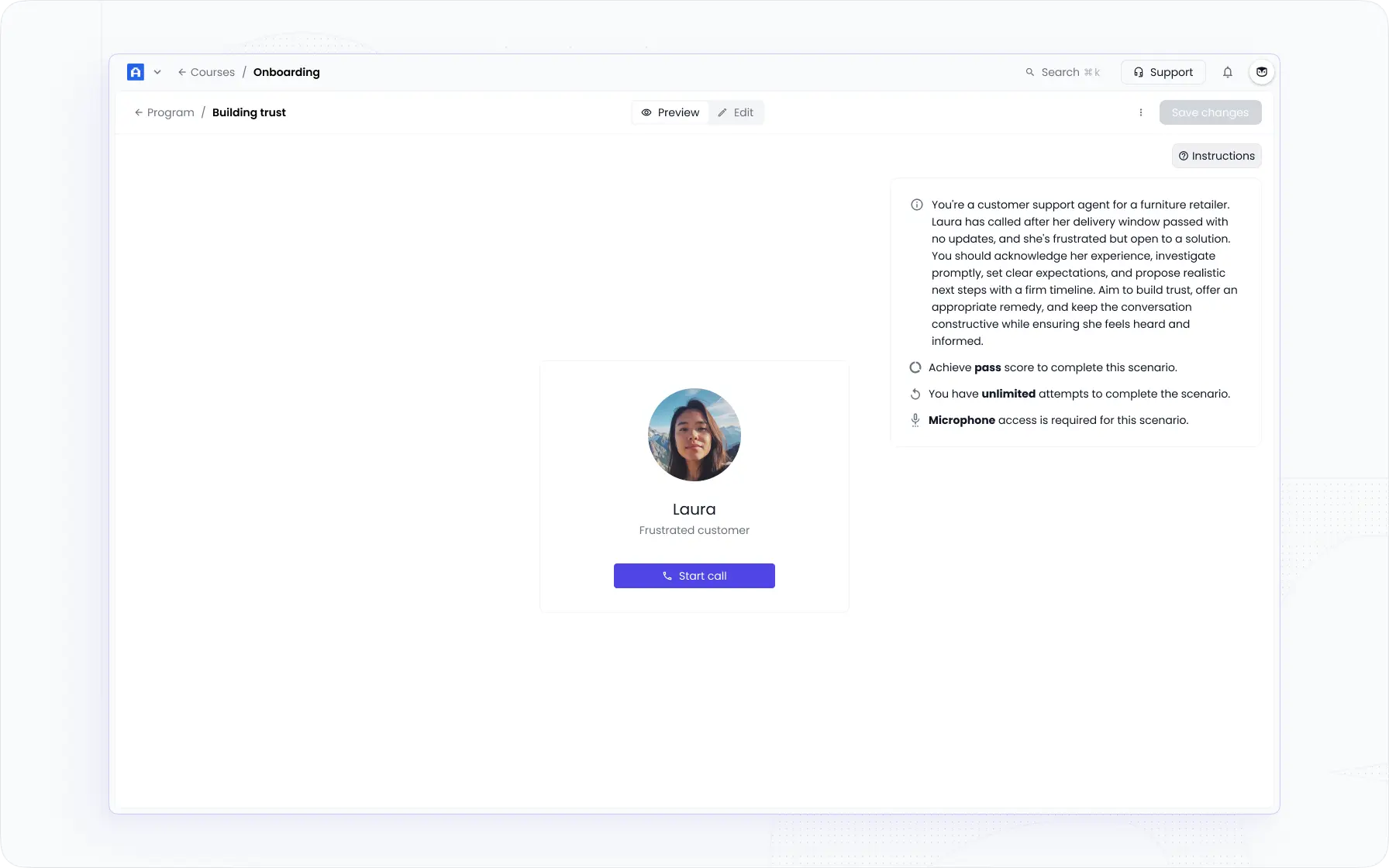
Beyond roleplay, AI is being used in sales training for three other things: personalised learning paths (adjusting what content a rep sees based on their skill gaps and role), content generation (turning product documentation or call recordings into structured training modules), and performance analytics (identifying which training activities correlate with pipeline outcomes).
The honest caveat: AI doesn't replace manager coaching. The reps who develop fastest are still the ones whose managers are actively in their deals and calls. AI extends coaching capacity — it doesn't substitute for it.
⚡ Try EducateMe's AI Roleplay Coach free — reps practise on demand, managers coach on what matters.
How to Run Sales Training Effectively
I'll be direct here: most sales training programmes are designed for the manager's convenience, not the rep's learning. They're structured around what's easy to build and deliver, not what actually produces behaviour change. Here's what a programme that works looks like instead.
Start with a skills gap analysis, not a content library
Before building or buying training, map out what your reps actually need. Call recordings, deal reviews, and win/loss data will tell you more about skill gaps than any survey. Common findings: reps skip discovery, lose control in negotiation, or can't articulate differentiation when a buyer pushes back on price. Build training to close those specific gaps.
Distribute learning across 90 days, not 3
Onboarding should not be a two-week event. A 30-60-90 day structure — where learning is staggered, reinforced, and connected to actual deals the rep is working — consistently outperforms intensive front-loaded programmes. Week one is context. Weeks two through four are skill-building. Months two and three are practice and reinforcement.
Make practice non-negotiable
Every skill module should have a practice component. If reps are learning objection handling, they should do a roleplay scenario before moving on — not as a nice-to-have, but as a requirement. This is where AI roleplay tools remove the bottleneck: reps don't need to wait for a manager to be available, and they can repeat the scenario without anyone watching.
Measure what changes, not what completes
Completion rates are a process metric, not an outcome metric. The metrics that matter are: ramp time to first deal, average deal size in month three versus month one, call quality scores, and win rate trends. If your sales training programme doesn't have a clear line to at least one of these, it's not accountable to anything.
Build feedback loops between training and the field
Managers should be reviewing calls and connecting what they see to training content. If a rep consistently struggles with the demo-to-proposal transition, that should trigger a specific coaching intervention — not a generic "watch the methodology module again." Training and coaching work when they're connected to real deal behaviour, not when they're treated as separate systems.
⚡Looking for tools to scale roleplay practice across your team? We put together a breakdown of the 5 best AI roleplay tools for sales training — including what each one is actually good for.
What Good Sales Training Looks Like in Practice
A SaaS company I worked with had a 90-day ramp problem — new AEs weren't hitting quota until month five or six, which was putting pressure on the sales team's overall performance against targets. We rebuilt their onboarding around three things: a structured 30-60-90 day curriculum (instead of a two-week product bootcamp), weekly AI roleplay assignments for objection handling and discovery, and bi-weekly call reviews where managers scored reps against a defined rubric.
Within two cohorts, average ramp time dropped from five months to three. The change wasn't the content — the content was similar to what they had before. The change was the structure, the practice frequency, and the feedback loop between coaching and training.
That's what effective sales training looks like. Not a better slide deck. A system that produces repeatable rep development.
Key Takeaways
- The sales training definition goes beyond product knowledge — it covers skills, methodology, practice, and ongoing reinforcement
- Single-event training doesn't produce lasting behaviour change; programmes distributed across 90 days consistently outperform intensive bootcamps
- AI plays a meaningful role in virtual sales training — particularly in scaling roleplay practice and personalising learning paths
- Measure ramp time, deal quality, and call scores — not just module completion
- Training and coaching work when connected to real deal activity, not when run as separate programmes
Frequently asked questions
Sales training delivers structured knowledge and skills — methodology, product knowledge, objection handling. Sales coaching applies those skills to specific deals and conversations a rep is actively working. Training sets the foundation; coaching reinforces and personalises it. The most effective programmes combine both, with training informing what managers focus on in coaching sessions.
A structured 90-day onboarding programme consistently outperforms intensive two-week bootcamps. The first 30 days should cover product knowledge, ICP, and sales methodology. Days 31–60 focus on skill-building and supervised deal activity. Days 61–90 shift to independent selling with regular coaching check-ins. Anything shorter tends to front-load information without building the practice time reps need to retain it.
AI in virtual sales training is primarily used for roleplay practice, personalised learning paths, and content creation. AI roleplay tools let reps practise objection handling, discovery calls, and demos on demand — without needing a manager to play the buyer. This makes consistent practice achievable even in teams without a dedicated sales enablement function. EducateMe's AI Roleplay Coach is built for exactly this use case.
Completion rates tell you whether people finished a module — not whether the training changed anything. The metrics that matter are: time-to-first-deal for new reps, win rate trends at 30, 60, and 90 days post-training, average deal size, and call quality scores. If your programme can't connect to at least one of these, it's not accountable to a business outcome.