
360Learning Pricing in 2026: Plans, Costs & What Buyers Miss

By Alexa BerezinaAlexa BerezinaL&D Specialist & CSM LeadMy name is Oleksandra (Alexa), and I’m a certified Learning & Development specialist focused on turning complex knowledge…Read more
L&D Specialist & CSM Lead
5 min read
360Learning pricing is more transparent than most enterprise LMS vendors, but it still has “gotchas” once you move beyond the entry plan.
As organizations scale or require enterprise features such as security controls and integrations, pricing moves from a fixed per-user rate to a custom contract. This shift can make it harder to estimate total cost early in the buying process. And usually, that’s where most pricing questions start.
This guide helps you understand the 360Learning pricing model and how to evaluate whether the platform offers good value for your needs. Read on!
How Does 360Learning Pricing Work?
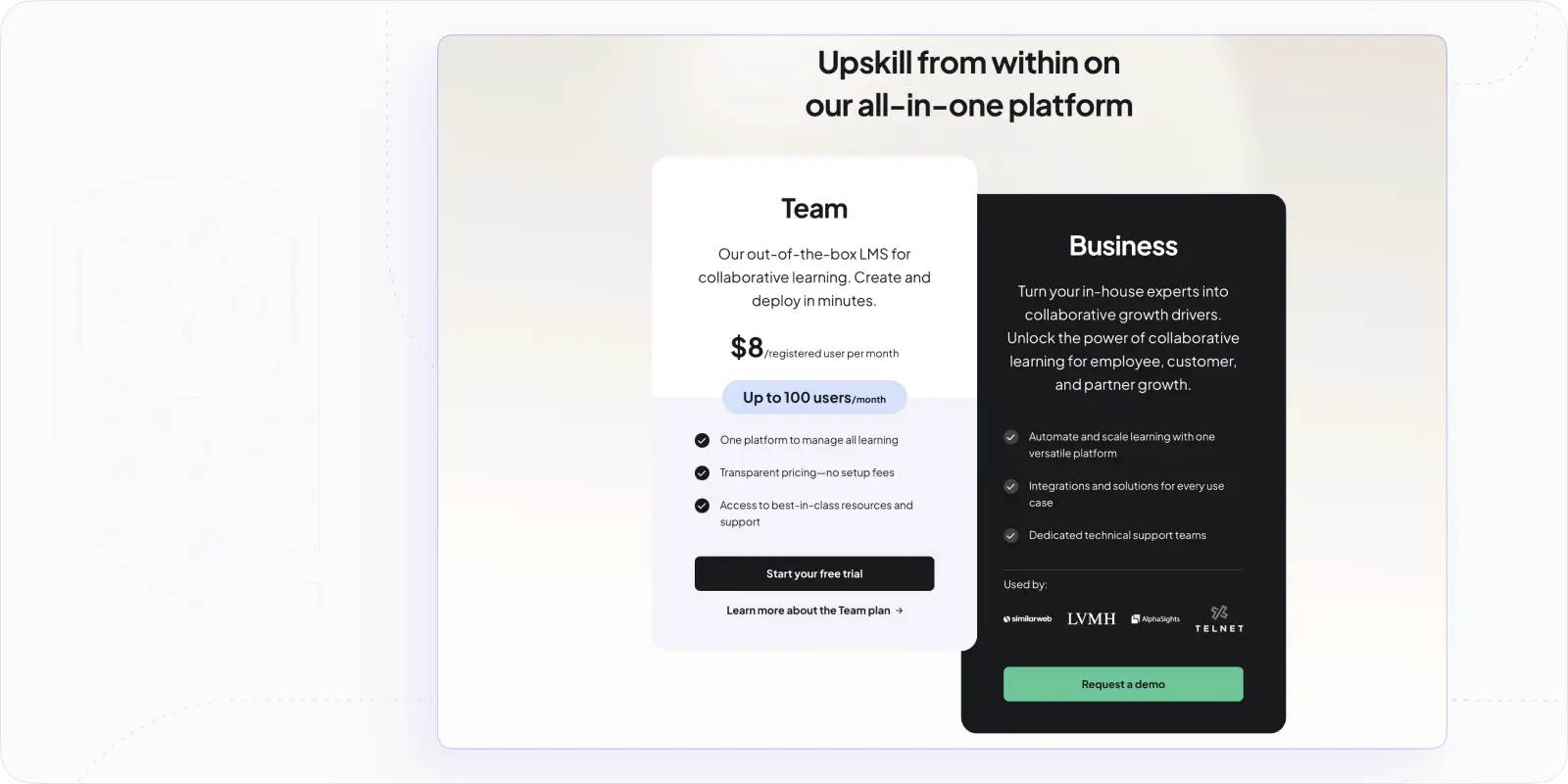
360Learning pricing follows a subscription model with a clear public entry point and a “talk to sales” path for larger rollouts. In practical terms, pricing works as follows:
- A published starting tier: The Team plan is the only tier with public pricing. It’s listed at $8 per user per month, with no setup fees, and is typically used by smaller teams (up to 100 users) that want to move quickly without a lengthy procurement process.
- User-based billing: Pricing is calculated per user, but the definition of a “user” matters. Depending on the agreement, billing may be based on registered users or active users, which can materially affect total cost in organizations with uneven or seasonal usage.
- A shift to custom contracts at scale: Once requirements extend beyond the basics (such as single sign-on, advanced administrative controls, API access, or tighter security and compliance alignment), pricing moves to a custom contract. At that point, cost is driven by deployment scope rather than a fixed per-user rate.
Practical takeaway: 360Learning LMS pricing is “partly transparent.” You can benchmark the entry tier immediately, but you cannot reliably estimate a global, multi-region enterprise deployment without a scoped proposal.
360Learning Pricing Plans Breakdown
Here is a buyer-friendly way to think about costs, using what’s public plus realistic procurement logic for mid-market and enterprise deals.
| Plan | What it covers | What to expect | Best suited for |
|---|---|---|---|
| Team plan | Core LMS features, collaborative authoring, and standard support | $8 per user per month (≈ $96 per user per year), typically capped at around 100 users | Small teams or departments that want a modern LMS without heavy IT involvement |
| Business / Enterprise | Advanced admin controls, SSO, API access, governance, enterprise support | Custom annual contract based on scope | Mid-market and enterprise organizations (≈500–10,000+ users) with integration, security, or multi-region needs |
Takeaways:
- At the Team level: Budgeting is straightforward. For example, 100 users at list price comes out to ≈ $800 per month or ≈ $9,600 per year, making early cost planning simple and predictable.
- Beyond the Team plan: The published rate becomes a reference point rather than a forecast. Business and Enterprise pricing is shaped by factors such as identity management, security requirements, integrations, and support expectations, which are defined through a custom contract.
Procurement tip: Ask your sales contact to confirm, in writing, whether pricing is based on registered, active, or contracted users — then align that definition with how your organization actually uses training (seasonal activity, onboarding spikes, compliance campaigns, partner training, etc.).
Additional Costs to Expect
While the Team plan is positioned as transparent, with no setup fees, it generally holds for smaller deployments. At the enterprise level, however, total cost usually extends beyond the subscription itself.
Here are the areas where costs most often expand for mid-market and enterprise buyers.
Implementation and onboarding support
Although the LMS is quick to get started, larger organizations require additional time or services to get it production-ready. This often includes migrating existing content and users, setting up groups and permissions, validating reporting for compliance, and standardizing authoring and approval workflows.
G2 reviewers frequently describe onboarding as smooth when the vendor is closely involved. In practice, that level of support reflects additional effort (either internal or vendor-led) that affects overall cost and time to value.
Integrations with existing systems
Integration, to enable the LMS to connect with the rest of the tech stack, is another major pricing factor. Your organization may need to include identity providers for single sign-on and HR systems for user and role synchronization. Additionally, you may also need APIs for custom workflows and CRM connections for sales or partner training.
These capabilities are typically associated with higher-tier plans and are often handled as part of a custom enterprise contract rather than the base subscription.
Support levels and service expectations
Standard support is usually sufficient at the Team level. However, at enterprise deployments, organizations often require more defined service commitments. This can include named support contacts, faster response times, contractual SLAs, and assistance with security or compliance reviews.
Those expectations are normally reflected in the overall contract value rather than listed as standalone line items.
Reporting depth and administrative governance
Reporting is another area where expectations tend to grow over time. Enterprise stakeholders often need segmented reporting by region or role, audit-ready exports, executive dashboards, and insights that go beyond basic completion tracking.
While 360Learning provides reporting and analytics features, the practical question is whether the level of detail required is included in the selected tier or becomes part of the broader enterprise scope.
Is 360Learning Expensive or Affordable?
In practice, 360Learning tends to be:
- Affordable when organizations can rely on standard functionality, limit customization, and operate with minimal integrations and standard support.
- More expensive when the rollout requires enterprise identity and security controls, complex administrative structures, multi-region governance, advanced analytics, or dedicated support. At that point, pricing reflects the scope of the contract rather than the per-user rate.
Market perception also aligns with that nuance. For example, review platforms like Capterra show a strong “value for money” rating in the mid-4s.
However, individual buyers still flag pricing as “hefty” compared to alternatives, depending on needs and tier. The value weakens when organizations require simple course delivery, fixed pricing, or have very large learner groups with limited collaboration opportunities. In those situations, many of the collaborative features go unused.
Note: Before committing, it’s essential to compare 360Learning alternatives to pressure-test pricing and scope.
For teams evaluating alternatives, platforms like EducateMe are often part of the comparison set. It’s typically considered by organizations that want a faster setup and clearer pricing without the heavier governance and configuration overhead that comes with enterprise-level LMS contracts.
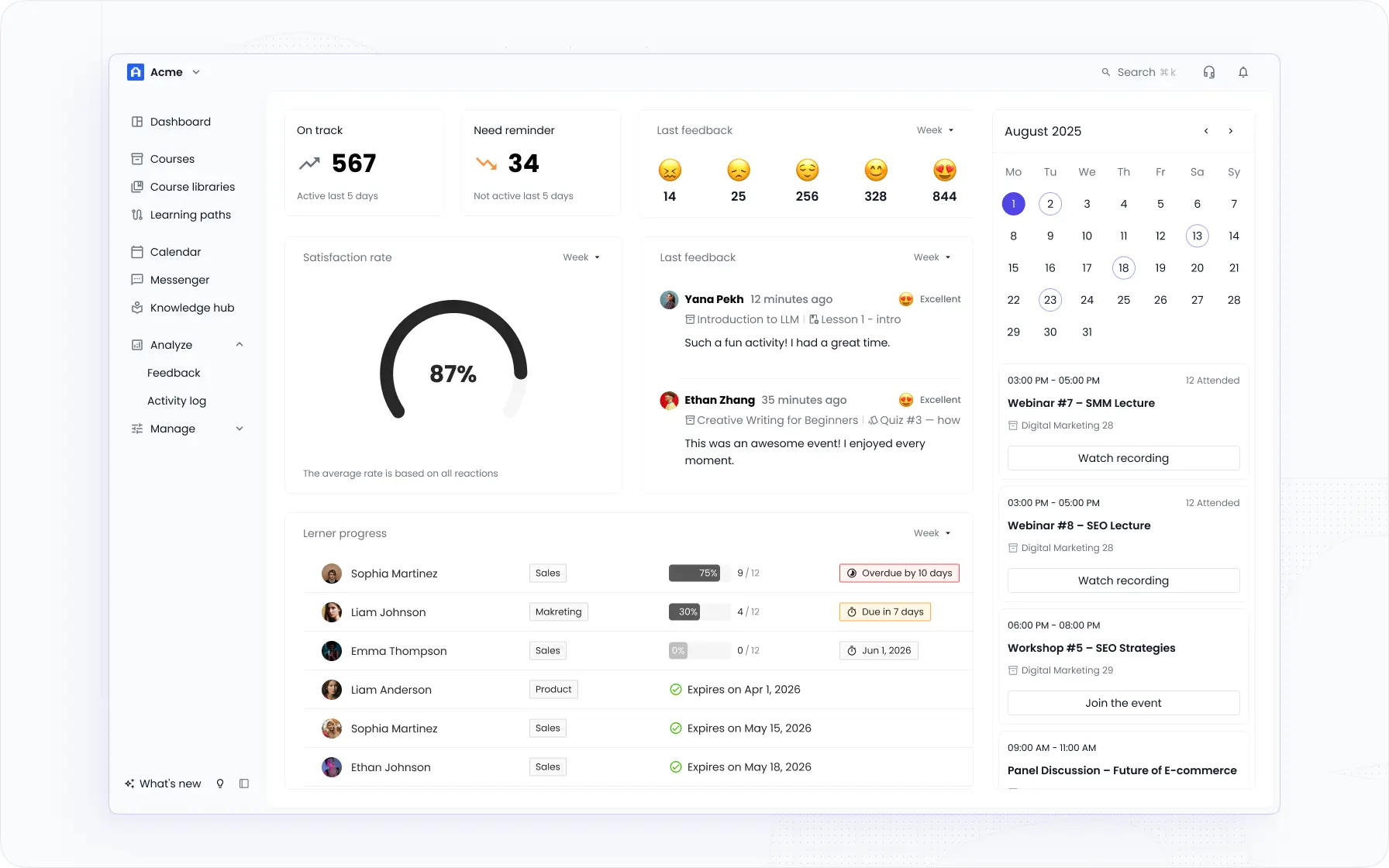
EducateMe positions itself as a more lightweight, flexible option, with strengths that include:
- Transparent, scalable pricing that adapts as teams grow, without complex contract negotiations
- Fast implementation, often within hours rather than months
- AI-powered assistance for course creation, content structuring, and routine automation, helping reduce manual effort
- Multi-tenancy, making it suitable for departments, partners, or client-facing training use cases
- White-labeling, live sessions, analytics, and integrations presented through a clean, unified interface
- A free trial, allowing teams to evaluate the platform in real conditions before committing
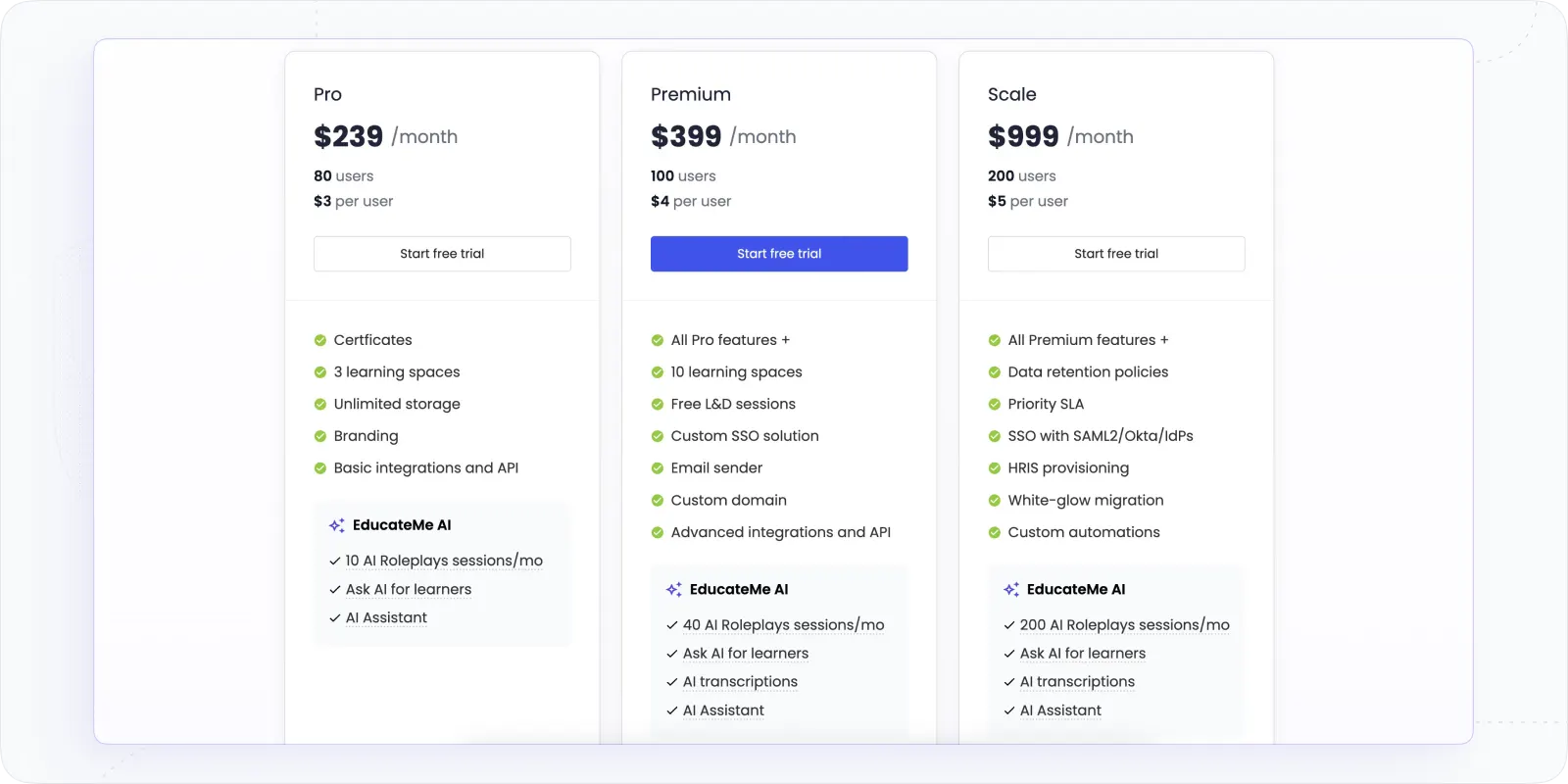
Ultimately, 360Learning delivers the most value for organizations that fully leverage its collaborative and enterprise capabilities. Teams with simpler structures, tighter budgets, or faster timelines may find that a more streamlined LMS aligns better with their actual usage patterns and long-term costs.
You can try EducateMe for free or book a demo to assess whether its pricing structure and feature set better align with how your learning programs actually operate.
Frequently asked questions
360Learning publishes pricing only for its Team plan, which is listed at $8 per user per month. Pricing for Business and Enterprise plans is not public and is provided through a custom sales quote based on scope and requirements.
At the entry level, 360Learning costs $8 per user per month (≈ $96 per user per year) on the Team plan, typically capped at around 100 users. Beyond that tier, per-user cost depends on contract terms, user volume, and enterprise requirements.
Annual billing is typical, especially for larger deployments. Monthly billing may be available in some cases, but it often comes at a higher effective per-user cost. Billing terms are finalized during the sales process.
Enterprise pricing is influenced by factors such as: Number of users. User definition (registered vs active vs contracted). Security and compliance requirements. Integrations (SSO, HRIS, APIs). Support level and SLAs. Reporting and governance needs. As these requirements increase, pricing shifts from a fixed rate to a scoped contract.