
Sana Labs Pricing: Real Costs, Plans, and What Enterprises Should Expect in 2026

By Sofia KondratSofia KondratCorporate Training Expert & Content EditorHey there! I’m Sofi Kondrat, your go-to corporate training advisor here at EducateMe. I’ve been navigating the highs…Read more
Corporate Training Expert & Content Editor
5 min read
Sana Labs (now part of Workday) is often positioned as a next-generation, AI-first learning platform for enterprise training. It promises personalized learning paths, adaptive content, and data-driven insights at scale. In other words, all things modern L&D teams are actively looking for in 2026.
But once interest turns into evaluation, one practical question shows up fast: How does Sana Labs pricing actually work?
Buyers searching for Sana pricing quickly realize that while some pricing is visible, full Sana LMS pricing is more complex. Sana Labs publishes limited pricing information publicly, but enterprise LMS deployments under Sana Learn still require a sales conversation. Costs depend on user volume, minimum license commitments, and enterprise requirements, which makes early budget planning harder than it first appears.
Below, we break down Sana Labs pricing in realistic terms: what you’re likely to pay, what’s included, and when the investment actually makes sense.
How Sana Labs Pricing Works
The Sana Labs pricing model is split between publicly visible plans and enterprise-level pricing that requires direct engagement with sales.
In practice, Sana Labs uses two different pricing layers, depending on how the product is used.
Public pricing vs. enterprise LMS pricing
Sana Labs publishes clear entry-level pricing cues on its website:
- Free — $0
- Team — $30 per user/month
- Enterprise — custom pricing
These are part of the broader Sana Learn pricing plans, but they don’t represent enterprise LMS usage.
The Free and Team plans are primarily designed for:
- Smaller teams
- Knowledge management and AI assistant use cases
- Internal collaboration and document-based workflows
Once Sana Labs is evaluated as a full-scale learning platform, with structured training programs, governance, integrations, and compliance requirements, pricing shifts into the Enterprise model, where details are no longer public.
What actually determines Sana Labs enterprise pricing
For enterprise deployments, Sana Labs pricing enterprise contracts are shaped by multiple factors rather than a flat rate:
- Number of users. Enterprise pricing is still user-based, but often includes minimum seat commitments.
- Scope of use. Whether Sana is used for lightweight enablement or as a core LMS impacts cost.
- Security and identity requirements. Features like SAML-based SSO, SCIM provisioning, and domain verification typically fall under enterprise agreements.
- Integrations and APIs. Connecting Sana Labs to HRIS, identity providers, or internal systems can influence pricing.
- Support and SLAs. Priority support, uptime guarantees, and dedicated success teams are usually part of enterprise contracts.
This structure reflects the broader Sana Labs pricing business model, where cost scales with depth of adoption rather than surface-level usage.
Billing structure and commitments
A few mechanics matter upfront when evaluating Sana LMS pricing:
- Annual billing is standard for enterprise customers
- Monthly pricing is usually a reference, not the billing cadence
- Minimum commitments often apply, which affects the effective per-user cost
- Enterprise pricing almost always requires contacting sales
This is why many buyers searching for Sana Labs pricing struggle to estimate total cost early on: the visible prices don’t reflect the full enterprise LMS deployment.
Sana Labs Pricing Breakdown
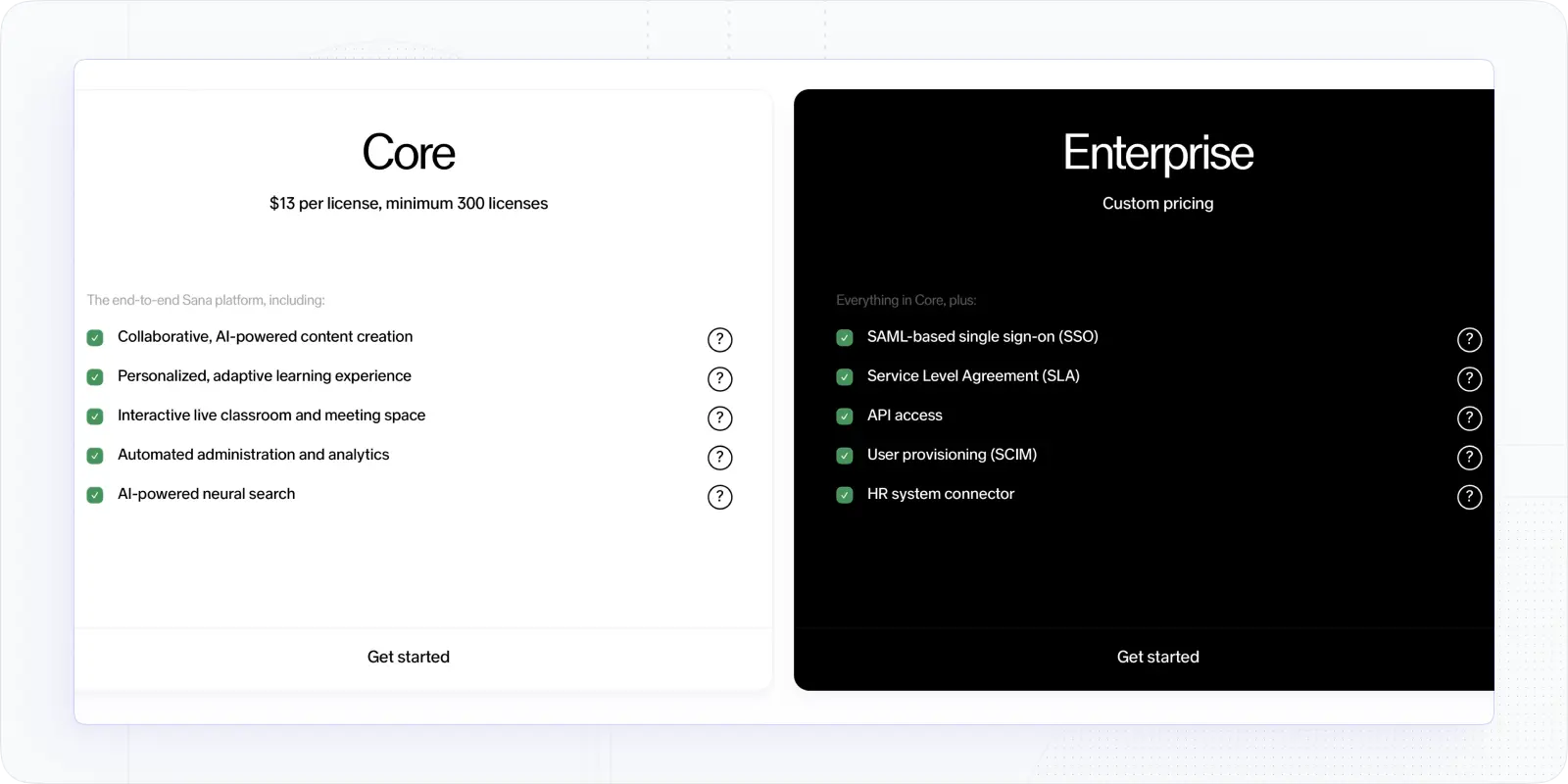
While Sana Labs shows entry-level prices publicly, enterprise LMS pricing starts meaningfully higher and is shaped by minimum commitments and deployment scope.
Below is a realistic breakdown based on:
- Sana Labs’ published pricing cues
- Enterprise LMS market benchmarks
- How Sana is typically deployed in mid-market and enterprise organizations
This isn’t a list of official plans. It’s an estimate of what buyers usually end up paying in practice.
Estimated Sana Labs pricing by deployment type
| Plan / Deployment Type | What’s Included | Typical Annual Price Range | Best For |
|---|---|---|---|
| Free | Limited meetings, basic assistants, capped integrations | $0 | Individuals or very small teams testing Sana |
| Team | Core AI features, integrations, up to ~50 users | ~$30 per user/month | Small teams using Sana for collaboration or knowledge access |
| Sana Learn – Core | AI-driven learning, analytics, and content creation | ≈ $46,800/year minimum (300 licenses × $13 × 12) | Mid-size organizations using Sana as an LMS |
| Sana Learn – Enterprise | Core & SSO, SCIM, API access, HR connectors, SLAs | Custom quote | Large enterprises with complex requirements |
What this table doesn’t show (but buyers should know)
For enterprise LMS buyers, the Team price is rarely representative of the final cost.
Once Sana Labs is used for:
- Structured employee training
- Compliance or regulated learning
- Organization-wide rollout
- Deep system integrations
pricing typically shifts into custom enterprise contracts, often with:
- Minimum seat commitments (commonly a few hundred users)
- Annual billing
- Bundled enterprise features rather than à-la-carte add-ons
This is why organizations searching for Sana Labs pricing per user often see a disconnect between the public $30 figure and real enterprise quotes.
Why the effective per-user cost can be higher than expected
Even when the per-license rate seems reasonable, minimum commitments change the math.
A 300-license minimum under Sana Learn pricing creates a baseline spend of nearly $47,000 per year, even if usage fluctuates. This is where many buyers reassessing Sana Labs pricing enterprise start questioning long-term flexibility.
Additional Costs to Expect
To be honest, the license fee is only part of the total cost. For enterprise LMS deployments, implementation, integrations, and support tiers often add meaningful overhead that isn’t visible in initial pricing cues.
These considerations frequently appear in a detailed Sana Labs review, especially from buyers in regulated or global environments.
Implementation and onboarding
For enterprise use cases, Sana Labs is rarely a “plug-and-play” LMS.
Common implementation-related costs include:
- Guided onboarding and rollout support
- Configuration of learning structures and permissions
- Initial setup of AI-driven learning flows
- Internal admin training
In some cases, these services are bundled into the first-year contract. In others, they appear as professional services. Either way, implementation typically requires both budget and internal time.
Integrations and technical setup
Enterprise LMS deployments almost always involve integrations, but not all of them are included by default.
Potential cost drivers:
- HRIS integrations (for user provisioning and lifecycle management)
- Identity providers (SSO, SCIM, domain verification)
- Internal knowledge bases or content repositories
- API access for custom workflows
Even when integrations are supported technically, the configuration effort can increase overall cost, especially in complex environments.
Security, compliance, and identity management
For regulated or global organizations, security requirements are non-negotiable.
Enterprise pricing often reflects:
- SAML-based single sign-on
- SCIM provisioning
- Data processing agreements
- Compliance and audit support
These features are typically part of enterprise contracts, not entry-level plans, and they influence final pricing.
Support tiers and service levels
Basic support is usually included, but enterprise customers often require more.
Higher-tier support may involve:
- Priority response times
- Dedicated success or account teams
- Custom SLAs and uptime guarantees
These service levels tend to scale with organization size and deployment complexity, increasing total annual spend.
Renewals and long-term cost considerations
One area buyers often underestimate is renewal pricing.
Things to watch for:
- Annual renewals as the default
- Price adjustments at renewal unless negotiated upfront
- Multi-year agreements that may reduce cost but increase commitment
Ignoring renewal terms can significantly impact the long-term total cost of ownership.
No self-serve enterprise trial
While Sana Labs offers a Free tier, enterprise LMS evaluation typically happens through demos and sales-led discussions, not full-featured trials.
This adds:
- Time to the buying process
- Dependence on sales estimates early on
- Less opportunity to test enterprise features before committing
In short, Sana Labs pricing goes beyond the license fee. Implementation, integrations, security, and support all shape the real cost, especially for enterprise LMS deployments.
Final Verdict: Is Sana Labs Worth It in 2026?
Shortly, yes, Sana Labs is worth the price only if you’re set up to use its AI depth at scale. If not, the cost and commitments can outweigh the benefits.
Here’s how that plays out in practice.
When Sana Labs is a good fit
Sana Labs makes sense for organizations that:
- Run large, structured learning programs across departments or regions
- Actively use AI-driven personalization (not just basic course hosting)
- Need enterprise-grade security, identity management, and compliance
- Can commit to annual contracts and minimum seat requirements
- Have a stable headcount and predictable training demand
In these cases, the pricing aligns with the value. The platform’s AI capabilities, analytics, and integrations can justify the spend when learning outcomes and operational efficiency are measurable.
When Sana Labs is not a good fit
Sana Labs is harder to justify if your organization:
- Has fewer than a few hundred learners or fluctuating usage
- Needs strict pricing transparency early in procurement
- Wants flexibility to scale down as well as up
- Is still experimenting with learning formats or content strategy
- Doesn’t rely heavily on AI-driven personalization
For these teams, the minimum commitments and enterprise overhead often drive the effective cost higher than expected. And that's where teams are starting to look for the Sana Labs alternatives.
The value-for-money question
Sana Labs isn’t “overpriced”. It’s purpose-built for enterprise AI learning. The issue is fit.
If your learning strategy genuinely depends on adaptive AI, the investment can pay off. If you mainly need a reliable, modern LMS without long-term lock-in, the same budget may deliver more value elsewhere.
This is why many buyers evaluating Sana Labs pricing also compare competitors before making a decision. One of the best AI-powered alternatives on the market is EducateMe.
Why EducateMe?
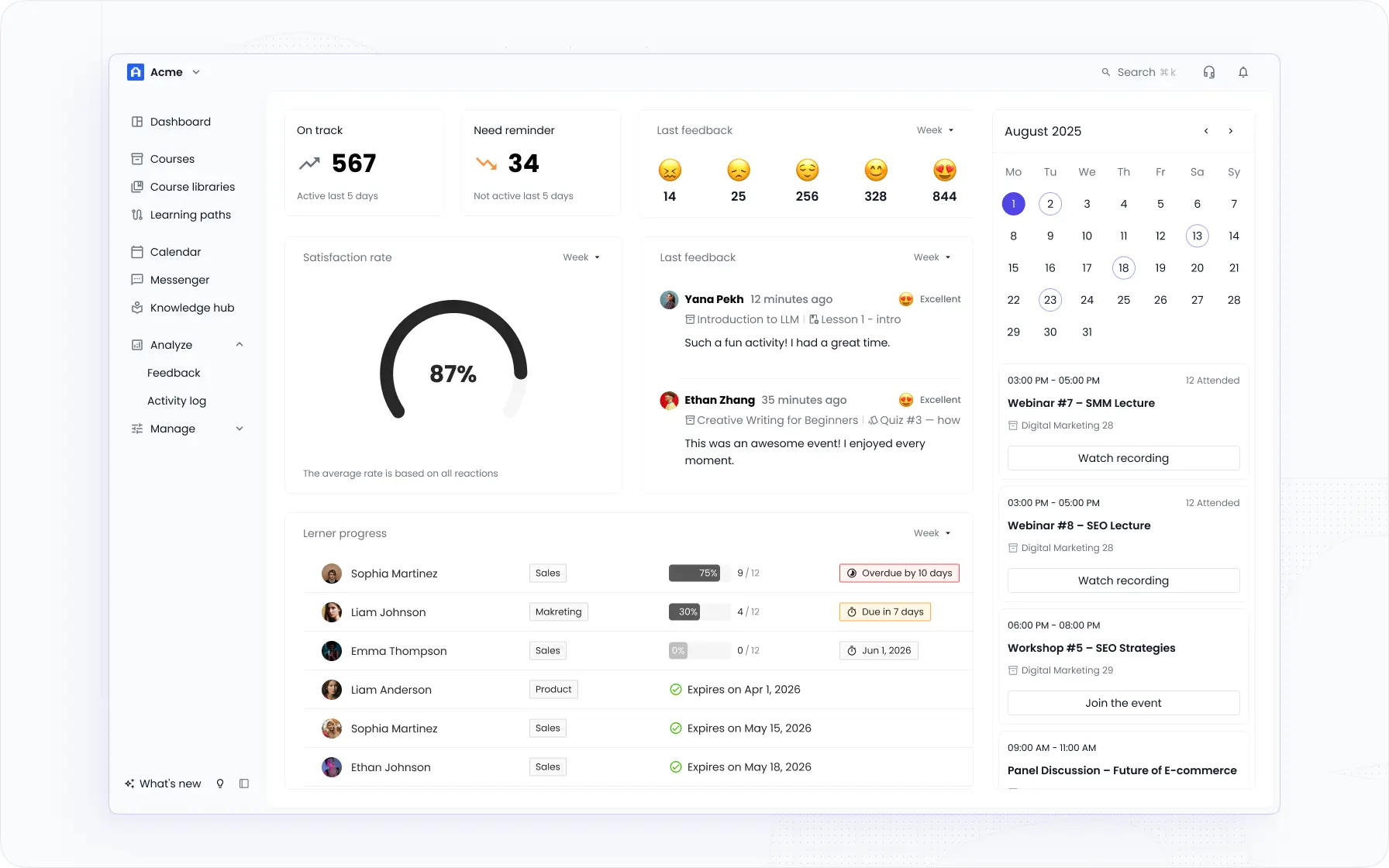
EducateMe offers a streamlined approach to corporate learning that works well for:
- Mid-market companies
- Fast-scaling organizations
- Teams replacing legacy LMS tools without locking into long-term commitments
With EducateMe, organizations get:
- Flexible, scalable pricing that grows with usage instead of enforcing high minimums
- Fast setup, often allowing fully branded learning portals to launch in hours, not months
- AI-powered course creation and automation to reduce manual admin work
- Multi-tenancy support, useful for departments, partners, or client-facing training
- Advanced white-labeling for brand consistency
- Live sessions, analytics, and integrations in a clean, easy-to-manage interface
- A free trial, making it possible to evaluate the platform without procurement risk
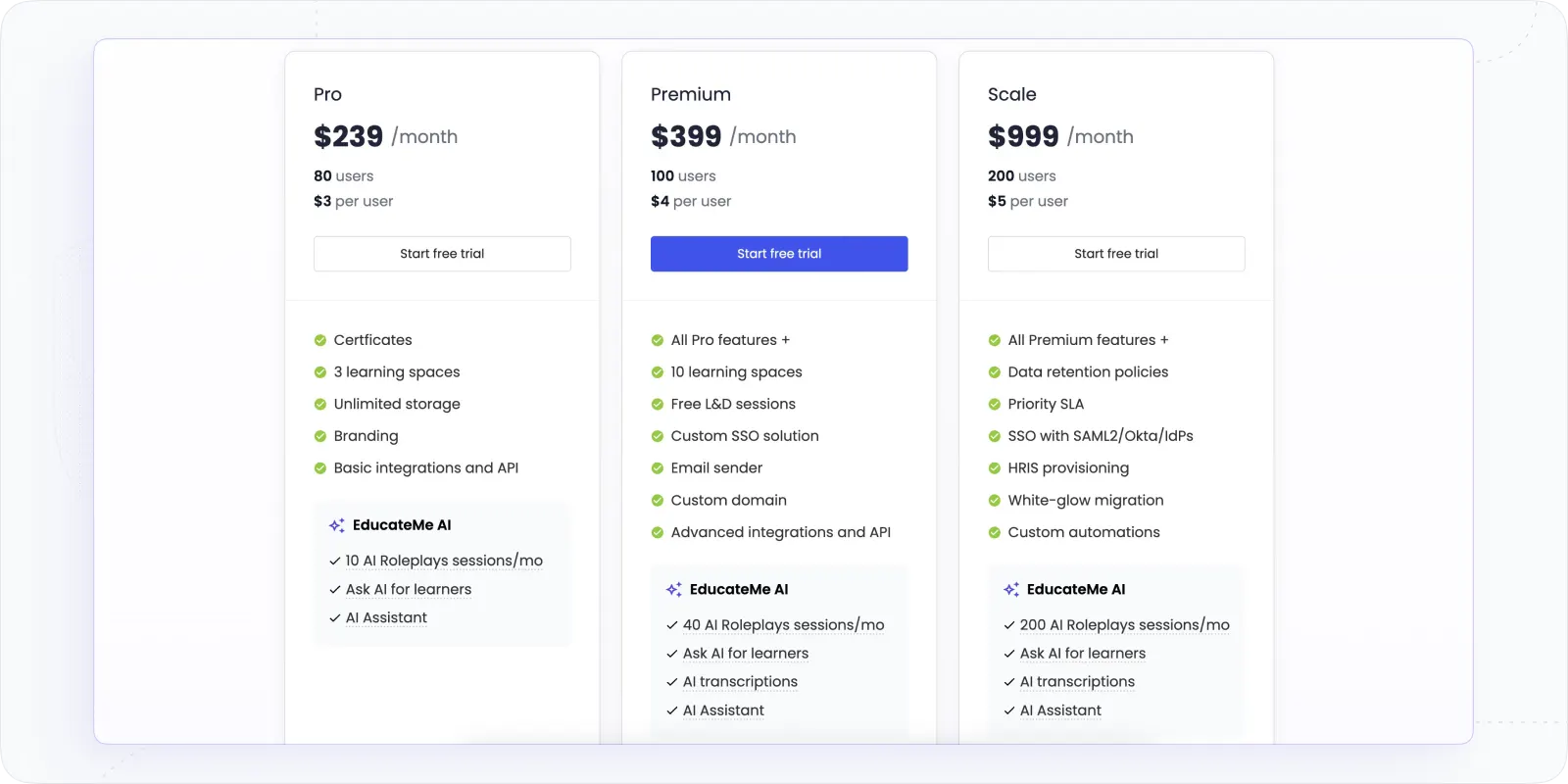
If Sana Labs feels too rigid, too expensive at a lower scale, or simply larger than what your current learning strategy requires, EducateMe can offer a more balanced path: capable enough for serious training needs, but flexible enough to adapt as priorities change.
Ready to explore a modern, flexible, and budget-friendly LMS? Book a demo with the EducateMe team today and receive custom pricing for your organization.
Frequently asked questions
Not really. The Free and Team tiers are built for smaller teams, knowledge management, and AI-assistant use — internal collaboration and document workflows, not structured training. Once you need governance, compliance, SSO, integrations, and organization-wide rollout, you're into the custom enterprise contract where pricing stops being public. Treat the $30 Team price as a starting cue, not the cost of running Sana as your actual learning platform.
It's a factor worth watching, not an immediate change. Acquisitions often reshape pricing and packaging over time, and Sana joining Workday may pull its commercial model toward the broader HCM suite at future renewals. For existing customers, nothing shifts overnight, but independent buyers should ask directly how ownership affects pricing, contract terms, and standalone availability before committing. Lock in renewal terms upfront rather than assuming today's structure holds.
They set a floor you pay regardless of usage. A 300-license minimum creates a baseline near $47,000 a year even if only half those seats train — so your effective per-user cost climbs when usage fluctuates. This is the gap between the visible $30 rate and real enterprise spend. If your headcount or training demand swings, model cost against your lowest active month, not your peak, before signing.
Focus on the levers that move real cost. Push on the seat minimum (commit to what you'll actually use, not an inflated baseline) and negotiate the ability to scale down, not just up. Cap renewal increases in writing before signing, and ask for an all-in first-year figure including implementation and integrations. If AI depth isn't central to your strategy, flexible-pricing platforms like EducateMe are worth comparing — book a demo for custom pricing.