
SkyPrep Pricing in 2026: Real Costs, Plans & Budget Guide

By Roman ShaukRoman ShaukCorporate Training & AI Expert, FounderRoman Shauk is the Founder of EducateMe.Read more
Corporate Training & AI Expert, Founder
7 min read
SkyPrep pricing is not fully public, so most buyers only see the “real number” after a sales call and a proposal. That’s normal in the mid-market LMS category, but it still makes budgeting, procurement, and renewal planning harder.
This guide explains how SkyPrep LMS pricing works, what organizations typically pay (with realistic ranges), what tends to drive costs up, and what “extra” fees show up in real deployments. It also includes a practical value check and a credible comparison point to help you decide whether SkyPrep is priced fairly for your use case.
How SkyPrep pricing works
SkyPrep pricing is shaped by deployment scope rather than fixed plans. The final cost depends on how many learners are active, which features are included, and how much configuration, integration, and support the organization requires. Let’s get into detail.
Pricing model (what you’re actually buying)
Enterprise buyers should view SkyPrep as a subscription LMS priced around usage and packaged capabilities, not a self-serve tool with fixed plans. Across SkyPrep’s public materials and third-party summaries on platforms such as Capterra, three patterns consistently emerge:
- Quote-based pricing: SkyPrep pricing is finalized through a sales proposal rather than published plans, with contract terms tailored to each deployment.
- Active learner model: Costs are tied to active users, learners who log in during a billing cycle, rather than total registered accounts.
- Tiered packaging: Historical pricing documents show structured tiers (for example, Starter, Advanced, Premium, Enterprise; later Core, Premium, Enterprise), with feature access expanding at higher levels.
What does this mean for budgeting?
“Per learner” pricing rarely tells the full story. In practice, SkyPrep contracts are structured around a base platform license, defined allowances for active users, and optional add-ons or services. As a result, total cost is driven less by headline per-user rates and more by how the platform is deployed, scaled, and supported over time.
Visibility of pricing (why you don’t see a simple table)
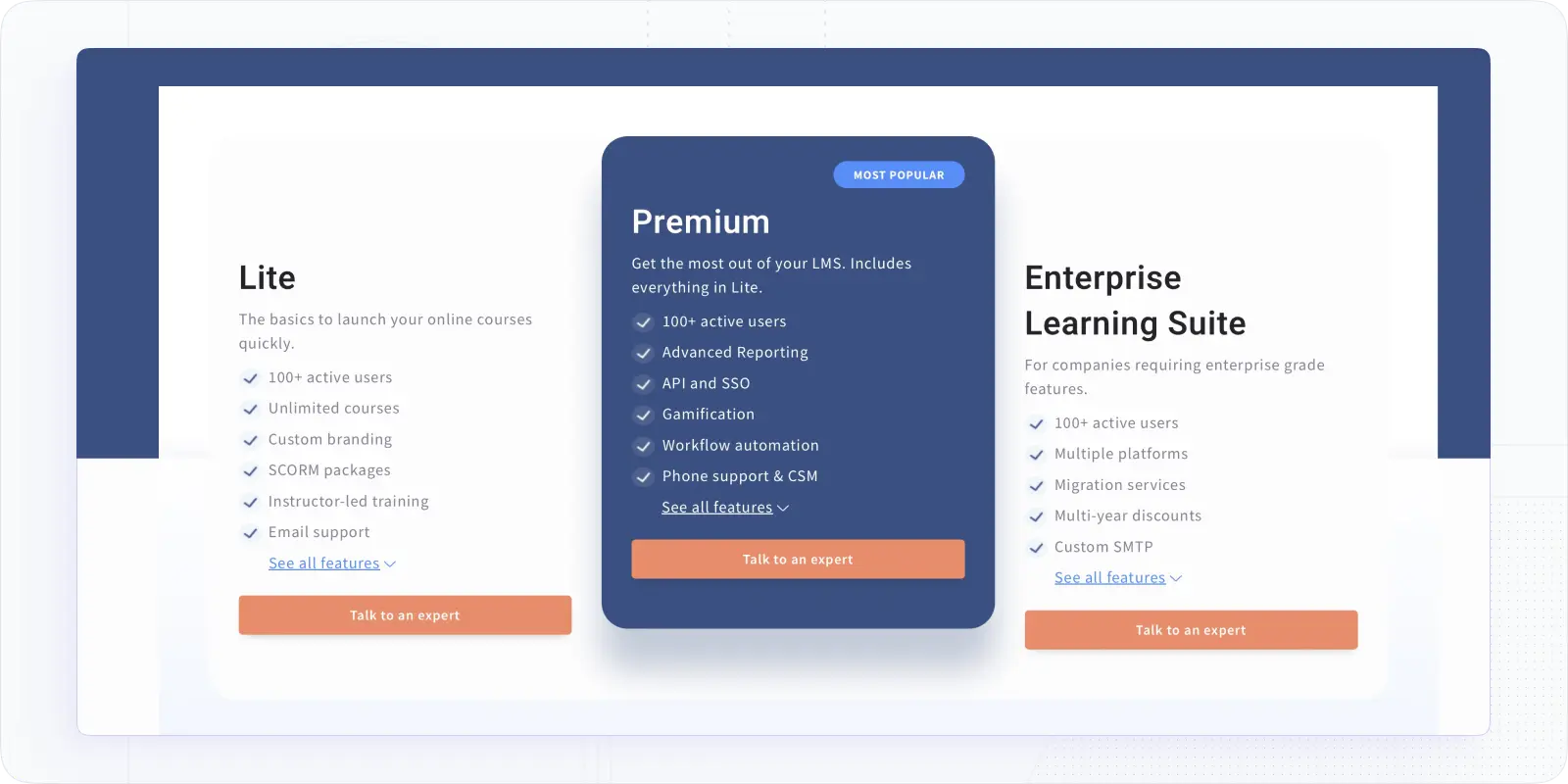
If you’ve looked for a clear SkyPrep pricing table and found mostly “contact sales,” that’s intentional. SkyPrep uses a proposal-driven pricing model and does not publish fixed plans for mid-market or enterprise buyers.
That doesn’t mean cost expectations are unknowable. Several external reference points help establish realistic budget ranges:
Vendr transaction data
Based on completed deals in Vendr’s dataset, SkyPrep contracts typically fall between ~$7,500 and ~$23,000. This reflects real transactions, not list pricing, and should be treated as a directional benchmark rather than a hard ceiling.
Historical pricing structure (for context only)
A 2018 SkyPrep pricing PDF lists annual plans at $349, $499, and $749 per month, each tied to active-user caps (100/250/500), with enterprise pricing available on request.
Additionally, a later 2020 document shows a Core plan at $199 per month (billed annually), with active users sold in blocks of 100, overage charges per active user, and minimum usage thresholds.
Note: While these documents are outdated for 2026 pricing, they are useful for understanding how SkyPrep historically structured costs around platform access and active usage.
Market context
Industry platforms such as Capterra note that LMS spend varies widely based on scale and features, with many smaller deployments budgeting $625–$1,250 per month. This is not SkyPrep-specific pricing, but it provides a baseline for understanding where SkyPrep sits relative to the broader LMS market.
Editor's insight: Because pricing is negotiated, organizations with similar learner counts can end up with very different total costs. Variables such as portals, integrations, security requirements, reporting depth, and support levels often have a greater impact on price than user volume alone.
SkyPrep pricing breakdown (estimated)
The table below translates available market data into practical budget ranges for 2026 planning. These estimates reflect real-world deal minimums, SkyPrep’s historical pricing mechanics, and how costs typically evolve when mid-market and enterprise deployments add portals, integrations, and services
| Plan/deployment type | Core features included | Typical annual price range | Best for |
|---|---|---|---|
| Lite tier | Core LMS, course creation, SCORM/xAPI support, basic reporting. | ~$5,000–$15,000/year | Small teams or first-time LMS buyers |
| Premium tier | Advanced reporting, integrations, automation, multiple portals, priority support. | ~$20,000–$40,000/year | Growing organizations with structured training programs |
| Enterprise tier | Custom user volumes, advanced SLAs, white-labeling, bespoke integrations, and global support | $60,000–$100,000+/year | Large enterprises with complex, multi-audience training needs |
How SkyPrep pricing typically scales
SkyPrep pricing scales around usage patterns and deployment complexity, not simple headcount growth. In practice, three factors account for most cost increases over time:
- Active learners matter more than total seats. In most SkyPrep pricing discussions, cost is driven by users who log in during a billing cycle rather than total registered accounts.
- Usage spikes can trigger overage costs. Seasonal onboarding, compliance deadlines, or partner training launches can materially increase spend if active-user thresholds are exceeded.
- Enterprise pricing is highly variable. The largest cost swings usually come from multi-portal setups, integration depth, security requirements, and support or SLA commitments, not base licensing alone.
Note: Model SkyPrep costs around peak active usage and deployment scope, not average headcount.
Additional costs to expect
Even when the subscription covers core LMS functionality, enterprise deployments rarely stop at base licensing. In SkyPrep pricing discussions, the following add-ons and services are the most common contributors to higher total contract value.
1) Implementation and onboarding services
Organizations replacing a legacy LMS or rolling out across multiple regions typically require professional services. These costs are often front-loaded and can include:
- Administrator training and governance setup.
- Content migration planning and execution.
- Portal and group structure design.
- Reporting and dashboard configuration.
For complex rollouts, these services are usually unavoidable.
2) Integrations (HRIS, CRM, SSO, API)
Integrations are one of the fastest ways LMS contracts scale beyond initial estimates. Costs tend to increase when:
- SSO requirements (SAML/SCIM), MFA, or conditional access policies are strict.
- HRIS integrations must support complex organizational hierarchies and role mappings.
- Customer or partner training needs to be tied to CRM data.
Historical SkyPrep pricing materials show features such as Single Sign-On and API access appearing at higher tiers, which aligns with standard enterprise LMS pricing practices.
3) Support tiers and SLAs
Mid-market and enterprise buyers often negotiate support and service guarantees, including:
- Defined response and resolution times.
- Uptime commitments.
- Named customer success or account management.
- Escalation paths for critical incidents.
Depending on the contract, these may be bundled into higher tiers or priced separately as a premium.
4) Portals, multi-tenancy, and customization
Organizations training employees, partners, and customers typically require multiple portals. Each additional portal increases operational complexity (more environments, more reporting logic, more branding, and more permission management), which is reflected in pricing.
5) Data migration and one-time project work
SkyPrep’s terms explicitly note that data migration services are an additional cost, with a stated minimum of $500 per project, increasing based on scope. This should not be read as a typical migration cost, but as confirmation that migration is not included by default and should be budgeted as a separate line item.
Planning note: First-year LMS costs are usually higher due to onboarding, migration, and integration work. For accurate forecasting, it’s best to separate Year 1 (implementation-heavy) costs from Year 2+ (steady-state licensing).
So, is SkyPrep worth it in 2026?
SkyPrep is worth the price when its operating model aligns with how your training function actually runs, not when it’s evaluated purely on cost per user.
Independent review data support this positioning. On platforms such as Capterra, SkyPrep consistently scores highly for ease of use and perceived value, including strong value-for-money ratings from verified buyers. That sentiment reflects satisfaction with reliability, support, and day-to-day usability rather than bargain pricing.
For procurement teams, the more useful question is not “Is SkyPrep expensive?” but whether the total contract cost produces proportional operational value. That means weighing licensing, services, and integrations against outcomes such as reduced training friction, reporting accuracy, and scalability: not just headline per-learner rates.
When SkyPrep is a good fit?
SkyPrep tends to make sense when:
- Training programs are structured, recurring, and operationally important (onboarding, compliance, role-based enablement).
- Multiple audiences must be supported, and multi-portal delivery is a requirement rather than an edge case.
- Integrations, reporting, and governance controls are core operational needs, not optional features.
- The organization is comfortable with annual contracts and negotiated pricing tied to usage and scope.
When SkyPrep is not a good fit?
SkyPrep is usually a poor fit when:
- Buyers require fully transparent, self-serve pricing without sales involvement.
- LMS needs are limited and unlikely to justify higher-tier features or services.
- Procurement timelines are compressed and demand instant pricing and fast checkout.
Bottom line: SkyPrep is positioned as a mid-market to enterprise LMS, not a low-cost or self-serve platform. For organizations that need structure, scale, and support, the pricing can be justified. For teams seeking speed, simplicity, or minimal spend, it often isn’t.
Final word
SkyPrep pricing is designed for organizations that require a flexible LMS with strong integrations, automation, and the ability to scale across global teams. For many mid-market deployments, real-world deal data and typical packaging patterns often land contracts in the five-figure annual range, while larger deployments can push higher depending on portals, support, and integration scope.
But what if that level of investment feels too high (or too contract-heavy) for your current stage?
Many teams evaluating SkyPrep alternatives compare it against platforms that publish clearer pricing and reduce implementation overhead. One option often considered is EducateMe, which positions itself around transparent pricing and faster evaluation.
Why EducateMe?
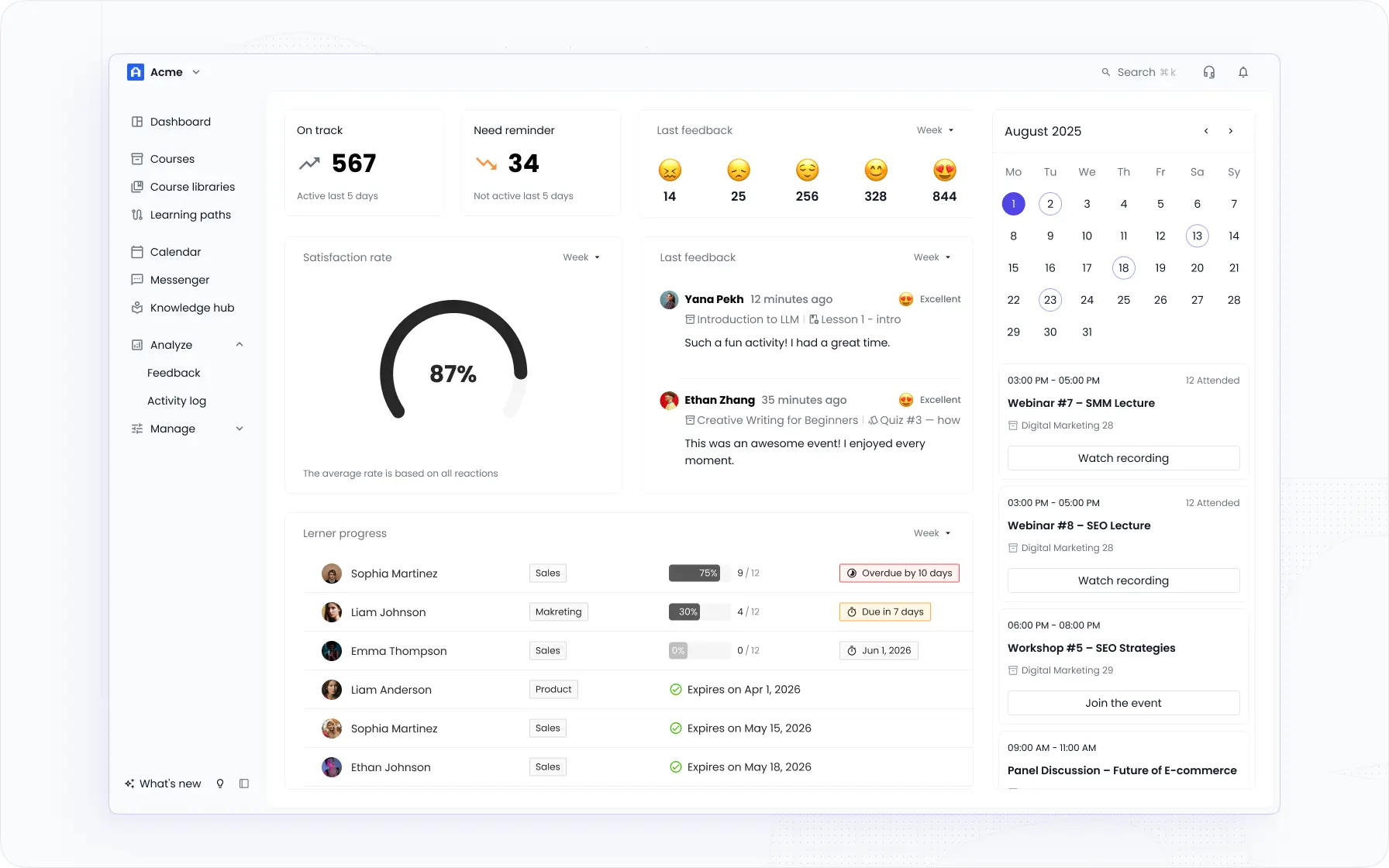
For teams evaluating SkyPrep LMS, the conversation often focuses on usability, flexibility, and how quickly a platform can be rolled out across different audiences. While SkyPrep offers a capable solution, many organizations find they need more adaptability, deeper customization, and greater efficiency to truly scale impactful training programs.
EducateMe is built for organizations that want strong learning outcomes without being constrained by rigid structures, limited configuration options, or feature trade-offs.
Rather than prioritizing simplicity at the expense of control, EducateMe balances ease of use with powerful functionality. Organizations that choose EducateMe typically benefit from:
- Transparent, practical pricing that reflects actual training needs instead of arbitrary user models
- Rapid deployment, allowing teams to launch fully branded academies in days, not months
- AI-powered content creation and automation, reducing manual admin work and accelerating course development
- Native multi-tenant architecture, ideal for training employees, customers, partners, or multiple departments from one platform
- Advanced white-labeling, providing full control over branding, domains, and learner experience
- Built-in live sessions, analytics, integrations, and progress tracking, delivered in a clean, intuitive interface
- A full-featured free trial, giving teams real product access before committing
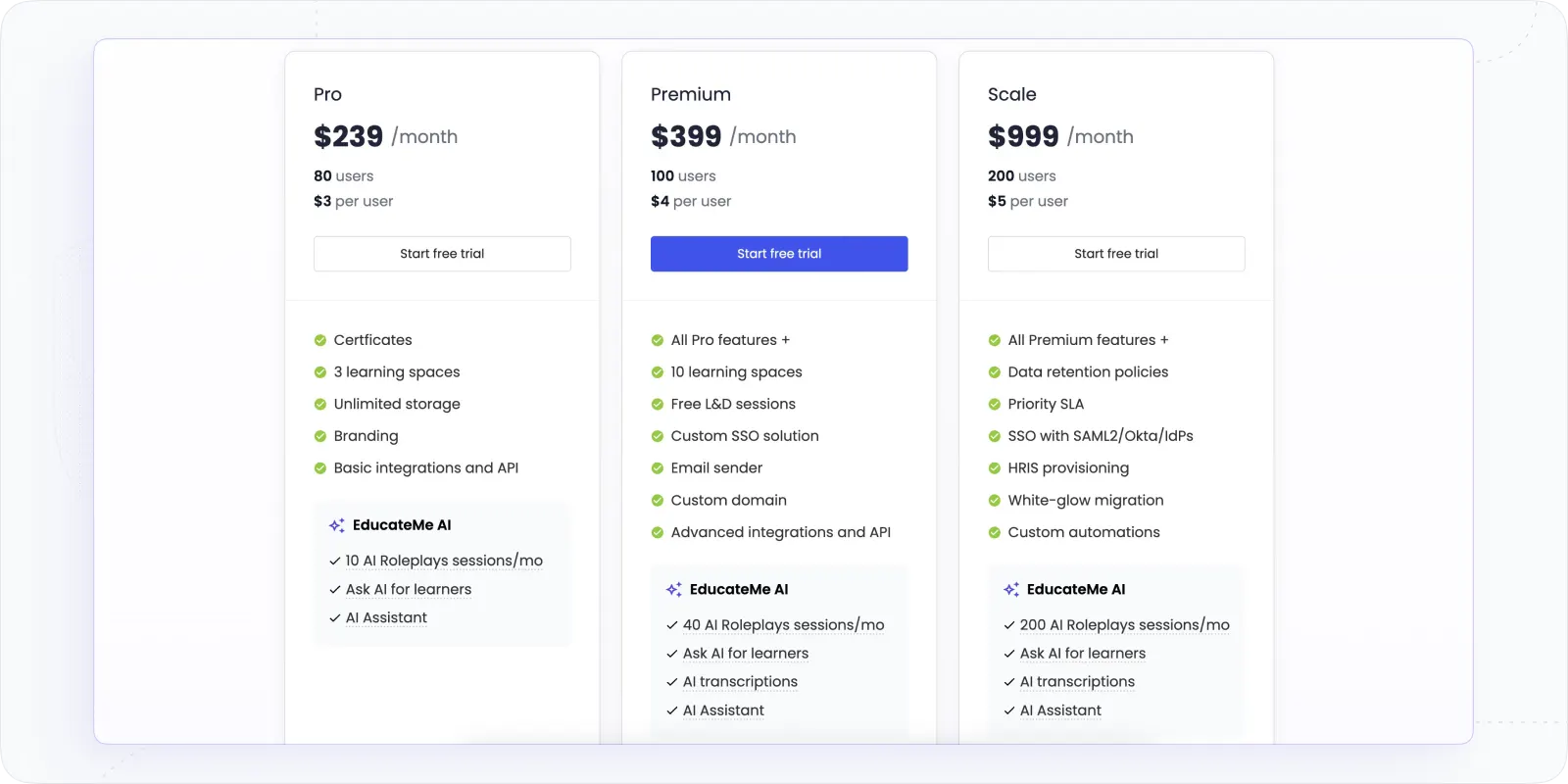
Considering SkyPrep alternatives? Book a demo and compare pricing and fit.
Frequently asked questions
SkyPrep bills on active learners — people who log in during a cycle — often sold in blocks with overage charges when you exceed the threshold. That's fine when usage is steady, but seasonal onboarding, compliance deadlines, or a partner training launch can push you over and trigger extra costs. Model your budget around your peak active month, not your average headcount, and confirm the block size and per-user overage rate before signing.
SkyPrep uses a proposal-driven, sales-led process rather than open self-serve access, so a full free trial isn't its standard entry point. Most buyers evaluate through a demo and a tailored proposal instead. If hands-on testing before committing budget matters, ask sales directly whether a trial or sandbox is available. Some mid-market alternatives offer full free trials with real product access, letting you evaluate the platform without a procurement commitment first.
Year one carries the one-off costs: implementation, content migration, integration setup, and admin training all land upfront, on top of licensing. SkyPrep, for instance, prices data migration separately from a stated minimum. Year two onward is mostly steady-state licensing, so it looks cheaper by comparison. When budgeting, separate implementation-heavy Year 1 from Year 2+ running costs — comparing a vendor's first-year quote against another's renewal rate is misleading.
Focus on what actually drives cost: active-user allowances, number of portals, integrations, and support tier. Negotiate the active-user block and overage terms to match real usage, and cap renewal increases in writing before signing. Ask for a line-item quote separating licensing, implementation, and migration so you see each cost. Teams wanting published pricing and lighter setup often compare transparent-pricing platforms like EducateMe.